

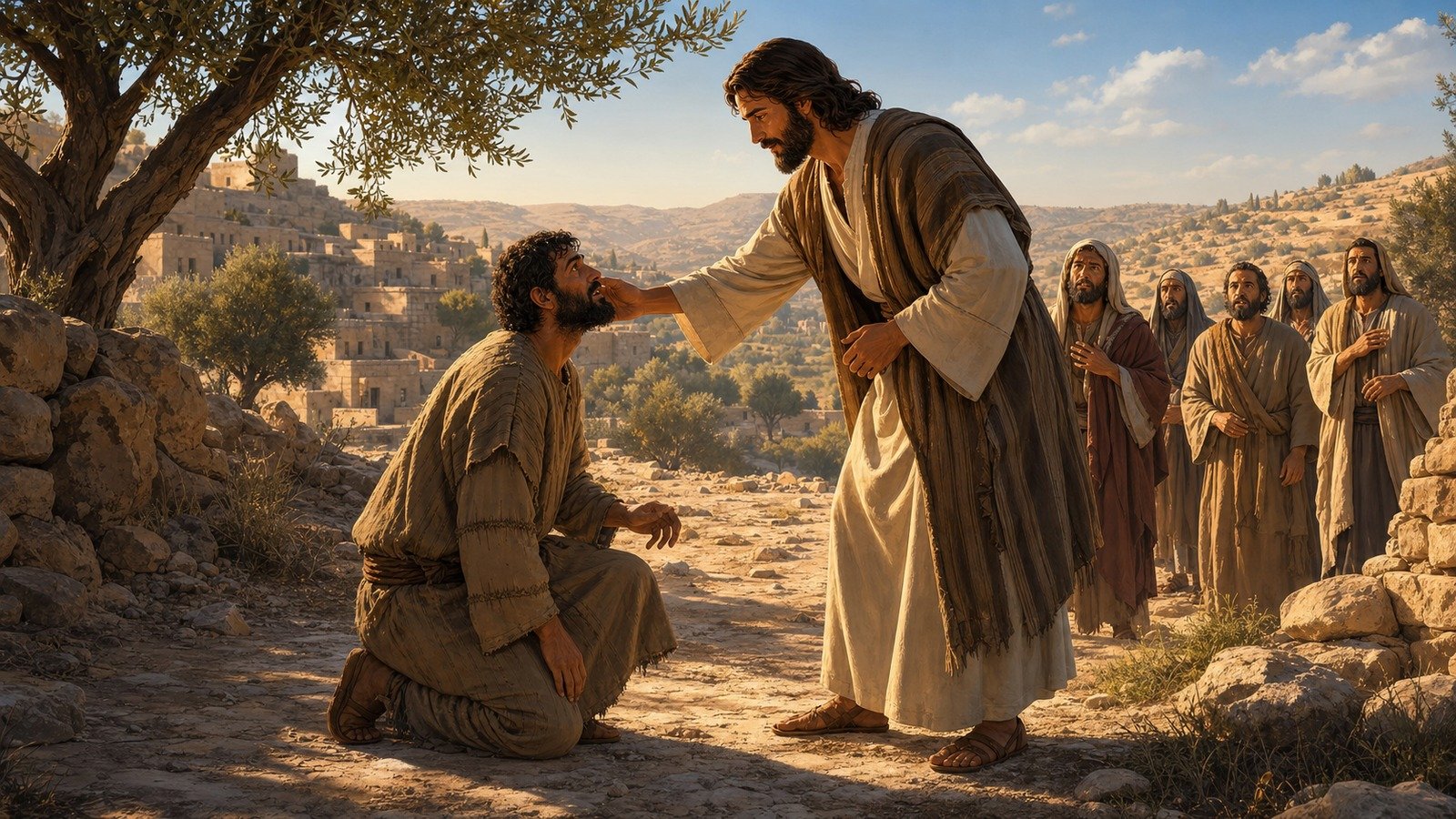
A man with leprosy, an illness that made him ritually unclean and socially isolated, asks Jesus for healing; Jesus touches him, an act itself transgressing purity taboos, and he is cleansed immediately.
Further context
3 min readThe word translated leprosy covers a range of skin conditions and not only the disease now called by that name, and what mattered socially was the legal status rather than the diagnosis. A person declared unclean by a priest had to live outside the community, wear torn clothes, leave their hair unkempt and call out unclean, unclean when anyone approached. The isolation was total and in most cases permanent, and the law devoted two long chapters to the examination procedure and the ritual for anyone who recovered.
Leviticus provided that ritual, which tells you it was not considered impossible, but the ceremony had reportedly not been performed within living memory.
The man comes and kneels and says something carefully worded: if you are willing, you can make me clean. The man is not doubting the ability. He is asking about the willingness, which is what somebody in his position would have learned to ask.
Two things happen in the reply and the first of them is the one to hold on to. Jesus is filled with compassion, and he reaches out his hand and touches the man. Touching somebody in that condition transferred uncleanness under the law and no one did it. The touch happens before the healing and there was no reason for it at all; a word would have done, as it does in other cases.
A small number of ancient manuscripts read that he was indignant rather than filled with compassion, and the harder reading is sometimes preferred by editors on the principle that a copyist is more likely to soften a difficult word than to sharpen a gentle one.
Then the words: I am willing. Be clean.
He is sent to a priest immediately with a strong warning to say nothing to anyone, and told to offer the sacrifices Moses commanded as a testimony to them. The legal process still matters: a man cannot rejoin the community until he has been certified, and the certification is the readmission.
He goes out and talks freely, spreading the news, with the result that Jesus can no longer enter a town openly but has to stay outside in lonely places, and people still come to him from everywhere.
One phrase in the request has kept commentators occupied for a long time. If you are willing, you can make me clean. Not heal me, but make me clean, which is the legal category. What the man wants is not only a body that works but permission to go home, to eat with his family and to stand in a synagogue, and the two things were not separable.
The man who was excluded is restored to the town, and the man who healed him is now the one who cannot go into it.
The condition covered by the term included several skin diseases and was diagnosed by a priest according to detailed criteria about hair colour, depth of the sore and whether it spread, with a period of isolation and re-examination built in.
The consequences were social. A person declared unclean lived outside the community, tore their clothes, left their hair unkempt and called out unclean, unclean when anyone approached.
The man's approach breaks all of that, and so does the response. Jesus reached out his hand and touched the man. Touching him made the toucher unclean under the law, and nobody remarks on it.
The words used are careful in both directions: if you are willing, you can make me clean, and, I am willing. Be clean.
The instruction afterwards is to say nothing and to go and show himself to the priest and offer the prescribed sacrifices, which is the legal procedure for readmission to the community.