

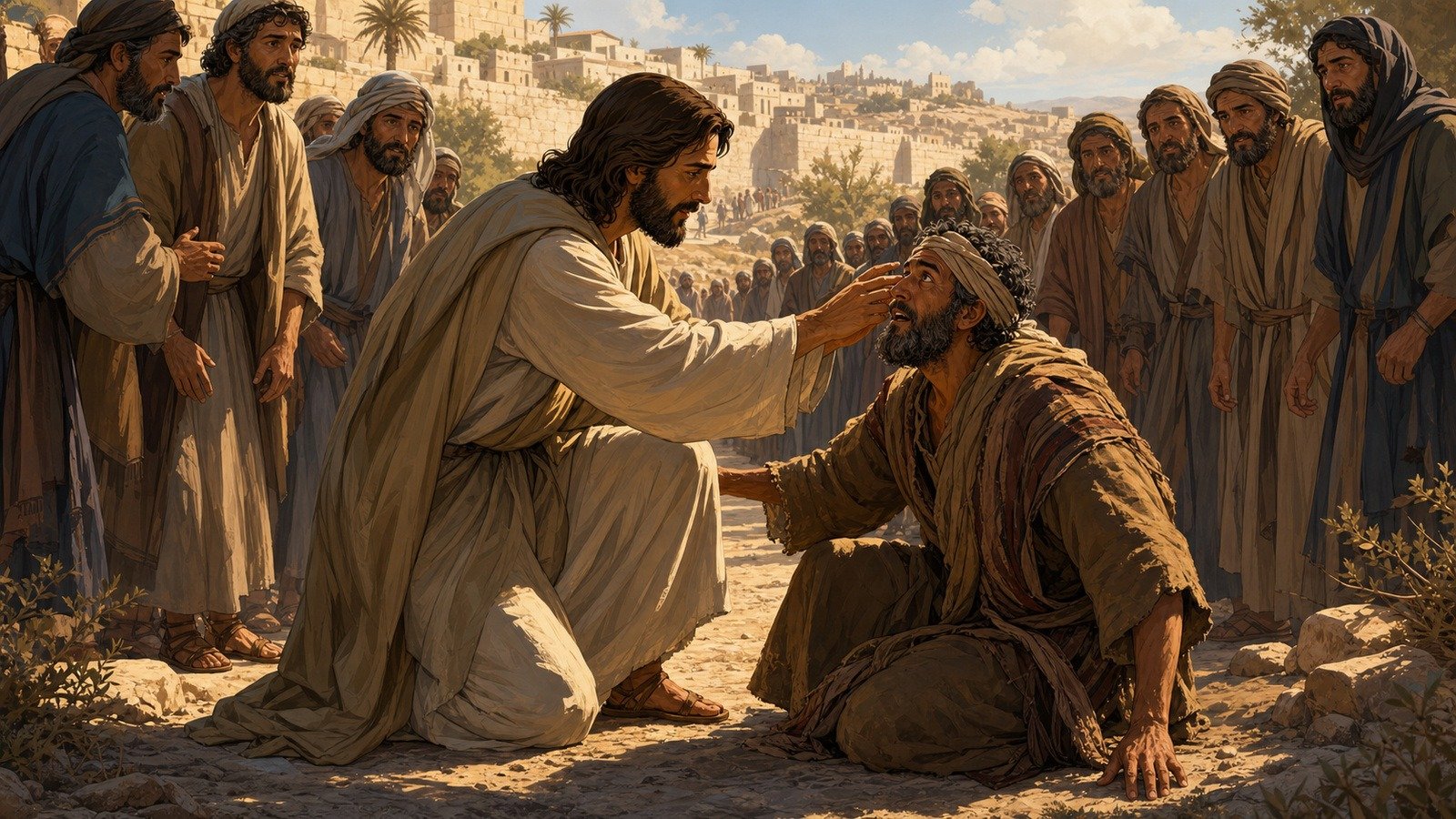
A blind beggar, Bartimaeus in Mark's account, calls out to Jesus as "Son of David" despite the crowd's attempts to silence him; Jesus stops, restores his sight, and Bartimaeus follows him on the road, one of the final healings before Jerusalem.
Further context
2 min readJericho lies in the Jordan valley about two hundred and fifty metres below sea level, one of the oldest continuously occupied places on earth, watered by a spring and famous for its palms and its balsam. Herod the Great had built a winter palace there with swimming pools and gardens, and the site has been excavated. Pilgrims from Galilee heading to Jerusalem for Passover came through it and began the long climb from there.
A blind man is begging by the roadside, and he is named: Bartimaeus, meaning son of Timaeus. Naming a healed man is unusual, and the most natural explanation is that he was known later in the community that preserved the story.
Hearing that Jesus of Nazareth is passing, he begins to shout: Jesus, Son of David, have mercy on me.
That title is the point of the episode. Son of David is a claim about royal descent and about the promised king, and it is the first time anyone uses it in public in Mark, on the road up to Jerusalem, days before the entry into the city. A beggar who cannot see has grasped what people with functioning eyes have argued about for two years.
Many rebuke him and tell him to be quiet, which is the crowd protecting the dignity of the occasion. He shouts all the louder.
Jesus stops and says, call him. The way the instruction is passed on is one of those small details that sound like an eyewitness: cheer up, on your feet, he is calling you.
Throwing his cloak aside, he jumps to his feet and comes. A beggar's cloak was his shelter at night and the thing he spread on the ground to catch coins, quite possibly everything he owned, and leaving it on a crowded roadside meant not expecting to need it.
The question he is asked is the same one put to James and John a few paragraphs earlier: what do you want me to do for you? The two answers sit against each other deliberately. They asked for thrones. He says, Rabbi, I want to see.
Go, your faith has healed you. The Greek verb also means saved, and it carries both senses.
Immediately he received his sight and followed him along the road.
That last clause is not decoration. The road went up to Jerusalem, and everyone who took it that week was walking towards what happened there.
Matthew's version has two blind men rather than one and places the encounter as he was leaving Jericho, while Luke sets it on the approach. Part of the explanation is that there were two Jerichos in the first century, the old settlement and the Herodian town built about two kilometres away, so a traveller could be leaving one and approaching the other at the same moment.
The episode closes the long journey narrative. From Jericho the road climbs to Jerusalem, and the next thing that happens is a colt being untied in a village on the Mount of Olives. The last healing before the final week is of a man who could not see, performed for someone who had already named him correctly, and it is the last miracle recorded before the entry into the city.