

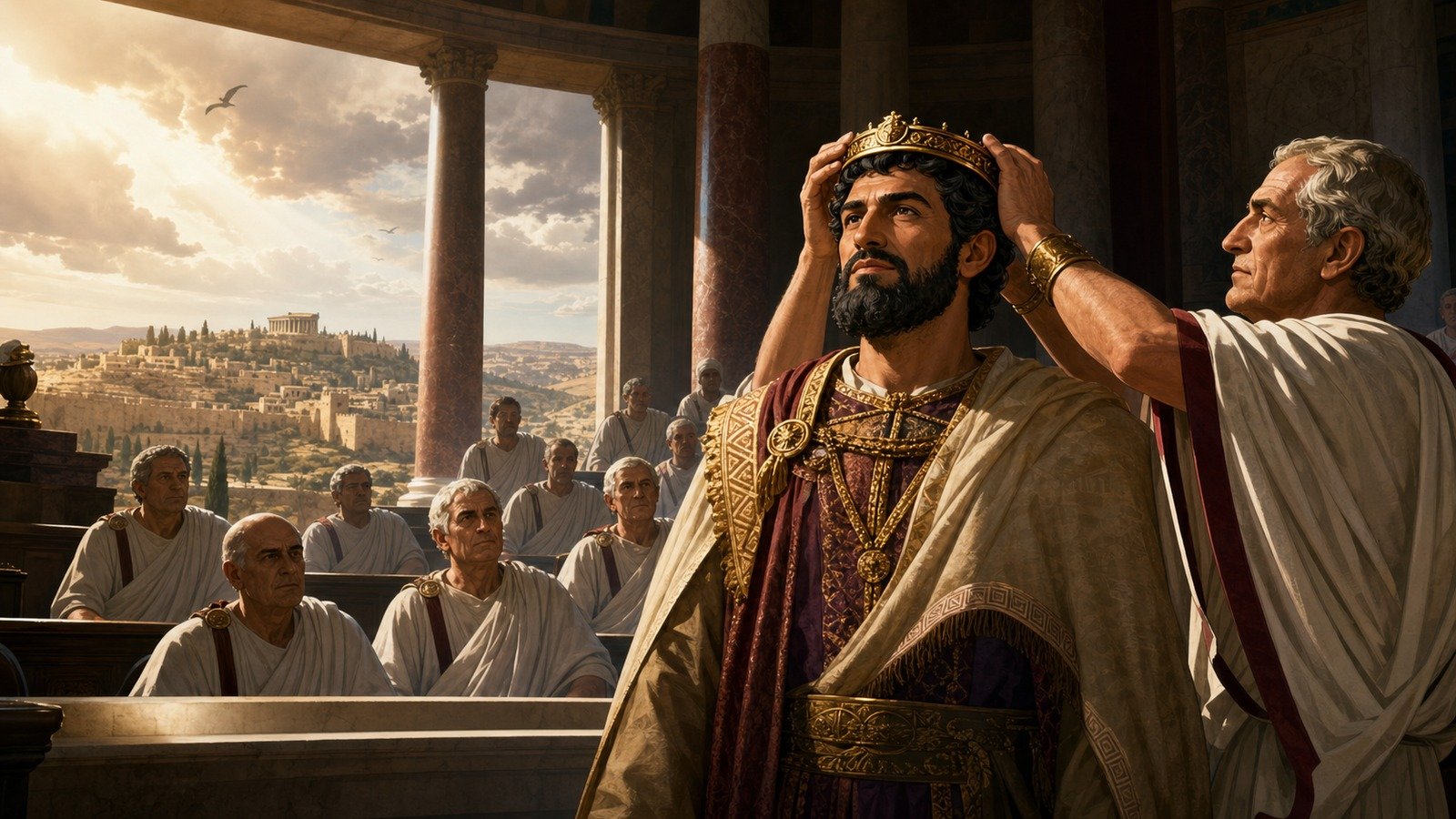
The Roman Senate names Herod, an Idumean with no Hasmonean blood, "King of the Jews"; it takes him three further years of fighting to actually secure Jerusalem, after which he rules as a Roman client king known for both grand building projects and ruthless suppression of rivals, including members of his own family.
No canonical Scripture reference (historical context outside the Protestant canon)
Further context
3 min readHerod is Idumean by descent, from the people forcibly converted a few generations earlier, which means he is Jewish by religion and law and was never regarded as Jewish by the population he ruled. That single fact explains most of his reign.
His father Antipater had made himself indispensable to the Romans during the civil wars and had been appointed procurator of Judea, and Herod was governor of Galilee in his twenties. When a Parthian invasion in 40 BC installed a Hasmonean claimant in Jerusalem, he escaped to Rome, and the Senate, on the recommendation of Antony and Octavian, named him king of Judea. It took him three years and a Roman army to take the kingdom he had been given.
He rules for over thirty years and he is very good at it by the only measure Rome applied: the province is quiet, the taxes arrive, and he backs the winning side in every Roman civil war, including switching from Antony to Octavian after Actium and keeping his throne.
He is also a murderer on a domestic scale that shocked even Romans. He marries a Hasmonean princess, Mariamne, to give himself legitimacy, and then executes her, her mother, her brother, her grandfather and eventually two of his own sons by her, along with a third son five days before his own death. A remark attributed to Augustus survives as a pun that works in Greek: it is better to be Herod's pig than his son.
The paranoia was not baseless. He had taken the throne from a dynasty that still had heirs, in a country that regarded him as a foreigner, backed by an occupying power.
His death is the fixed point that dates the birth of Jesus. It is placed in 4 BC on the basis of a lunar eclipse mentioned by Josephus in connection with his final illness and the reigns of his sons, and a minority of scholars argue for 1 BC on the same kind of evidence. The Gospel accounts of the birth put it before that death, which is why the calendar is out by several years and why Jesus is generally dated to around 6 or 5 BC.
The scale of the man is worth registering alongside the murders, because both are true. He kept a volatile province quiet for over thirty years, fed it through a severe famine at his own expense, and built on a scale nobody in the region matched before or after. He also died hated, and Josephus records that he ordered leading men of the nation to be locked in a stadium and killed at the moment of his death, so that there would be mourning; the order was not carried out.
The kingdom is divided at his death between three sons: Archelaus in Judea, who is removed by Rome within a decade for incompetence, Antipas in Galilee, who executes John the Baptist and questions Jesus, and Philip in the north-east.
Herod's route to the throne runs through Roman civil war politics. His father Antipater had backed Julius Caesar; Herod backed Cassius, then Antony, then Octavian, switching each time before it was too late and surviving every change.
The senate declared him king of Judea in 40 BC, and it took him three years and a Roman army to take the country from the last Hasmonean claimant.
The domestic record is what he is remembered for. He married Mariamne, a Hasmonean princess, and executed her, her brother, her mother and her grandfather, and later two of his own sons by her, and a third son five days before his own death.
Augustus is reported to have said it was better to be Herod's pig than his son, which works as a joke in Greek because the words are nearly identical.
Josephus also records the order to have leading men executed at his death so that the country would mourn.