
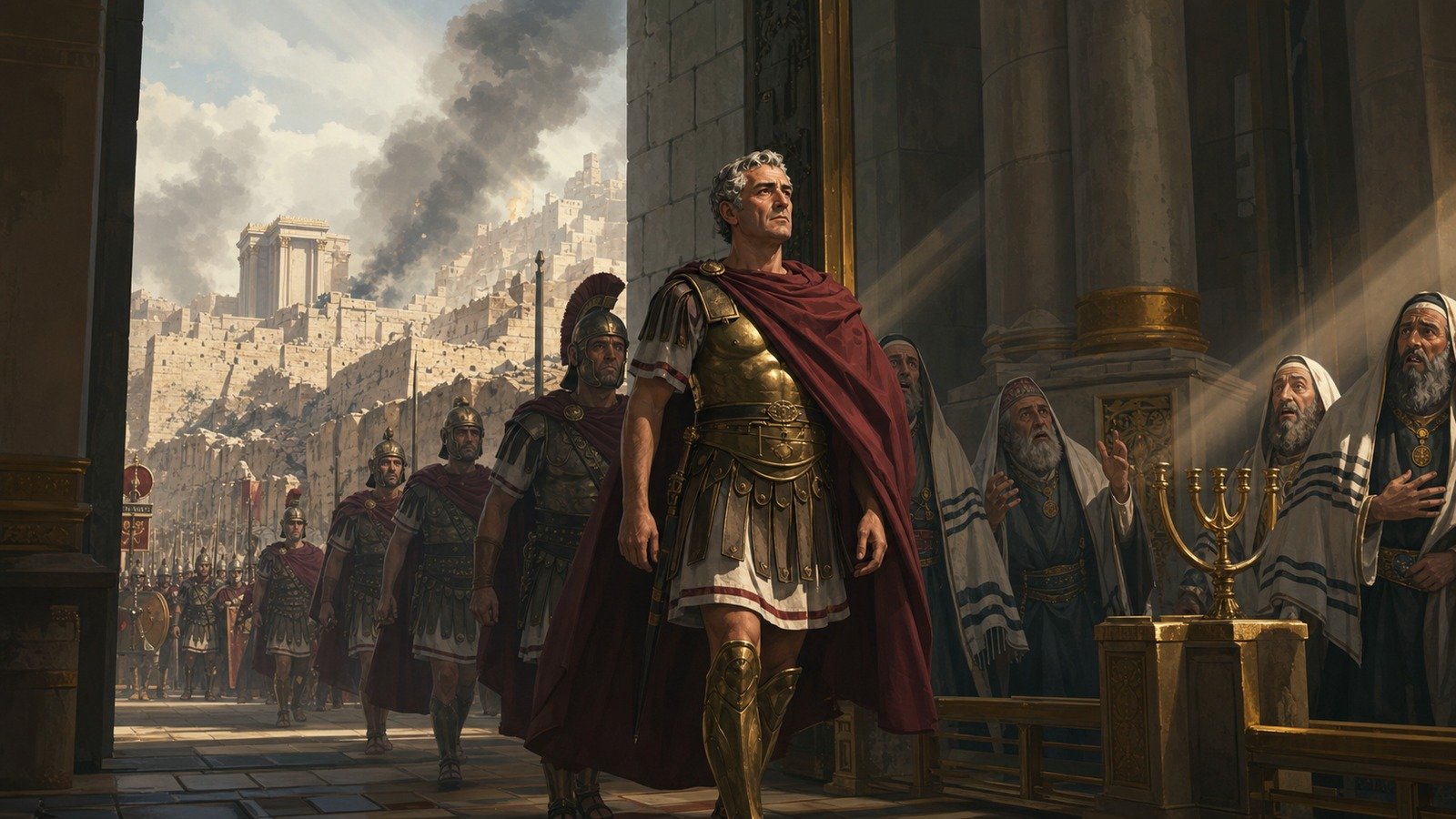
Called in to arbitrate a Hasmonean succession dispute, the Roman general Pompey instead takes Jerusalem by force and enters the Temple's Most Holy Place, ending Jewish political independence and beginning direct Roman involvement in Judean affairs.
No canonical Scripture reference (historical context outside the Protestant canon)
Further context
3 min readPompey is in Damascus reorganising the east when three delegations arrive from Judea: one from each of the quarrelling brothers, and a third from the people, asking to be rid of both and to be governed by the priesthood as before.
He takes his time, and Aristobulus loses patience and shuts himself up in Jerusalem. The city divides. Hyrcanus's supporters open the gates. Aristobulus's hold the temple mount, which is a fortified enclosure, and it takes a three-month siege to reduce it.
The Romans build ramps and bring up siege engines, and the detail every ancient account of it records is that the work advanced fastest on the Sabbath, because the defenders would fight to prevent an assault but would not interfere with earthworks. When the wall is breached the priests continue the sacrifice and are cut down at the altar. Twelve thousand are reported killed.
Then Pompey does the thing that is remembered. He walks into the Holy of Holies, which no one except the high priest was permitted to enter, and only once a year. Roman accounts note what he found: the golden table, the lampstand, vessels, spices and a large quantity of money, and no image of any kind. An empty room was not what a Roman commander expected in the innermost sanctuary of a national religion, and it puzzled him.
He takes nothing, orders the temple cleansed and the sacrifices resumed the next day, and confirms Hyrcanus as high priest without the title of king.
The political settlement is the end of independence. Judea becomes a tribute-paying dependency, its territory is reduced, the Greek cities are detached and reorganised, and the whole region is placed under the governor of Syria. Aristobulus and his family are taken to Rome to walk in a triumph.
A Jewish poem written shortly afterwards describes the arrogant one who battered down the fortified walls with a ram and was not stopped, and then his death in Egypt on a shore, unburied, because he did not recognise that God is great. Pompey was assassinated on a beach near Alexandria in 48 BC and his body left on the sand.
One consequence of the settlement shaped everything afterwards. The high priest continued to run internal affairs, which meant that the religious leadership was now the instrument of an occupying power and was answerable to it. That arrangement is what stands behind the calculation put to the council decades later, that it is better for one man to die for the people than for the whole nation to be destroyed.
Sixty years later a Galilean is born in a country that has been governed from Rome ever since, and the tax question put to him about paying Caesar goes back to this settlement.
The two brothers quarrelling were Hyrcanus II and Aristobulus II, sons of Alexander Jannaeus and Salome Alexandra, and their dispute over the succession is what brought Rome in.
Pompey was in Damascus reorganising the east after defeating Mithridates, and three delegations came to him: one from each brother, and a third from the people asking to be rid of both and governed by the priesthood as before.
The siege of the temple mount lasted three months and ended on a Sabbath, when the defenders would not interrupt the Roman siegeworks. Twelve thousand are said to have died, and Josephus records that the priests went on with the sacrifices while they were being cut down.
Pompey then walked into the Holy of Holies, which no one but the high priest could enter, and found it empty. He touched nothing and had the temple cleansed the next day, and the offence was never forgotten.