

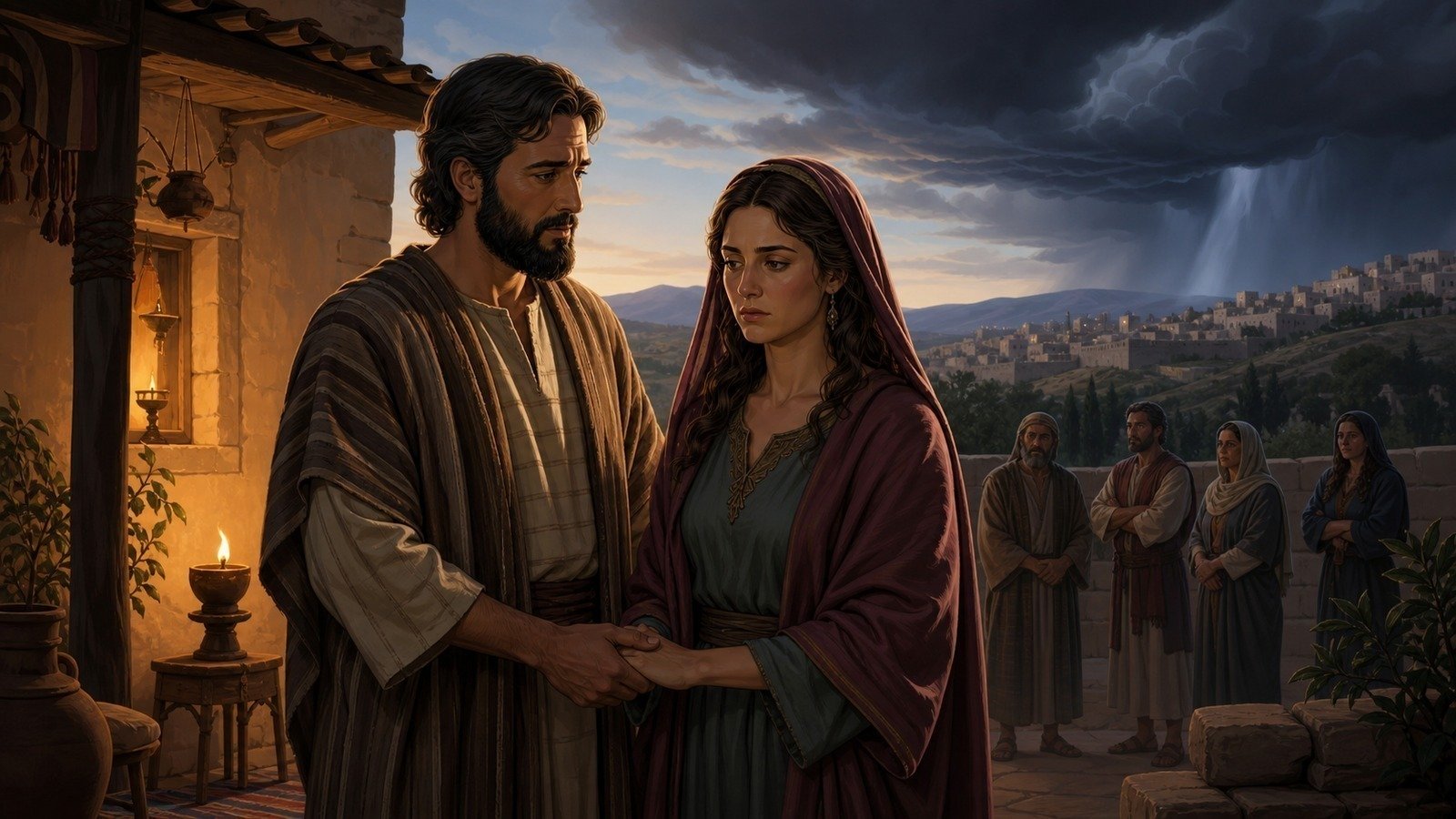
God instructs Hosea to marry an unfaithful woman, Gomer, as a living picture of Israel's unfaithfulness to God; his ministry spans the final, chaotic decades of the northern kingdom up to its fall.
Further context
3 min readThe first instruction Hosea receives is to marry a promiscuous woman and have children with her, because the land itself is guilty of unfaithfulness. He marries Gomer daughter of Diblaim, and the marriage becomes the message.
Three children are born and each is given a name that is a public statement. The first is Jezreel, after the valley where Jehu had carried out the massacre that founded the dynasty then on the throne, and the name announces that God will punish that house for it. The second is a daughter called Lo-Ruhamah, meaning not loved. The third is a son called Lo-Ammi, meaning not my people, which reverses the formula that had defined the nation since Sinai.
Naming your own children as walking indictments of your country is the hardest thing any of these figures is asked to do, and it lasts as long as they are alive.
Later he is told to go and show love to his wife again, though she is loved by another man and is an adulteress, and to love her as the LORD loves the Israelites, though they turn to other gods. He buys her back for fifteen shekels of silver and a homer and a lethek of barley, which is roughly the price of a slave, and tells her to live with him many days without prostituting herself or being intimate with any man, and that he will behave the same way towards her.
Whether Gomer was already promiscuous when he married her, became so afterwards, or whether the whole thing is a sustained parable rather than a biography, has been argued since the earliest commentators. The book gives names, prices and quantities, which is not how parables are usually written.
What he says about the country is the most emotionally direct material in the prophetic books. Israel is a stubborn heifer, a silly dove easily deceived, a half-baked loaf burnt on one side and raw on the other. There is no faithfulness, no love, no acknowledgement of God in the land, only cursing, lying, murder, stealing and adultery, and bloodshed follows bloodshed. Their political manoeuvring is described exactly: they call to Egypt and turn to Assyria, and foreigners sap their strength and they do not realise it.
Against that runs a register nothing else in these books matches. When Israel was a child, I loved him, and out of Egypt I called my son. It was I who taught Ephraim to walk, taking them by the arms. I led them with cords of human kindness, with ties of love. To them I was like one who lifts a little child to the cheek, and I bent down to feed them.
And then: how can I give you up, Ephraim? My heart is changed within me; all my compassion is aroused.
He works for around forty years and watches the kingdom he is addressing disintegrate through six kings and four assassinations.
What happens to Gomer is left partly open. She bears three children, of whom the second and third are described in wording that may mean they were not his. Then a later instruction: go, show your love to your wife again, though she is loved by another man and is an adulteress. He buys her back for fifteen shekels of silver and a homer and a lethek of barley, which is roughly the price of a slave.
The three children's names are the message. Jezreel, after the valley where Jehu's massacre took place. Lo-Ruhamah, meaning not loved. Lo-Ammi, meaning not my people.
Then the reversal at the end, using the same names: I will plant her for myself in the land; I will show my love to the one I called not my loved one; I will say to those called not my people, you are my people.
Paul quotes those lines and applies them to Gentiles.