
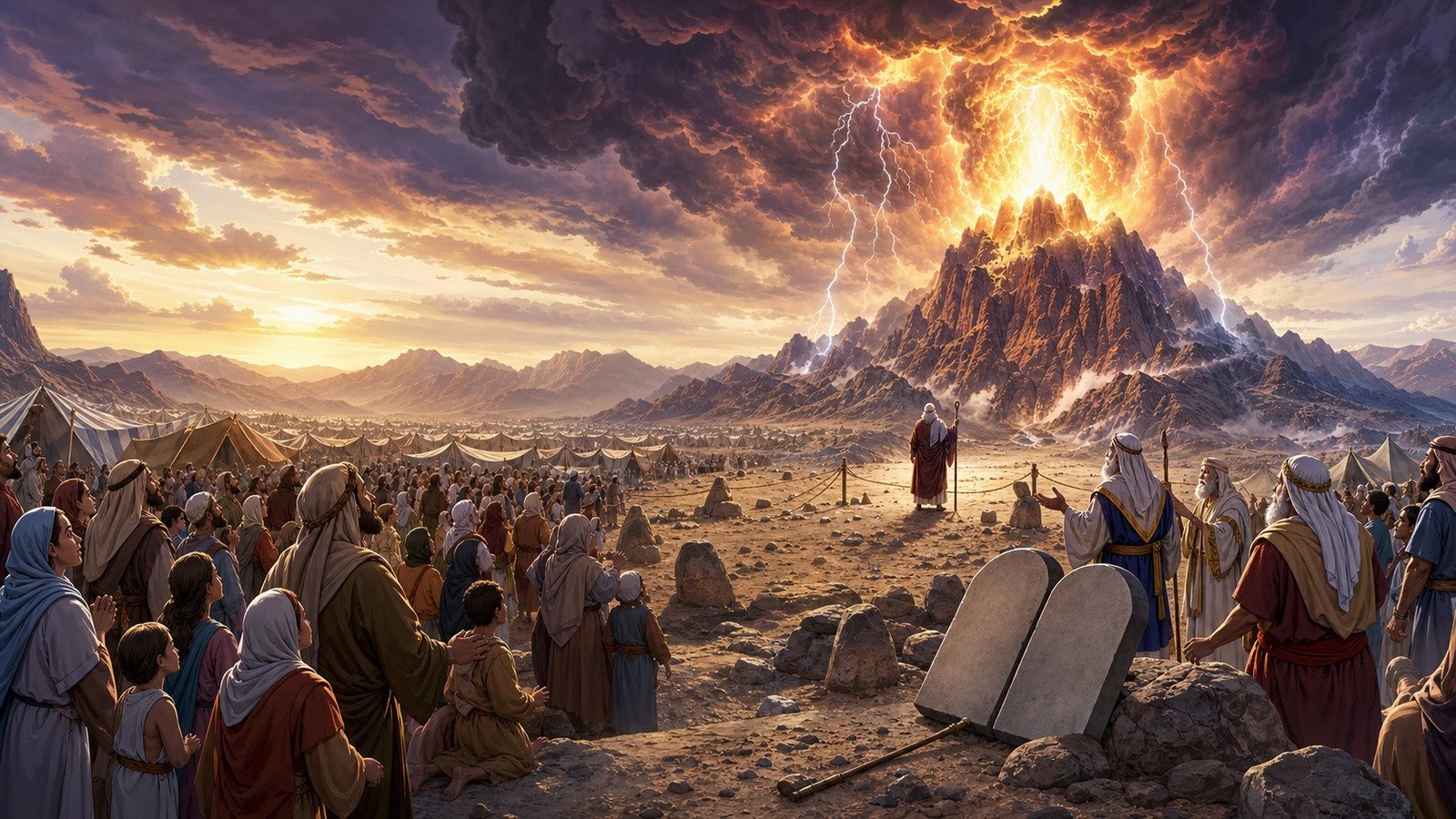
Three months after leaving Egypt, Israel camps at Sinai. God descends on the mountain in fire and smoke and speaks the Ten Commandments directly to the people, the foundational moral and covenantal law of Israel.
Further context
2 min readThree months after leaving Egypt they camp in front of the mountain, and what is said first is a summary of everything so far and a statement of what it was for. You yourselves have seen what I did to Egypt, and how I carried you on eagles' wings and brought you to myself. The destination named is not a country.
The offer that follows is conditional and corporate. If you obey me fully and keep my covenant, then out of all nations you will be my treasured possession, and you will be for me a kingdom of priests and a holy nation. Peter applies those words, centuries later, to scattered communities of believers around Asia Minor.
Preparation takes three days: consecration, washed clothes, and a boundary around the mountain that nobody may cross on pain of death. On the third morning there is thunder and lightning, a thick cloud, a very loud trumpet blast, smoke rising like smoke from a furnace, and the whole mountain trembling violently.
Then come what Hebrew calls the ten words. They open not with a command but with a statement of identity and history: I am the LORD your God, who brought you out of Egypt, out of the land of slavery. Everything after that is addressed to people who have already been rescued.
The commandments fall into two groups, the first concerning God and the second concerning other people. How they are numbered differs between traditions, and knowing that explains why published lists do not always match. Jewish reckoning treats the opening statement as the first word and combines the prohibitions on other gods and on images. Catholic and Lutheran reckoning combines those two and divides the final commandment on coveting into two. Reformed, Anglican and Orthodox reckoning separates other gods from images and keeps coveting as one. The total is ten in every case and the content is identical.
The form of the whole section has a recognised parallel. Suzerain-vassal treaties from the Hittite empire in the second millennium BC follow a standard shape: identification of the great king, a historical account of what he has done for the vassal, the stipulations, provision for the document to be deposited and read publicly, and witnesses. What was given at Sinai follows that structure closely enough that many scholars regard the resemblance as deliberate.
When the ten are repeated forty years later there is one substantive difference: the reason given for the Sabbath there is the deliverance from Egypt, where here it is the seventh day of creation.
It ends with the people standing at a distance and asking Moses to speak to them instead, because if God speaks to them directly they will die.
Where the mountain was is not settled. Jebel Musa in the southern Sinai has carried the identification since at least the fourth century AD, when Christian monastic settlement began there, and Saint Catherine's Monastery stands at its foot. That tradition is late and rests on Byzantine identification rather than earlier evidence. Alternatives place it elsewhere in the southern Sinai, in the north near the Mediterranean coast, or in north-western Arabia on the grounds that Midian lay there and Moses was tending Jethro's flocks when he found it. None has produced physical evidence.