

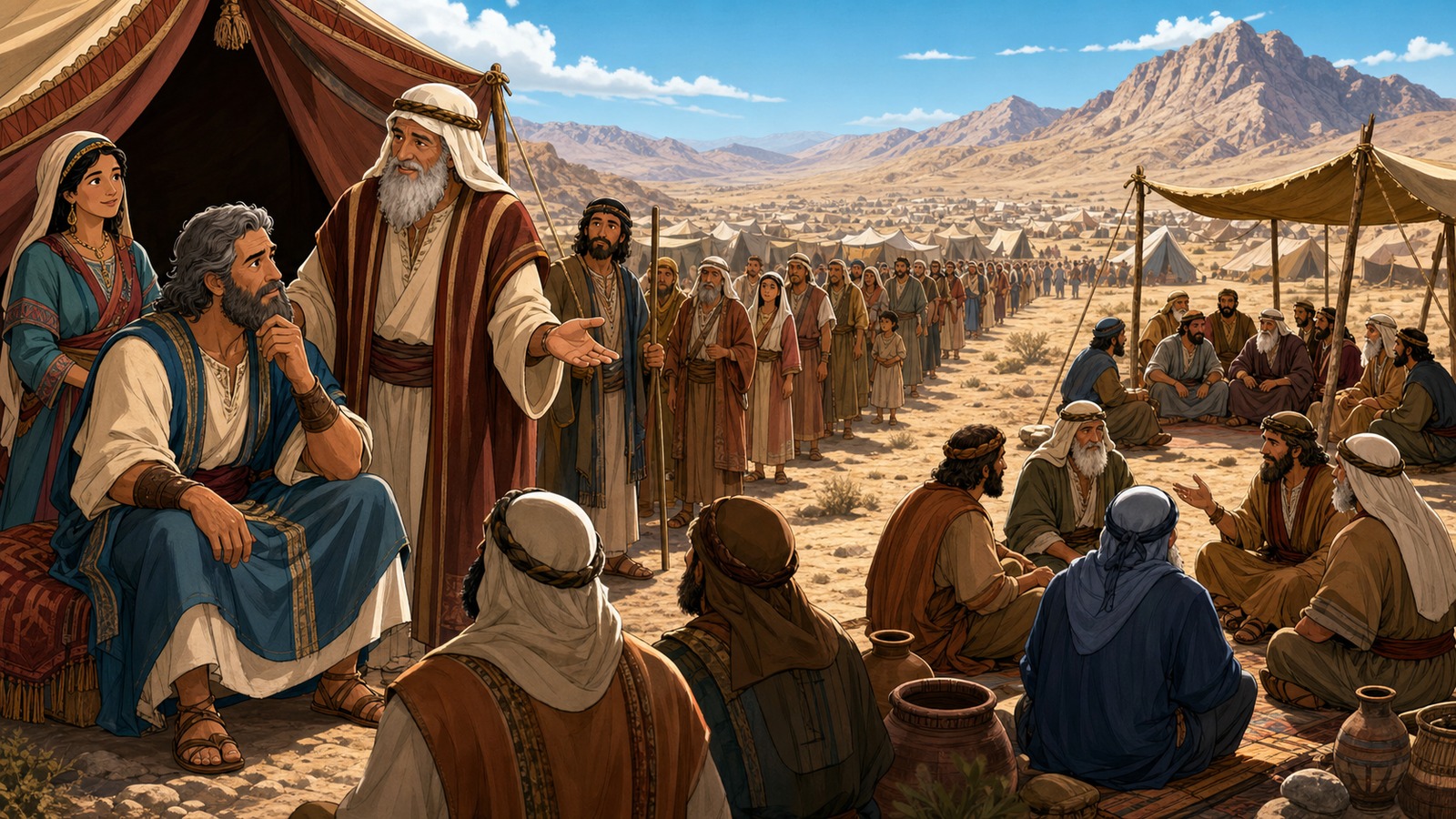
Moses' father-in-law Jethro visits and observes Moses judging every dispute alone; he advises appointing capable leaders over smaller groups to share the judicial burden, an early model of delegated governance Moses adopts.
Further context
2 min readJethro, the priest of Midian, hears what has happened and brings Moses' wife and two sons out to him at the mountain of God. Zipporah had been sent back at some earlier point, which is mentioned here in passing and nowhere explained. The two sons are Gershom and Eliezer, and the meanings of their names are given: a foreigner in a foreign land, and my father's God was my helper.
Moses tells his father-in-law everything, and the response is a confession from a man who is not an Israelite and is a priest of another people. Praise be to the LORD, who rescued you from the hand of the Egyptians. Now I know that the LORD is greater than all other gods. He brings a burnt offering and other sacrifices, and Aaron comes with all the elders of Israel to eat bread with him in the presence of God. A Midianite priest presides over a meal that the entire leadership of Israel attends.
The next day he watches Moses at work. He sits as judge from morning until evening while the people stand round him waiting, and when asked why, Moses explains that they come to him to seek God's will, and he decides between the parties and informs them of the decrees and instructions.
Jethro's assessment is direct: what you are doing is not good. You and these people who come to you will only wear yourselves out. The work is too heavy for you; you cannot handle it alone.
His proposal is a judicial structure. Moses should continue to represent the people before God and to teach them the decrees and show them the way to live. Beyond that he should appoint capable men as officials over thousands, hundreds, fifties and tens, who will judge ordinary cases and bring only the difficult ones to him. The qualifications are moral rather than technical: capable men who fear God, trustworthy men who hate dishonest gain.
Moses listens to his father-in-law and does everything he said.
Two things are worth stating plainly. The judicial system of Israel, which the following books elaborate at length, originates in a suggestion from a foreign priest, and that is recorded without embarrassment. And the criticism is delivered to a man who has just faced down an empire, by his wife's father, and is accepted without argument.
One feature of the structure distinguishes it from an ordinary chain of command. Cases move upward only when they are too difficult to settle lower down, so the great majority never reach Moses at all, and authority is distributed rather than delegated case by case. A second delegation of a different kind happens later, when seventy elders receive a share of the spirit that was on him, and the two are often read together as the beginning of the shared leadership that eventually produces the elders, judges and prophets of the later histories.
Everything before this is escape. Everything after it is the ordering of a community. Jethro then goes home to his own country, and the mountain comes into view.