

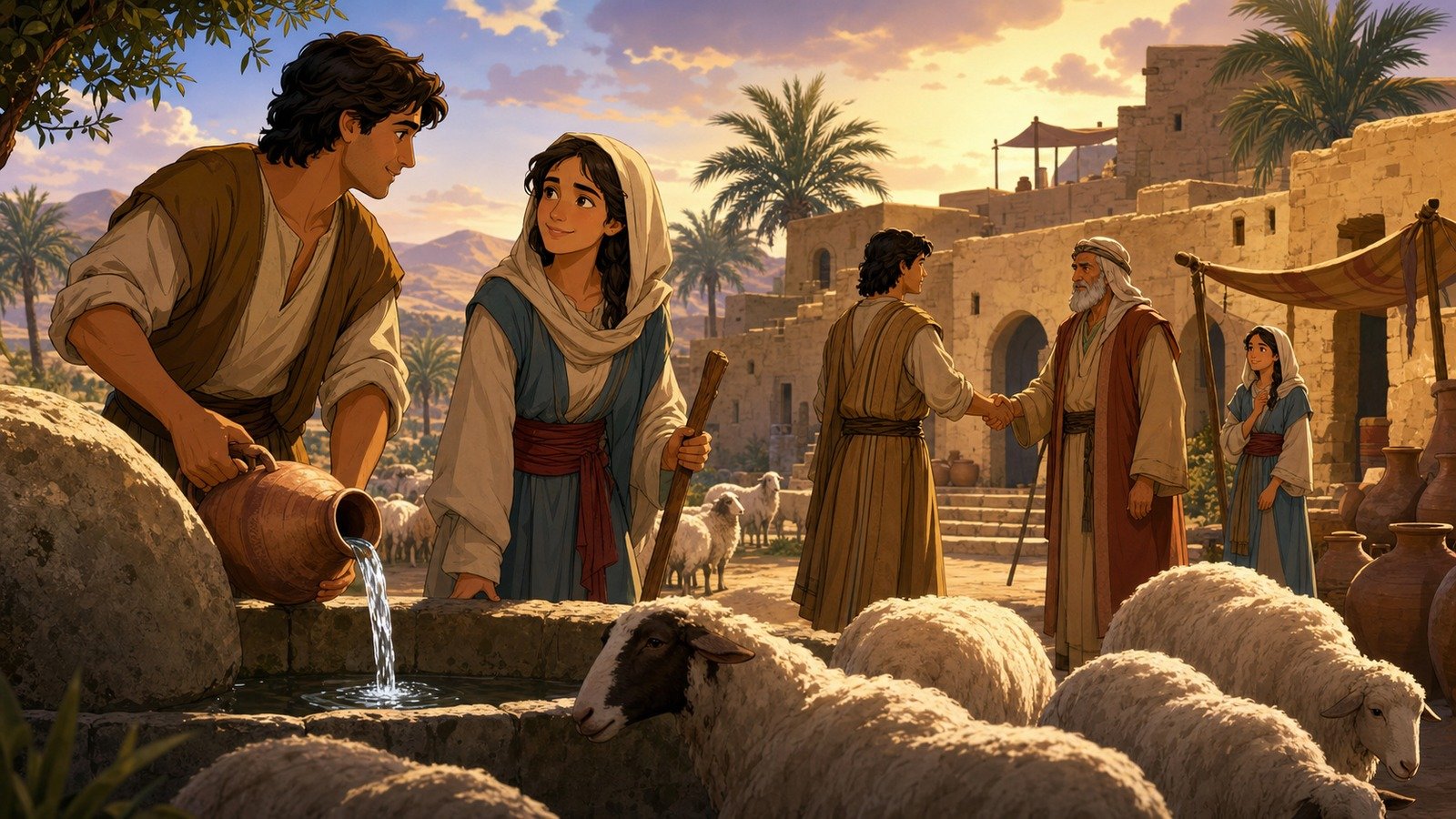
Arriving in Harran, Jacob meets Rachel at a well and agrees to work seven years for his uncle Laban in exchange for her hand in marriage.
Further context
3 min readJacob reaches the land of the eastern peoples and finds a well in a field with three flocks lying beside it. The local practice is explained: a large stone covered the mouth of the well, and the shepherds waited until all the flocks had gathered before rolling it away together, then put it back. Rationing access in that way protected a shared resource and required everyone to cooperate.
He asks the shepherds where they are from, learns they are from Harran, asks after Laban, and is told that Laban's daughter Rachel is on her way with the sheep. He suggests they water the flocks and move on, since it is still the middle of the day. They tell him they cannot until all the flocks are gathered.
When she arrives he goes over and rolls the stone away by himself and waters his uncle's flock. The gesture is presented as a feat, and it also breaks the arrangement the shepherds have just described to him. Then he kisses her and weeps aloud, and only afterwards tells her who he is.
Laban runs out to meet him, embraces him and says, you are my own flesh and blood. Anyone who remembers his earlier appearance, hurrying out to a stranger at the spring after seeing gold on his sister's arms, will read that welcome carefully.
After a month the question of wages is raised. Just because you are a relative of mine, should you work for me for nothing? Tell me what your wages should be. The offer sounds generous and it converts a nephew into an employee.
The two daughters are introduced here. Leah is the elder, and her eyes are described with an adjective (rakkot) whose meaning is genuinely uncertain. It can mean weak or delicate, and translations have gone in opposite directions, some suggesting poor eyesight and others suggesting soft or lovely eyes, in which case the sentence is contrasting one attractive feature with Rachel's overall appearance. Rachel is described as lovely in form and beautiful.
Jacob's proposal is seven years of work in return for Rachel. Bride payments in Mesopotamian contracts of the period commonly ran between ten and forty shekels of silver, and a hired labourer earned something in the order of a shekel for a month's work, which puts seven years of service far above the going rate. He names the figure himself, unprompted, having arrived with nothing, and Laban's reply is that it is better she be given to him than to another man. Which daughter is meant is never written down anywhere, and that omission does all the work of what happens next.
The closing line is one of the few unguarded sentences in his whole story: they seemed like only a few days to him because of his love for her.
Harran is where his grandfather's family stopped and settled two generations earlier, and where Terah died. Jacob has therefore walked eight hundred kilometres to arrive at the place Abraham was called out of, and he will spend twenty years there. The family is back where it started, working for a relative, in a household that keeps its own gods and will produce a theft, a substitution on a wedding night and ten changes of wages.
The pieces of what happens next have already been laid out. A younger brother who exploited an elder brother's hunger, and who deceived a blind father in the dark using a disguise and a borrowed identity, has just agreed a seven-year contract with a man who has two daughters and has not put in writing which one is meant.