

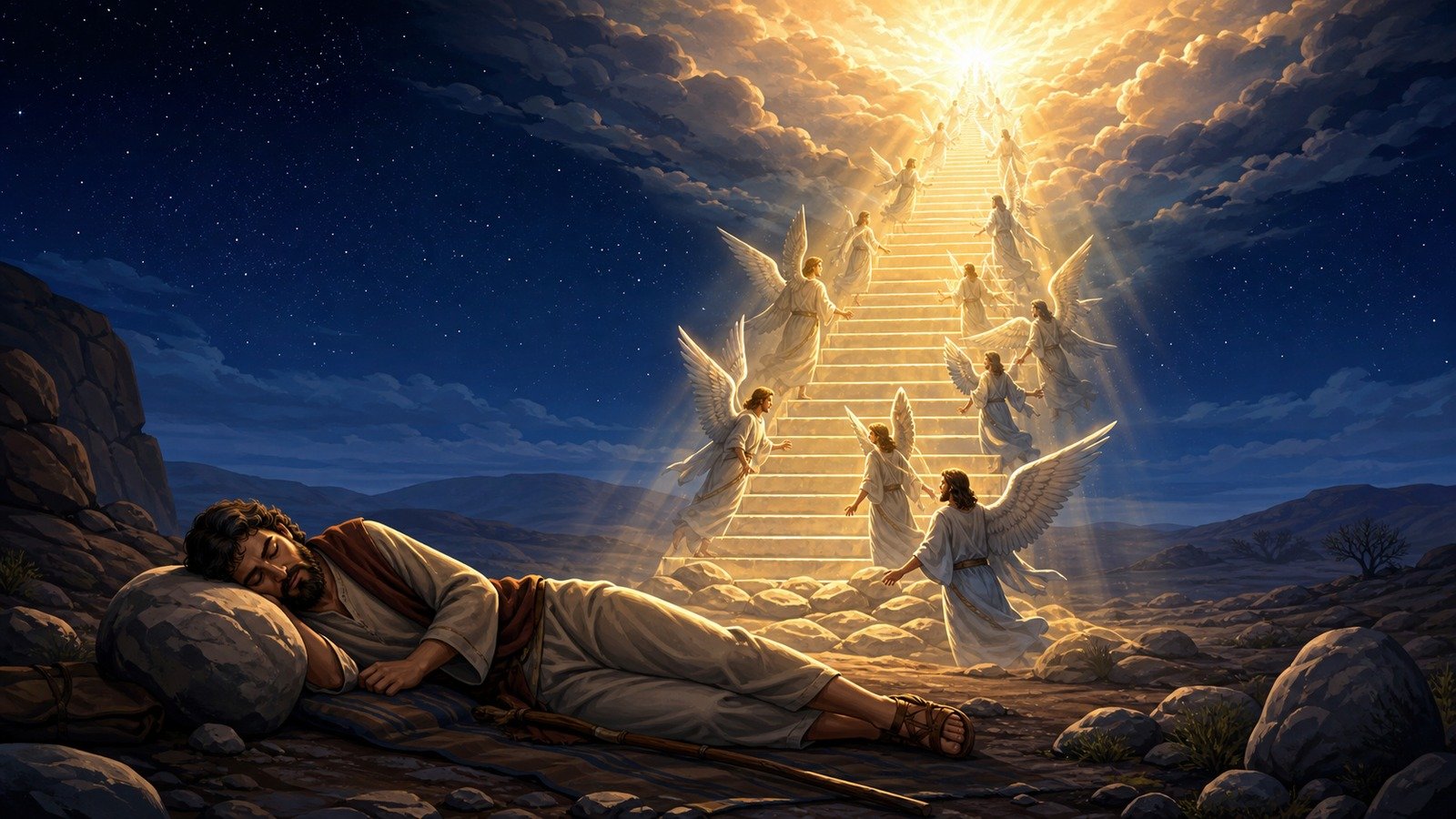
On the road to Harran, Jacob dreams of a stairway to heaven with angels ascending and descending; God personally renews to him the covenant promise first given to Abraham, and Jacob names the site Bethel, "house of God."
Further context
3 min readJacob stops for the night because the sun has set, and takes one of the stones lying there and puts it under his head. That is all the setting there is. He is alone, running from a brother who wants to kill him, about a hundred kilometres into a journey of eight hundred.
The dream is usually pictured as a ladder, and the Hebrew word probably means something else. It occurs only here in the whole Bible (sullam), and its likely root suggests something raised up or heaped up, which points to a ramp or a staircase rather than a ladder with rungs. The stepped temple towers of Mesopotamia had monumental staircases on their outer face, built so that a deity could come down to the shrine at the top, and a structure of that kind fits a description of something set on the earth with its top reaching to heaven and figures moving up and down it in both directions.
That association gives the scene an edge. The builders at Babel put up a tower with its top in the heavens in order to make a name for themselves and were scattered across the earth. Here a man with no name, no possessions and nowhere to sleep is shown a staircase he did not build, and the traffic on it comes down as well as going up.
God stands above it, or beside him, since the Hebrew allows either, and speaks. The promise is the one given to Abraham and repeated to Isaac: this land, offspring like the dust of the earth spreading in every direction, and all peoples on earth blessed through him. Then four short clauses that address his immediate situation rather than his descendants. I am with you. I will watch over you wherever you go. I will bring you back to this land. I will not leave you until I have done what I have promised.
He wakes and says he did not know God was in this place, and calls it awesome, the house of God and the gate of heaven. That second phrase is worth noticing, because the gate of the god is exactly what Babylon's own name meant, and that name has already been turned into a pun on confusion. The gate of heaven turns out to be an unremarkable hillside where a fugitive slept on a stone.
He sets the stone up as a pillar, pours oil on it, and renames the place Bethel, house of God, replacing the old name Luz.
His vow is then recorded exactly as he made it, conditions and all. If God will be with him and watch over him and give him food and clothing so that he returns safely, then the LORD will be his God, the stone will be God's house, and he will give a tenth of everything. He has just been given an unconditional promise and he answers with a bargain. Nothing is said about that either way, and the twenty years that follow are the answer.
Much later Jesus told a man named Nathanael that he would see heaven open and the angels of God ascending and descending on the Son of Man, taking the image from this hillside and attaching it to a person rather than to a place.