

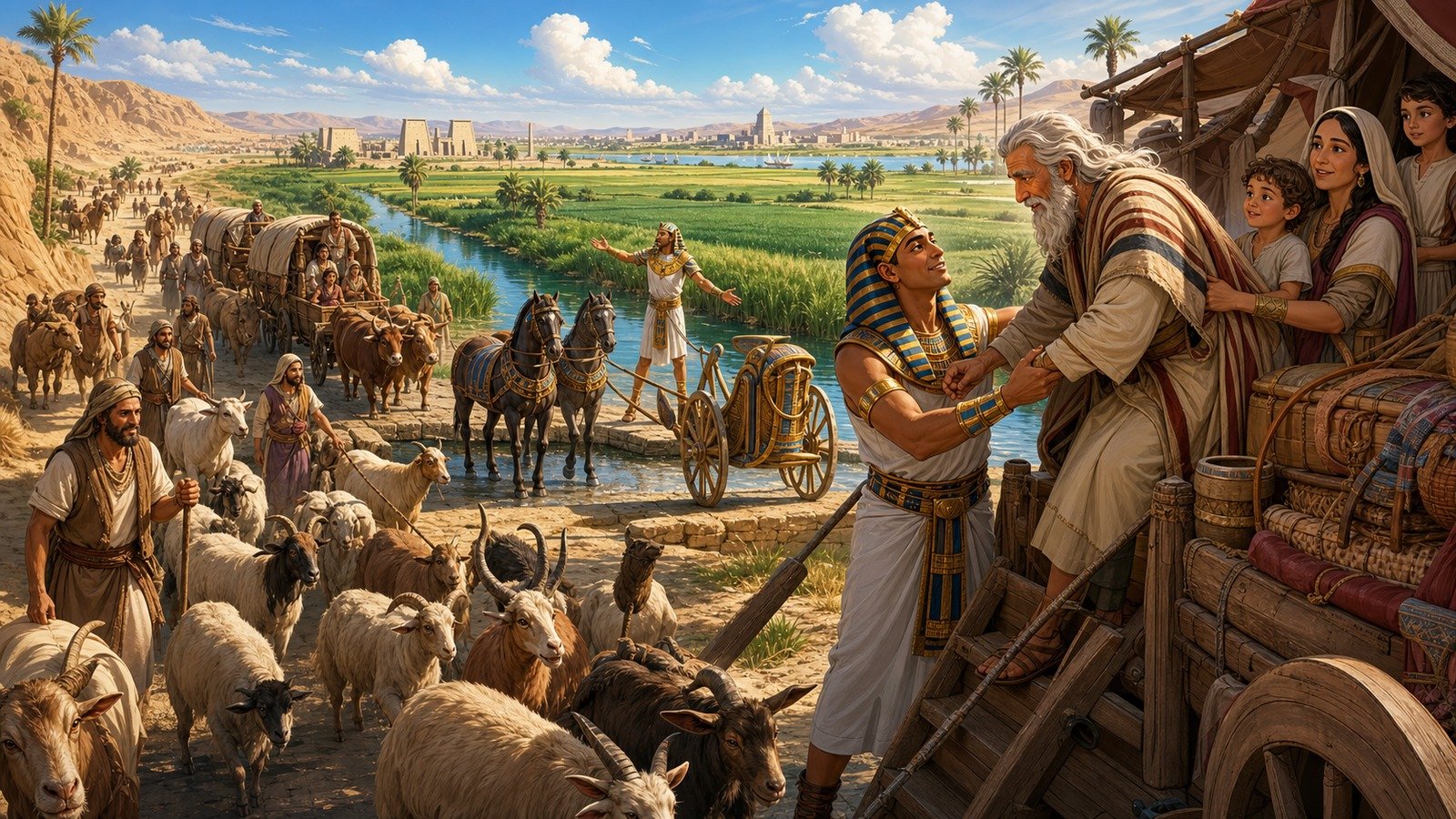
Jacob, now 130, leads seventy family members down into Egypt, where Pharaoh grants them the fertile region of Goshen to settle as shepherds, separate from the Egyptian population. This migration begins the sojourn later reversed by the Exodus.
Further context
2 min readJacob stops at Beersheba on the way south and offers sacrifices to the God of his father Isaac. Beersheba is the last town before the desert road to Egypt, and it is where Abraham planted a tamarisk and Isaac built an altar. Leaving the land of promise is not a small decision, and his grandfather's trip to Egypt in a famine had gone badly.
God speaks to him there in a vision at night, with four statements. Do not be afraid to go down to Egypt, for I will make you into a great nation there. I will go down to Egypt with you. I will surely bring you back again. And Joseph's own hand will close your eyes. A promise of return is given at the moment of departure, four centuries before it happens.
The family that goes down is then listed name by name and counted at seventy persons. Stephen, retelling the story in Jerusalem centuries later, gives seventy-five instead, following the Greek version, which includes additional descendants of Joseph born in Egypt. A Hebrew copy of Exodus among the Dead Sea Scrolls carries the higher figure as well, so the difference is a matter of manuscript tradition rather than an error in arithmetic.
Judah is sent ahead to get directions to Goshen, which is a quiet indication of who now speaks for the family. Joseph rides out in his chariot to meet his father, throws his arms around him and weeps for a long time, and Jacob says he is ready to die now that he has seen his face.
What Joseph arranges next is deliberate policy rather than protocol. He tells his brothers to say they and their fathers have tended livestock from their youth, and explains why: all shepherds are detestable to the Egyptians. Egyptian texts and tomb art show a settled agricultural society with a low view of Asiatic herdsmen, and he turns that prejudice into an advantage. Presented as shepherds, the family will be given grazing land in Goshen on the eastern edge of the Delta and left alone there, separate from Egyptian society. A family absorbed into Egypt would not have survived as a distinct people, and this arrangement is what keeps it intact for four hundred years.
Five of the brothers are presented to Pharaoh and give the answer as instructed. Then Jacob is brought in, and the exchange is short and unusual. Pharaoh asks his age. He answers that the years of his pilgrimage are a hundred and thirty, that they have been few and difficult, and that they do not equal the years of his fathers. Then he blesses Pharaoh, and he blesses him again on the way out. An old herdsman with no property pronounces a blessing over the ruler of Egypt, twice, and nothing is said about it.
How long the family stayed is disputed and it matters for dating the Exodus. Four hundred years is given in one place and four hundred and thirty in another, and the question belongs with the departure rather than the arrival.