

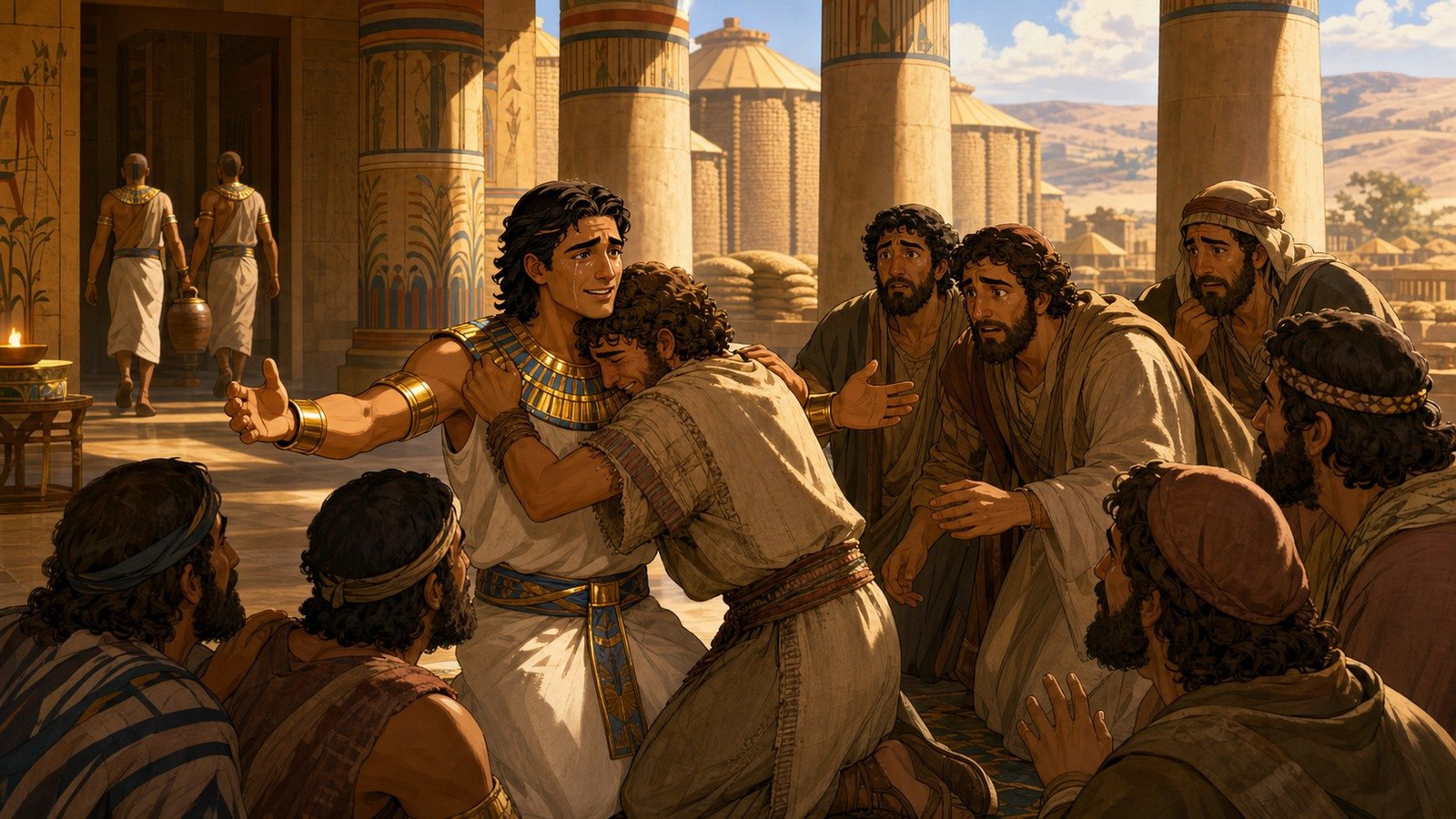
Overcome with emotion, Joseph reveals who he is, forgives his brothers, and reframes their betrayal within God's purpose to preserve life through famine. He sends for Jacob and the whole family to settle in Egypt.
Further context
2 min readJoseph cannot keep control of himself any longer and orders every Egyptian out of the room. He weeps so loudly that they hear him outside, and the news reaches Pharaoh's household, so the private moment is private only in the sense that his brothers are alone with him.
His first words are four in Hebrew: I am Joseph. Is my father still living? That is the question he has been circling for two years, and he asks it before anything else, of men who have just discovered that the second most powerful person in Egypt is the brother they sold.
They were terrified at his presence and could not answer him. He tells them to come close, and says it again with the detail included: I am your brother Joseph, the one you sold into Egypt.
What he says next needs reading carefully because it flattens easily. Do not be distressed and do not be angry with yourselves for selling me here, because it was to save lives that God sent me ahead of you. He repeats the point three times in five sentences, and the last time he puts it as strongly as it can be put: it was not you who sent me here, but God.
He is not denying what they did. He states it plainly three times over, and years later he says it again in a form that holds both facts at once: you intended to harm me, but God intended it for good. This is not an argument that the sale was acceptable. It is an argument that the sale was not the last word on what happened.
He then gives them information they need. Two years of the famine have passed and five remain, with neither ploughing nor harvesting in them. They are to bring their father down and settle in the region of Goshen, near him, with their flocks and herds and everything they own.
Pharaoh hears about it and is pleased, which is a political detail worth noticing, since the alternative was a foreign official importing his relatives. He instructs Joseph to bring the family and promises them the best of the land, and he sends carts, which is what finally convinces Jacob. Each brother is given new clothing, and Benjamin receives three hundred shekels of silver and five sets. The man who was sold for twenty shekels and stripped of a robe sends his brothers home with silver and clothes.
The last thing he says as they leave is one clause: do not quarrel on the way. Anyone who has followed this family will recognise the realism of it.
What he never does is as telling as what he says. He asks no questions about how they explained his disappearance, demands no explanation for the missing years, and imposes no conditions on the invitation. The tests of the previous months were designed to establish whether they had changed, and once Judah offered himself in Benjamin's place the answer was in. No confession is ever asked for and none is ever recorded.
Jacob's reaction is reported without softening. He was stunned and did not believe them. Only when he saw the carts did his spirit revive, and he said he would go and see him before he died.