

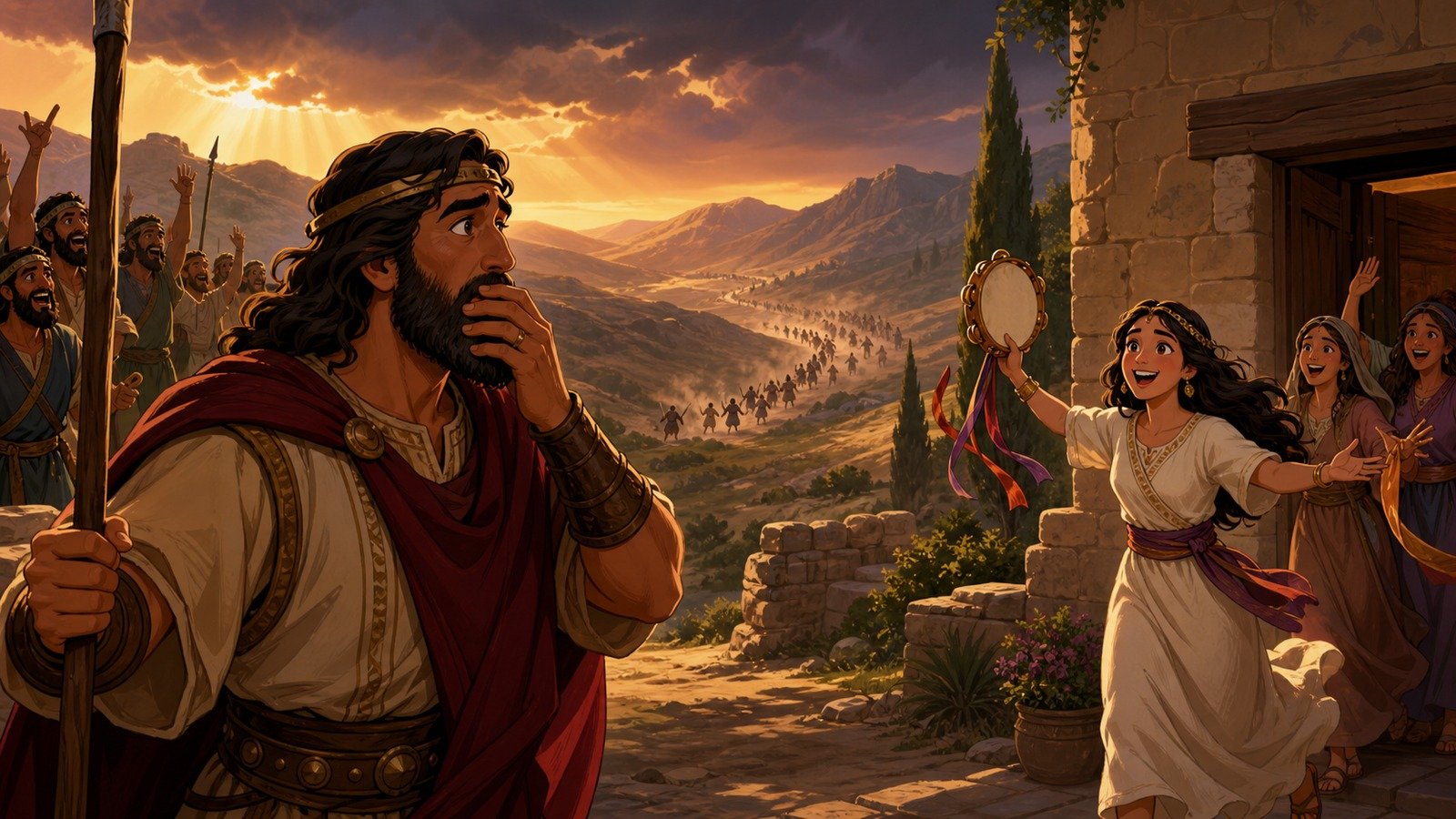
Jephthah, a rejected outcast, is recalled to lead Israel against Ammon and makes a rash vow to sacrifice whatever comes from his house first if granted victory; it proves to be his own daughter, one of the most disturbing episodes in the book.
Further context
2 min readJephthah is the son of a prostitute, driven out of his father's household by his half-brothers so that he would not share the inheritance, and he has spent years in the land of Tob at the head of a band of what are frankly described as scoundrels. When the Ammonites attack, the elders of Gilead come and ask him to lead them, and his reply is exactly what anyone would expect: did you not hate me and drive me from my father's house? Why do you come to me now? He negotiates the leadership as a permanent position before agreeing.
Before fighting he tries diplomacy, and the exchange is a long argument about historical title. The Ammonite king claims Israel took his land coming up from Egypt. Jephthah answers with a detailed rehearsal of the route: Israel went round Edom and Moab, took nothing from either, and captured the territory in question from Sihon the Amorite, who attacked first. Then he adds a sharp piece of reasoning: will you not take what your god Chemosh gives you? Whatever the LORD our God has given us, we will possess. And he points out that Israel has occupied the area for three hundred years and nobody objected until now.
Then the vow. If you give the Ammonites into my hands, whatever comes out of the door of my house to meet me when I return in triumph will be the LORD's, and I will sacrifice it as a burnt offering.
He wins decisively, and what comes out to meet him is his daughter, dancing to the sound of timbrels. She is his only child. He tears his clothes and tells her he cannot break his word. She asks for two months in the hills with her friends to grieve, because she will never marry, and then he does as he had vowed.
Interpreters divide on what that means, and the ambiguity is genuine. The straightforward reading is that he killed her, and human sacrifice is condemned in the strongest terms throughout the Hebrew scriptures. The alternative is that she was committed to lifelong service at the sanctuary and celibacy, which is why her own lament is about never marrying rather than about dying. The Hebrew permits both, and the fact that the annual four-day commemoration by the young women of Israel is mentioned without further explanation has been used on both sides.
Nothing anywhere approves of the vow. What is described is a man making a rash promise in a moment of fear, who could have sought a way out through the priests and did not, and who was operating in a period where nobody seems to have known the law well enough to tell him he had other options.
The episode ends in a civil war with Ephraim and a massacre at the Jordan fords, where forty-two thousand men are identified by their inability to pronounce the word shibboleth.