

Uzziah (also called Azariah) reigns long and successfully, strengthening Judah's military and economy, until pride leads him to usurp priestly duties in the Temple and he is struck with a skin disease for the rest of his life, ruling from isolation with his son Jotham as co-regent.
Further context
3 min readUzziah reigns fifty-two years in Jerusalem, one of the longest in either kingdom, and the assessment is favourable with the usual note about the high places. He is also called Azariah in one of the two histories, which is a second throne name of the kind several kings of this period carried.
The reign is a period of substantial expansion and it is described in unusual technical detail. He defeats the Philistines and breaks down the walls of Gath, Jabneh and Ashdod. He receives tribute from the Ammonites. He rebuilds Elath on the Gulf of Aqaba and restores it to Judah, which reopens the Red Sea trade route. He builds towers in Jerusalem at the Corner Gate, the Valley Gate and the angle of the wall, and fortifies them. He digs cisterns and keeps large herds, and employs people working his fields and vineyards in the hills and in the fertile lands, because he loved the soil.
He also invests in weapons. The army is equipped with shields, spears, helmets, coats of armour, bows and slingstones, and machines designed by skilful men are installed on the towers and corner defences to shoot arrows and hurl large stones. Torsion artillery in the eighth century BC would be several centuries early by the usual reckoning, and what those machines actually were is debated; frames for massed archery and simple stone-throwing devices have both been proposed.
His fame spreads far and wide, and the summary sentence is the one the rest of the reign turns on: he was greatly helped until he became powerful.
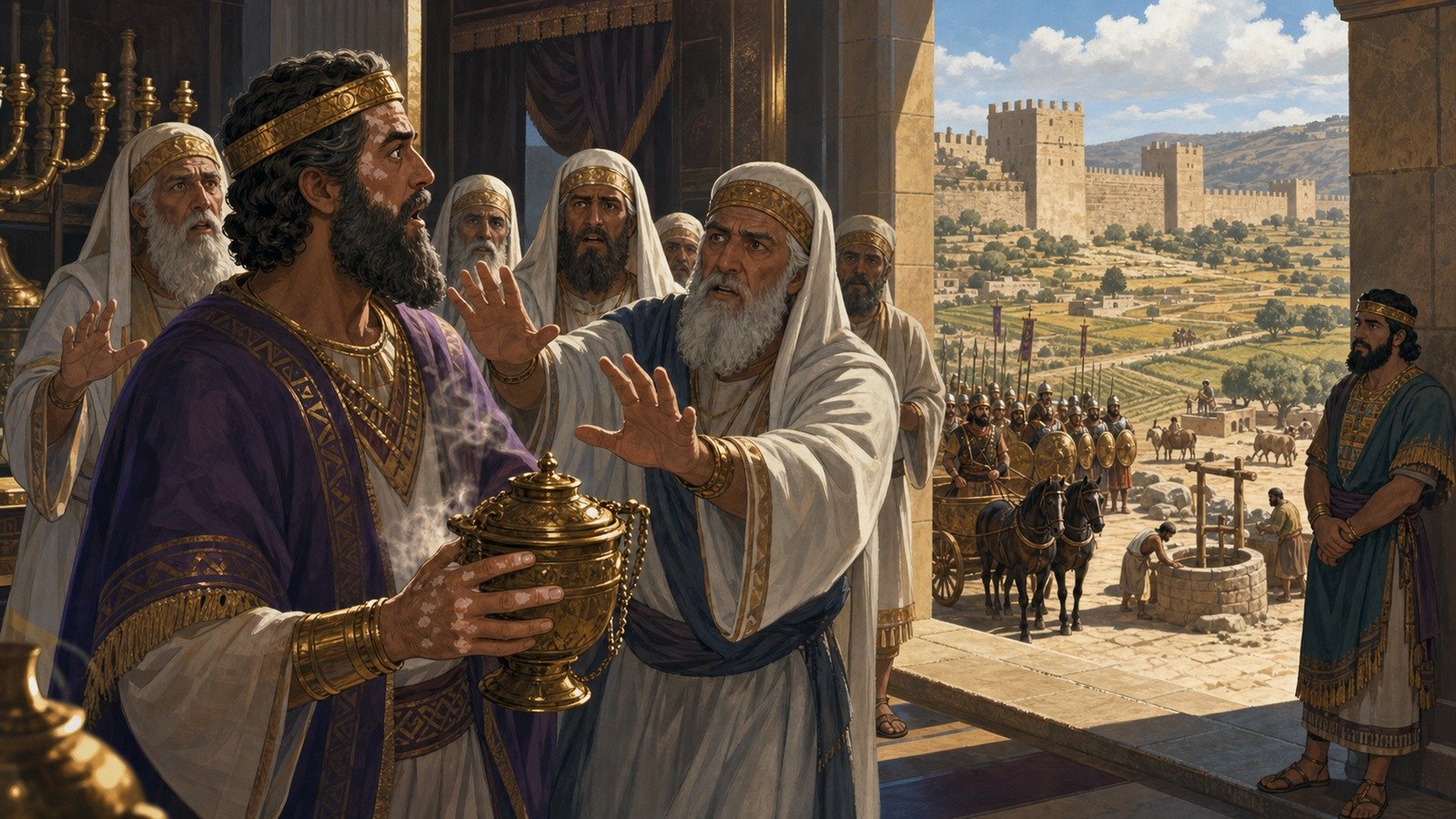
What ends it is an attempt to combine two offices that Israelite practice kept rigidly apart. He enters the temple to burn incense on the altar, which was the exclusive function of the priests. Azariah the priest and eighty other courageous priests follow him in and confront him: it is not right for you to burn incense to the LORD. That is for the priests, the descendants of Aaron. Leave the sanctuary, for you have been unfaithful.
He is holding a censer and becomes enraged, and while he is raging at them leprosy breaks out on his forehead in front of the altar. They hurry him out, and he himself is eager to leave.
He lives in a separate house for the rest of his life, excluded from the temple, with his son Jotham governing in his place. The two throne names are worth a word, because they cause confusion in every list of these kings. Uzziah and Azariah are used of the same man in the two histories, and several other kings of this era carry a second name as well. Regnal names distinct from personal ones are attested across the region, and the practice is what produces most of the apparent duplication in the king lists.
His death is the moment Isaiah dates his own call to: in the year that King Uzziah died, I saw the Lord.
Fifty-two years, one of the longest reigns in either kingdom, and the material achievements are listed at length: towers in Jerusalem and the desert, cisterns, large herds, farmers and vine growers in the hills, a reorganised army, and engines invented for shooting arrows and hurling stones from the towers.
His fame spread far and wide, for he was greatly helped until he became powerful.
The judgement comes when he enters the temple to burn incense on the altar, which was a priestly function. Eighty-one priests confront him, he becomes angry with a censer in his hand, and leprosy breaks out on his forehead in front of them. He lived in a separate house for the rest of his life, with his son running the country.
A stone plaque found in Jerusalem, dating from around the first century, reads: here were brought the bones of Uzziah, king of Judah. Do not open.