

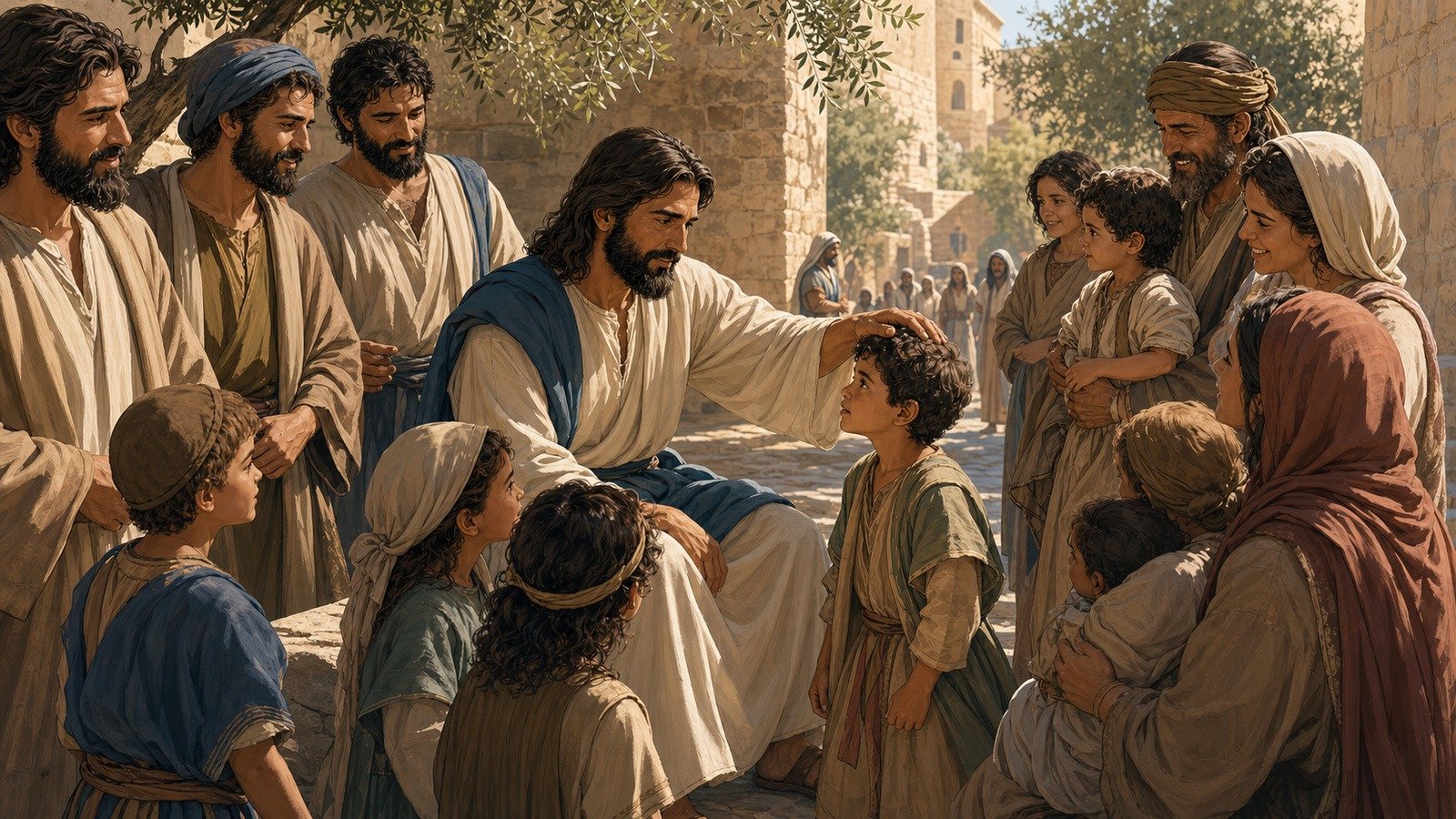
Jesus welcomes children his disciples had tried to turn away, saying "the kingdom of heaven belongs to such as these," and blesses them by placing his hands on them.
Further context
2 min readPeople are bringing little children to Jesus to have him place his hands on them and pray for them, and the disciples rebuke them.
Blessing a child by laying hands on the head was an old practice, and mothers are recorded bringing children to rabbis for it, so nothing about the request was unusual. The disciples are not being cruel; they are managing a schedule. He has been talking about marriage and divorce, he is on the road to Jerusalem, and there are queues of people with serious business.
When he sees it, he is indignant. The Greek word is strong and is used of him only here.
Let the little children come to me, and do not hinder them, for the kingdom of God belongs to such as these.
The word rendered little children covers infants through to young boys and girls, and Luke uses a term that means babies, describing children carried rather than walking.
Then the sentence that turns the illustration into a condition: truly I tell you, anyone who will not receive the kingdom of God like a little child will never enter it.
What quality is meant has been assumed rather than examined for a long time. Innocence is the usual answer offered, and nothing in what he says supports it; children are nowhere described in the Bible as innocent. Trustfulness is closer, and dependence is closer still. A child in that world owned nothing, earned nothing, could enforce no claim and had no honour to trade on. Receiving the kingdom like a child means receiving it as someone with nothing to bring.
And he took the children in his arms, placed his hands on them and blessed them. The verb used there is an intensified form, meaning he blessed them fervently, and it appears nowhere else in the New Testament.
Two things follow from this scene historically. Household attitudes in the Greek and Roman world included the legal exposure of unwanted infants, left outside to die or be taken by anyone who found them, a practice attested in letters and law and one that Jews already refused. Christian communities took the same line from the beginning, and the refusal was noticed.
And the placing of this episode immediately before a rich and confident man walks away unable to give anything up is not accidental. The child who can bring nothing is set against the man who has everything and will not let go of it, and they are separated by three sentences.
The scene is set on the road through Judea or Perea, in the middle of a crowd following him towards Jerusalem, and the physical picture is a group of parents pushing through it with children in their arms.
Placing hands on a child's head to bless is an old gesture, going back to a blind patriarch reaching for his grandsons and crossing his arms over them. It was ordinary practice, and the disciples' instinct to shield him from it says more about what they thought his time was for than about what they thought of children.
The kingdom belongs to such as these is not a statement about who is admitted. It is a statement about what admission looks like, and the illustration standing in front of them owned nothing.