

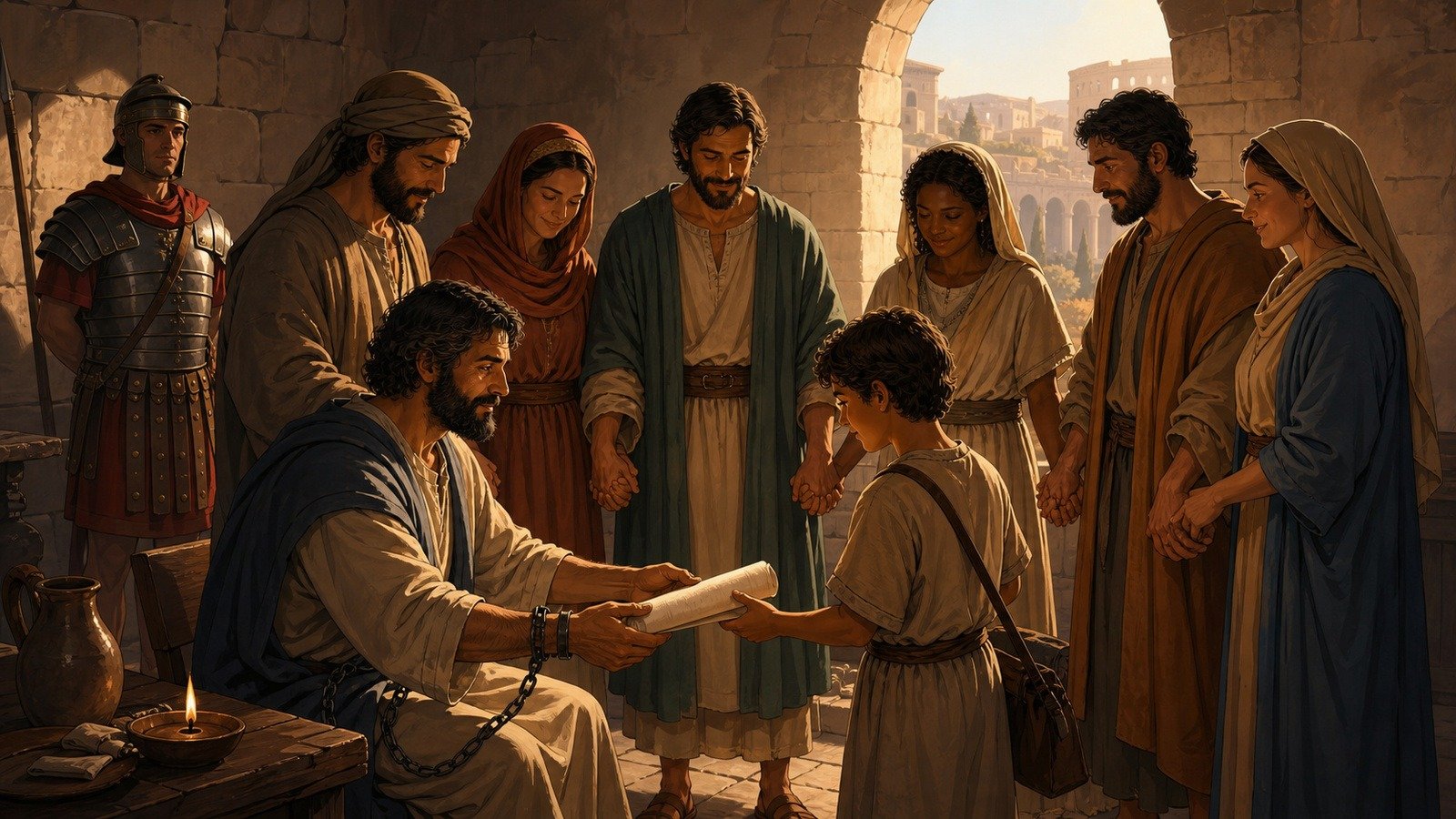
Written during a Roman imprisonment, this letter reflects broadly on the church as Christ's body drawing Jew and Gentile together, with less of the specific local detail found in Paul's other letters; a substantial body of scholarship questions whether Paul wrote it himself or a close follower wrote it in his name after his death, a common ancient practice.
Further context
2 min readWritten from prison, and unusual among Paul's letters for having almost no local detail in it at all.
That absence is the starting point for the question of who it was written to. The words in Ephesus are missing from the earliest and best manuscripts of the opening sentence, leaving an address that reads simply to God's holy people, the faithful in Christ Jesus. There is no greeting to individuals, which is odd in a letter to a city where the writer had spent three years and knew everybody, and he refers to having heard about their faith, which is odder still.
The most common explanation is that it was a circular, sent round the congregations of the province with a space left for the local name, and that the copy which survived was the Ephesian one.
Its authorship is also disputed more than most. The vocabulary contains words Paul does not use elsewhere, the sentences are much longer than his usual, and its relationship to the letter to the Colossians is so close in places that one appears to be reworking the other. Those who defend it point out that a man writing a general letter rather than answering a crisis would naturally write differently, and that secretaries did much of the actual composition in antiquity.
What it contains is a sustained argument about one thing: that Jew and Gentile have been made into a single body. He himself is the one who made both groups one and has destroyed the barrier, the dividing wall of hostility. For anyone who had seen the stone barrier in the temple courts, with its notices threatening death to foreigners who passed it, that image was not a metaphor plucked out of the air.
Out of it come some of the most familiar phrases in Christian usage: by grace you have been saved, through faith, and this is not from yourselves, it is the gift of God. And the description of the armour of God, with the belt of truth, the breastplate of righteousness and the shield of faith, written by a man who had a Roman soldier chained to him while he dictated.
The domestic instructions in the later chapters, about husbands and wives, children and parents, slaves and masters, have been among the most argued over in the New Testament for the last century.
The letter says almost nothing about anyone's circumstances, which is why it has been read for its own sake rather than as correspondence. It has also been the most quoted of Paul's letters in liturgy, since its opening chapter is a single sentence in Greek of over two hundred words and reads as a doxology.
Whatever the answer about authorship, the letter was known and used by the middle of the second century.
The letter's second half turns entirely practical, with instructions about speaking truthfully, working honestly, dealing with anger before nightfall, and speaking only what builds others up.
The letter's most quoted sentence about grace is followed immediately by a clause that is usually left off: created in Christ Jesus to do good works, which God prepared in advance for us to do.