

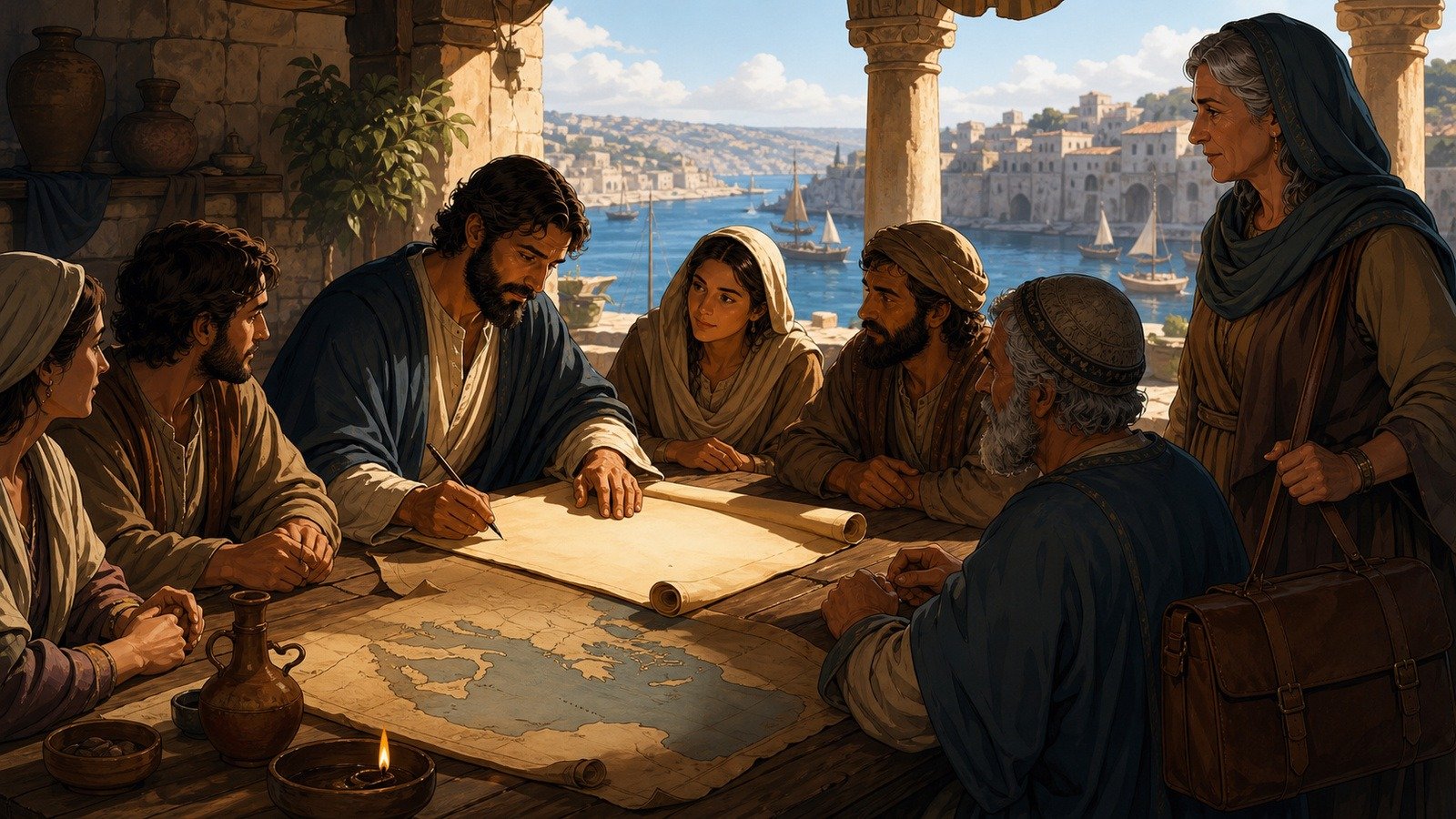
Writing from Corinth to a church he has not yet visited, Paul sets out his fullest treatment of sin, grace, justification by faith, and the place of Israel and the Gentiles in God's plan, before requesting support for a planned mission to Spain.
Further context
2 min readPaul writes from Corinth, during the three winter months in Greece, to a congregation he had never met, and it is the longest and most carefully constructed thing he produced.
The circumstances explain the shape of it. He is about to carry the collection to Jerusalem and expects trouble there. After that he intends to travel to Spain, and he wants Rome as his base for that work. So he is writing to introduce himself to a church that knew him only by reputation, and the reputation was mixed.
There is also a local problem behind it. Claudius had expelled the Jews from Rome around AD 49, leaving a Gentile congregation, and after his death in AD 54 they began returning to a church that had reorganised without them. The tensions between Jewish and Gentile believers that occupy the middle of the letter are not abstract.
The argument runs in a long sequence. All have sinned and fall short of the glory of God, Gentiles by suppressing what they knew from creation, Jews by possessing the law and not keeping it. Righteousness comes through faith in Jesus Christ to all who believe, and there is no difference between them. Abraham was counted righteous before he was circumcised, so he is the father of all who believe. Therefore, since we have been justified through faith, we have peace with God.
Then the consequences for how a person lives, the struggle described in the first person about doing what he does not want to do, and then the argument about the Spirit and adoption, ending in the claim that nothing in all creation can separate us from the love of God.
Three chapters then deal with Israel, and they are the most anguished thing he wrote: I have great sorrow and unceasing anguish in my heart. Whatever the letter says about the Gentiles being grafted in, it insists that God has not rejected his people, and warns the grafted branches against arrogance.
The final chapter greets twenty-six people by name in a city Paul had never visited, including nine women, a woman called Junia described as outstanding among the apostles, and Phoebe, a deacon of the church at Cenchreae, who almost certainly carried the letter.
Augustine was converted reading it. Luther's reading of one sentence in it began the Reformation. Wesley's heart was strangely warmed at a meeting where its preface was being read aloud.
Phoebe is described as a diakonos of the church at Cenchreae and as a prostatis, a word meaning patron or benefactor, of many people including Paul himself. Both terms are contested in translation, and how they are rendered has consequences that go well beyond one sentence.
The letter's last chapter is the single best source for what an early congregation looked like: house churches, named couples, relatives, former slaves, and a Roman official's household.
Paul never reached Spain as far as anyone can establish, and he did reach Rome, in chains, at the empire's expense, two or three years after posting the letter that asked for help with the journey.