

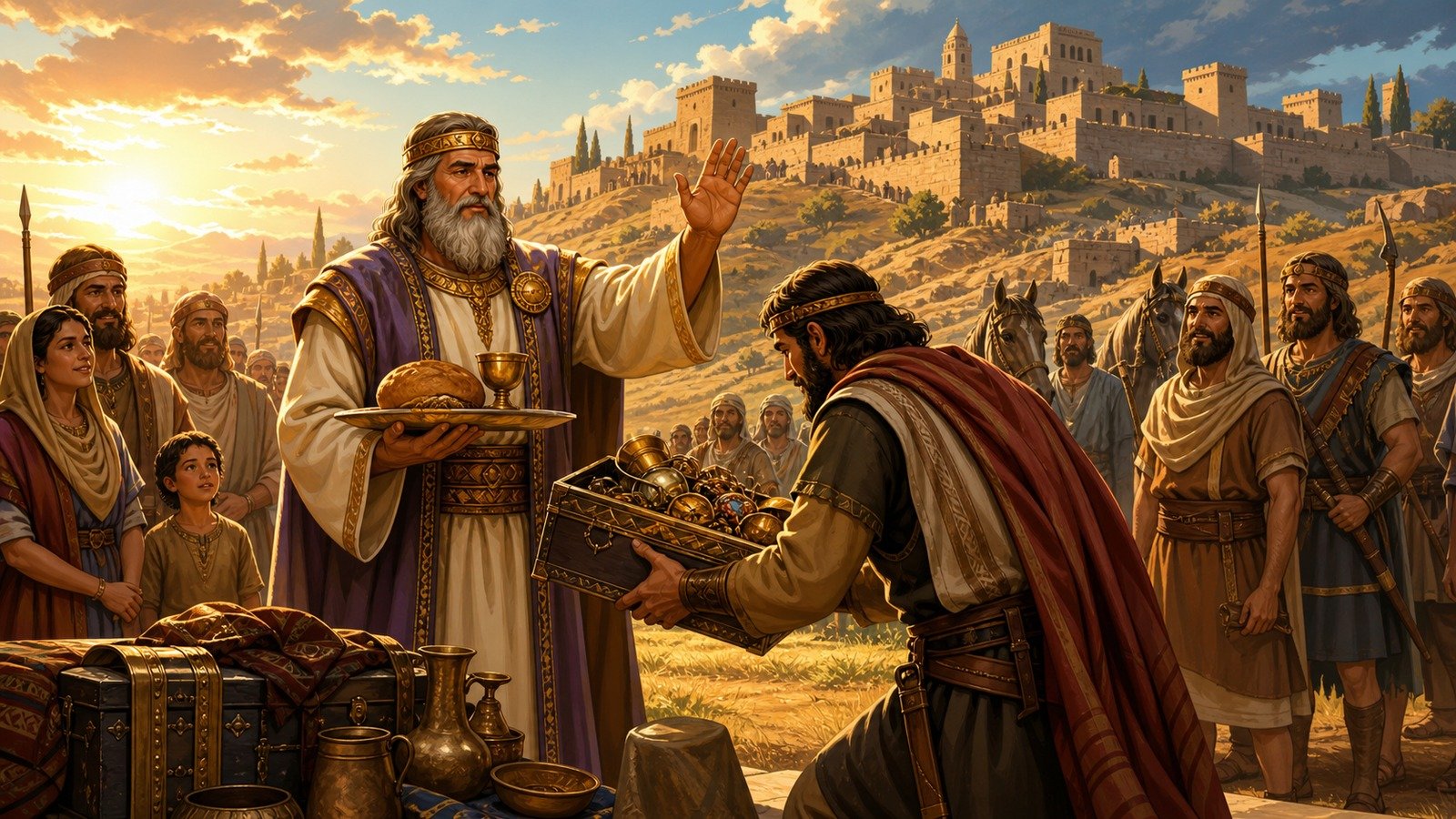
Returning from the rescue, Abram meets Melchizedek, king of Salem and priest of God Most High, who blesses him; Abram gives Melchizedek a tenth of the recovered spoils, an episode later central to the argument of Hebrews about Christ's priesthood.
Further context
2 min readTwo kings come out to meet him on the road back, and they want opposite things.
The first is Melchizedek, king of Salem, who is also described as priest of God Most High. He brings out bread and wine and pronounces a blessing: blessed be Abram by God Most High, Creator of heaven and earth, and blessed be God Most High, who delivered your enemies into your hand. Abram gives him a tenth of everything.
Almost nothing about him is explained. He has no genealogy in a story that supplies genealogies for everybody, no account of his birth or death, no successor and no second appearance. He worships the same God as Abram without belonging to Abram's family, which is unusual in a narrative organised around one chosen line. His name divides into two Hebrew words meaning king and righteousness. Salem is generally identified with Jerusalem, mainly because a psalm sets Salem in parallel with Zion.
Two further points are worth making. The tenth Abram hands over is the first tithe recorded anywhere, offered several centuries before any law required one and paid to a priest outside his own family. And the divine title Melchizedek uses, God Most High (El Elyon), is not distinctively Israelite vocabulary; related titles appear in Canaanite and Phoenician inscriptions. Abram takes the name up without correcting it, adding the personal name of his own God to it when he swears his oath a few sentences later. What is being described is a shared vocabulary, not a conversion in either direction.
The second king is the king of Sodom, and his offer is straightforward: give me the people and keep the goods. Abram refuses under oath, down to a thread or the strap of a sandal, and states his reason. The king must never be able to say that he made Abram rich. He allows only what his men have eaten and the share belonging to his three allies. The man who has just accepted a blessing and given away a tenth will not take anything from the city he rescued.
Melchizedek reappears twice more in Scripture, and both times the argument is built on what was left out of his story. A royal psalm addresses a king with the words "you are a priest for ever, in the order of Melchizedek", which matters because Israelite kings came from Judah and priests from Levi and the two offices were deliberately kept apart. That psalm proposes a priesthood of a different kind, older than Levi and attached to a king.
The letter to the Hebrews develops this at length and is candid about its method. The argument runs that Melchizedek is without father, mother or genealogy, without beginning of days or end of life, and so resembles the Son of God and remains a priest for ever. The reasoning is drawn from what was never recorded rather than from a claim that he had no parents, and it depends on the silence being deliberate. A second argument follows: Abraham paid a tenth to Melchizedek, and Levi, from whom the priesthood descends, was still unborn in his ancestor's body at the time, so the older priesthood is treated as the greater.