

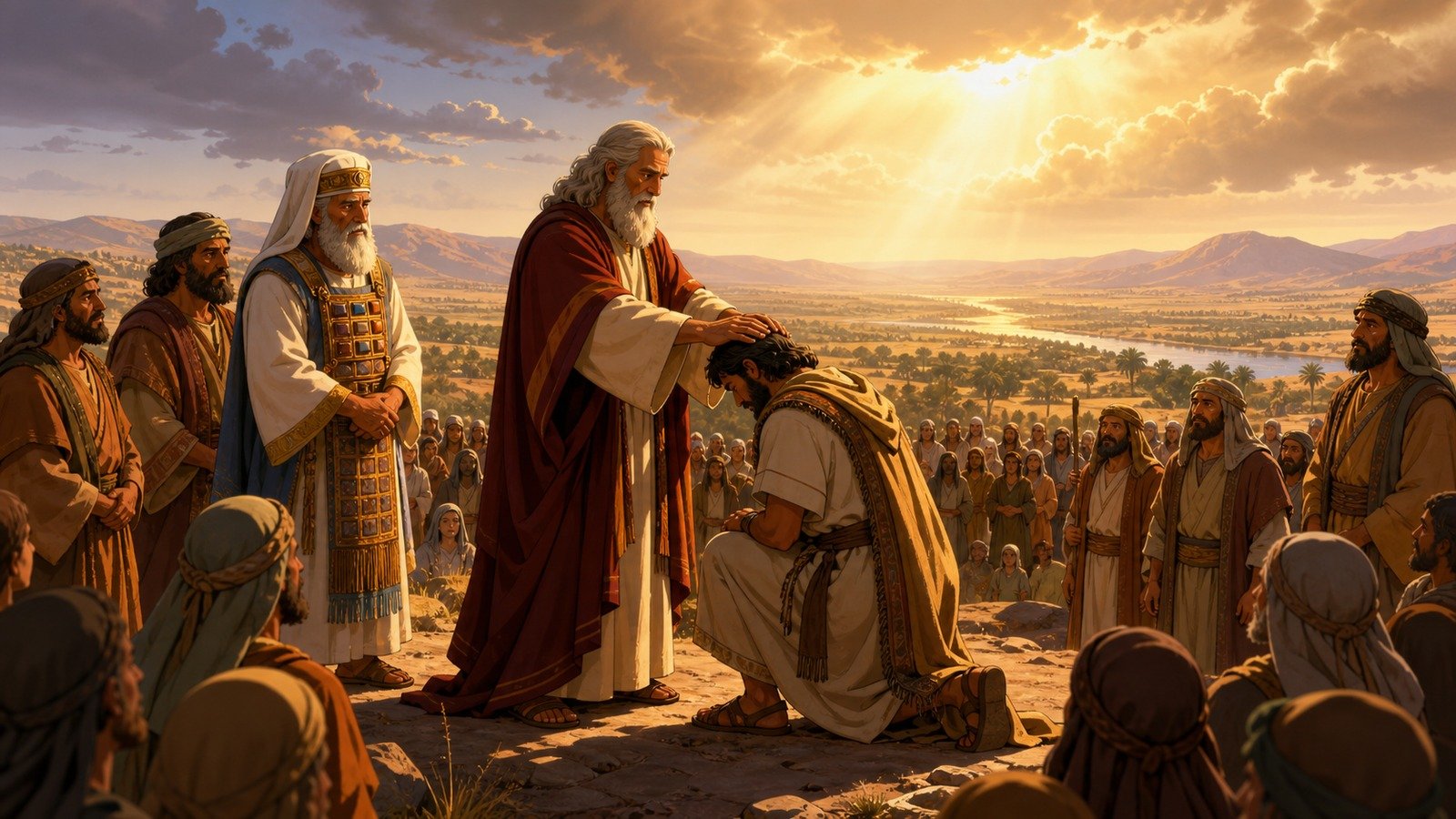
Told he will not enter Canaan himself, Moses asks God to appoint a successor; God formally commissions Joshua before the assembled community through the laying on of hands.
Further context
2 min readThe instruction he receives is also a sentence. Go up this mountain in the Abarim range and see the land I have given the Israelites. After you have seen it, you too will be gathered to your people, as your brother Aaron was, because you disobeyed my command at the waters of Meribah.
His reply is the part worth pausing on. He does not ask for the decision to be reconsidered. He asks for a successor: may the LORD, the God who gives breath to all living things, appoint someone over this community to go out and come in before them, one who will lead them out and bring them in, so the LORD's people will not be like sheep without a shepherd.
That phrase about sheep without a shepherd becomes the standard Hebrew expression for a leaderless people, and it turns up again in the Gospels, where it is used of the crowds Jesus saw.
Joshua is named, and the qualification given is a man in whom is the spirit. The installation is public and physical. He is to stand before Eleazar the priest and the whole assembly, have hands laid on him in their sight, and be given some of Moses' authority so that the whole community will obey him.
One clause defines the difference between the two men and does so without diminishing the successor. Joshua is to stand before Eleazar, who will obtain decisions for him by enquiring of the Urim. Moses spoke with God face to face. Joshua will receive guidance through the priest and the sacred lots. The office continues and the access does not, and the change is stated plainly rather than glossed over.
The scene is given again from another angle at the very end of Moses' life, with a man of a hundred and twenty telling the people he can no longer lead them out and come in, and then addressing Joshua in front of the whole nation with the words that open the next book: be strong and courageous, for you must go with this people into the land, and the LORD himself goes before you and will never leave you nor forsake you.
The transfer is arranged so that nobody can dispute it afterwards. It happens in front of the whole assembly, with the high priest present, by a gesture everyone can see, and with a share of authority explicitly conveyed rather than merely claimed by the successor. Nothing like it happens again for centuries; when Samuel dies, when Elijah is taken, when a king is deposed, the arrangements are messier and are contested.
Joshua has been in view since the battle at Rephidim, when he appeared without introduction and was handed a command. He has been the aide who did not leave the tent, one of the two scouts who came back recommending entry, and the man who waited while an entire generation died. He is around eighty.