

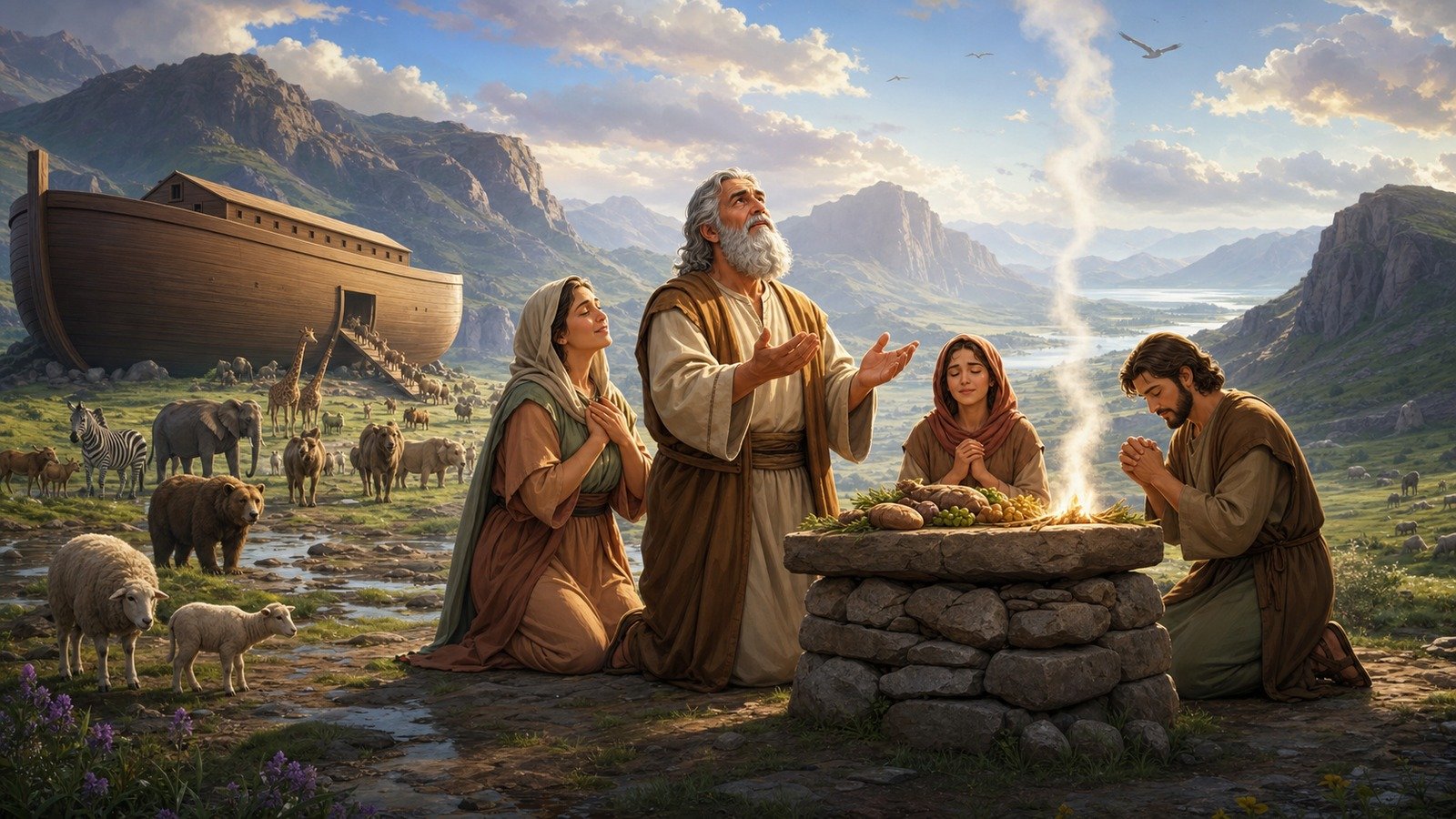
Noah, his family and the animals leave the ark, and Noah builds an altar and sacrifices some of every clean animal; God resolves never again to curse the ground because of humanity, and promises the regularity of the seasons will continue.
Further context
3 min readThe ground had been dry for weeks and Noah was still inside. He went in on instruction and he waits for instruction before coming out, which is reported without comment and is easy to read past. When the command comes, the wording repeats what was said over the creatures at the beginning: bring them out so they can multiply on the earth and be fruitful and increase in number.
The first thing he does on dry land is build an altar. It is the first altar anywhere in the Bible, and it explains something left hanging earlier. He takes some of every clean animal and every clean bird and offers them, which is only possible because seven pairs of the clean animals went aboard rather than one. A single pair would have meant extinguishing a species in order to give thanks for its survival.
What follows is startling in its plainness: the LORD smelled the pleasing aroma. That image is used sparingly here, and the comparison with the Mesopotamian version is instructive because the same picture appears there to an entirely different end. In the Gilgamesh version the gods, cut off from offerings while the flood ran, gather around the survivor's sacrifice like flies. They are hungry. The vocabulary of a pleasing smell is kept here and everything that made it necessary is stripped out, since nothing suggests that the offering was needed to sustain anyone.
The resolution that follows is an internal one rather than a speech to Noah. Never again will the ground be cursed because of human beings, and never again will every living creature be destroyed as it has been.
The reason attached is arresting, because it is the same reason given for sending the Flood in the first place: the inclination of the human heart is evil from childhood. The observation that provoked the judgement now supports a commitment never to repeat it. What has changed is the stated intention, not the state of humanity, and no attempt is made to soften that.
The undertaking is then expressed in terms of the farming year: as long as the earth endures, seedtime and harvest, cold and heat, summer and winter, day and night will never cease. For a society that ate what it grew, that is not an abstraction. It is the assurance that seed put in the ground in one season will still come up in another, which is precisely what a flood destroys and precisely what nobody can guarantee for themselves.
This is where the earliest section of the story turns round. It has run from a garden through a murder, a genealogy of decline and a drowned world. From this altar it restarts with a blessing, a commission to fill the earth and a family of eight, and within two chapters it will narrow from all the nations on earth to one childless man walking west out of Mesopotamia.
The promise made here is also the only one in the Bible addressed to the planet rather than to people. Seedtime and harvest, cold and heat, summer and winter, day and night are guaranteed to continue, and no condition is attached and nobody is asked to do anything in return. Everything that follows, the covenants with Abraham and with Israel and everything built on them, happens inside a world whose basic regularity has already been underwritten. A farmer putting seed in the ground is relying on this sentence whether or not he has ever heard it.