
God blesses Noah and his sons, permits the eating of meat, prohibits murder, and establishes an unconditional covenant never again to destroy all life by flood, with the rainbow given as its sign. This is the first explicit covenant named in Scripture.
Further context
2 min readBe fruitful, increase in number and fill the earth. The words spoken over humanity at the creation are spoken again to eight people standing on a mountainside, and the repetition is deliberate. This is a restart rather than a continuation.
Three things are different. Animals will now live in fear of human beings. Meat is explicitly permitted, where the original provision named plants and fruit. And a single restriction is attached to that permission: meat must not be eaten with its lifeblood still in it. That one prohibition becomes the foundation of Israelite slaughter practice, and it resurfaces thousands of years later at the council in Jerusalem as one of four things asked of non-Jewish believers.
Then comes the first judicial principle stated anywhere in the Bible. Whoever sheds human blood, by humans shall their blood be shed, and the reason given is that God made humanity in his own image. The sanction rests on the value of the victim rather than on the authority of a ruler, which is worth noticing because no ruler exists yet. There is no king, no court and no state; there are eight people and a rule about murder grounded in what a human being is. The long Christian argument about capital punishment begins here, and both sides of it start from this sentence.
The covenant itself is unusual among the covenants in Scripture, and its terms repay attention. It is made not only with Noah and his descendants but with every living creature that came out of the boat and with the earth itself, so its scope is the planet rather than a chosen family. It imposes no conditions and asks for nothing in return. Nothing anyone does can trigger it or forfeit it. The undertaking is simply that water will never again destroy all life, and it is repeated four times in eight verses.
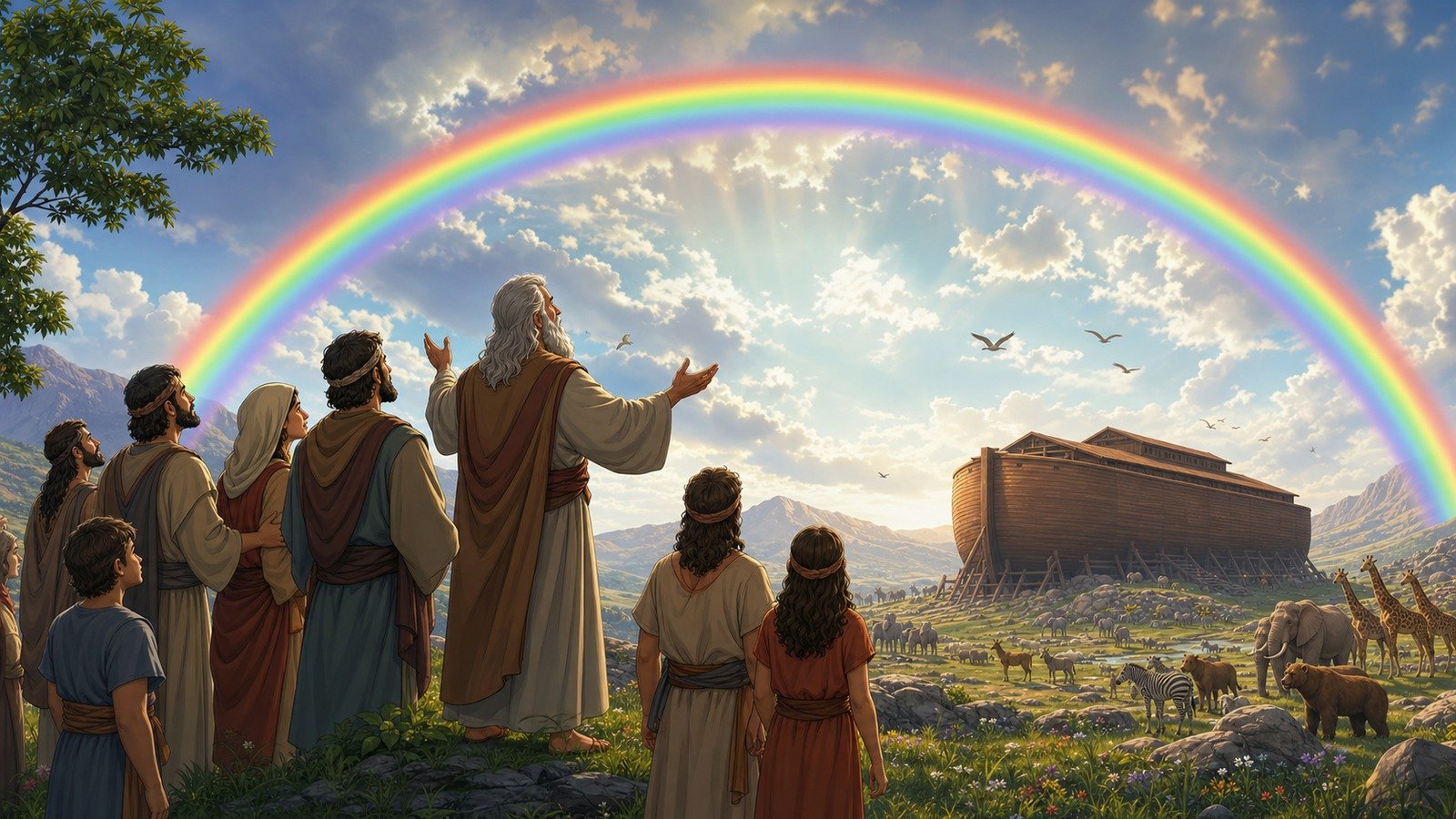
The sign given is a bow set in the clouds. The word used (qeshet) is the ordinary term for the weapon an archer carries, and it means that everywhere else in the Hebrew scriptures. There is no separate word for a rainbow, so the vocabulary does not by itself prove that a weapon is intended, but the choice has been noticed for a very long time, and a war bow hung up in the sky with its string towards the earth is a reasonable inference rather than an invention.
One question comes up constantly and can be answered from the grammar. Nothing requires that rainbows had never appeared before. What is being described is a sign, and a sign is something assigned a meaning rather than something newly manufactured.
Isaiah shows how the promise was used centuries later. Speaking to a defeated people in exile who had every reason to think God had finished with them, he compares the commitment made to them with the oath sworn after the Flood, and argues that mountains may be shaken and hills removed but this will not be. That argument only works because the promise to Noah was understood as unconditional and unbroken, which is exactly what these eight verses are at pains to establish.