

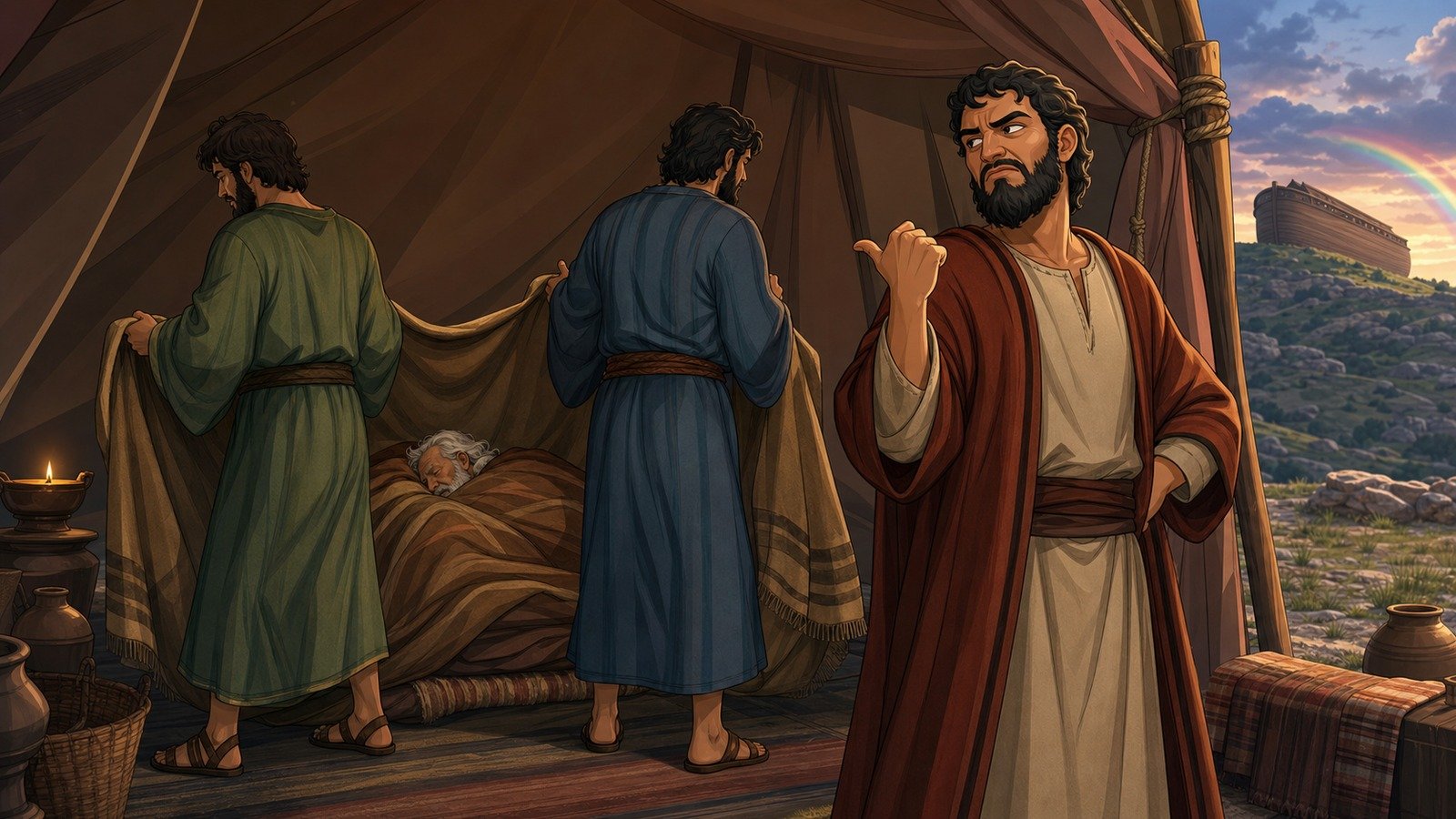
Noah becomes drunk and exposes himself in his tent; his son Ham's disrespect leads Noah to pronounce a curse on Ham's son Canaan, while blessing Shem and Japheth, an episode later readers have connected, at times controversially, to later Israelite-Canaanite conflict.
Further context
2 min readThe first vineyard in the Bible is planted by the man who has just walked off a boat onto an emptied world, and he is described as a man of the soil, using the noun (adamah) that stood behind Adam's name and behind the ground cursed after the garden. He drinks the wine, becomes drunk and lies uncovered inside his tent.
Ham, named three times over as the father of Canaan, sees his father naked and tells his two brothers outside. Shem and Japheth take a garment, lay it across their shoulders, walk in backwards and cover him without looking. When Noah wakes and learns what has happened he pronounces a curse, and the curse falls on Canaan.
That is the problem. Ham committed the act and Canaan, who is not present and has done nothing, receives the sentence. Three explanations are offered and each has a specific basis.
The first treats it as accounting for a situation the earliest readers already knew, since Canaan's descendants occupied the land Israel would later enter, and the story is explaining a relationship rather than establishing one. The second turns on idiom: the expression "to see the nakedness of" is used in the Israelite law codes for sexual offences rather than for looking, and related expressions there describe acts committed against a father through his wife, which on that reading would make Canaan the product of the offence. The third treats the repeated phrase about Ham being the father of Canaan as the mark of an editorial hand joining two originally separate traditions. None of the three can be demonstrated, and the disproportion is left standing.
What can be stated without any ambiguity is what does not happen here. Ham is not cursed. Skin colour is never mentioned, and his name has no established connection with any Hebrew word for black or dark, despite frequent claims otherwise. The curse falls on Canaan, whose descendants are listed a few paragraphs later as the peoples of the Levantine coast and the hills behind it, from Sidon down towards Gaza.
From roughly the fifteenth century onwards, and with increasing force through the Atlantic slave trade, this episode was used to argue that African peoples descended from Ham and lay under a divine curse of servitude. That argument required three moves none of which is available: transferring the curse from Canaan to Ham, relocating Ham's line from the Levant to sub-Saharan Africa, and converting a statement about one people's subjection to another into a permanent racial ordinance. Christian abolitionists attacked it on exactly those grounds, and the case against it does not depend on modern sensibilities. It depends on reading the sentences in order.
Noah lives another three hundred and fifty years and dies at nine hundred and fifty, the last of the immense lifespans. Nothing further is recorded of him. The man who built the boat, kept the world's animals alive for a year, and received the first unconditional promise God ever made, leaves the story drunk in a tent with his sons quarrelling outside it, and the story does not tidy that up.