

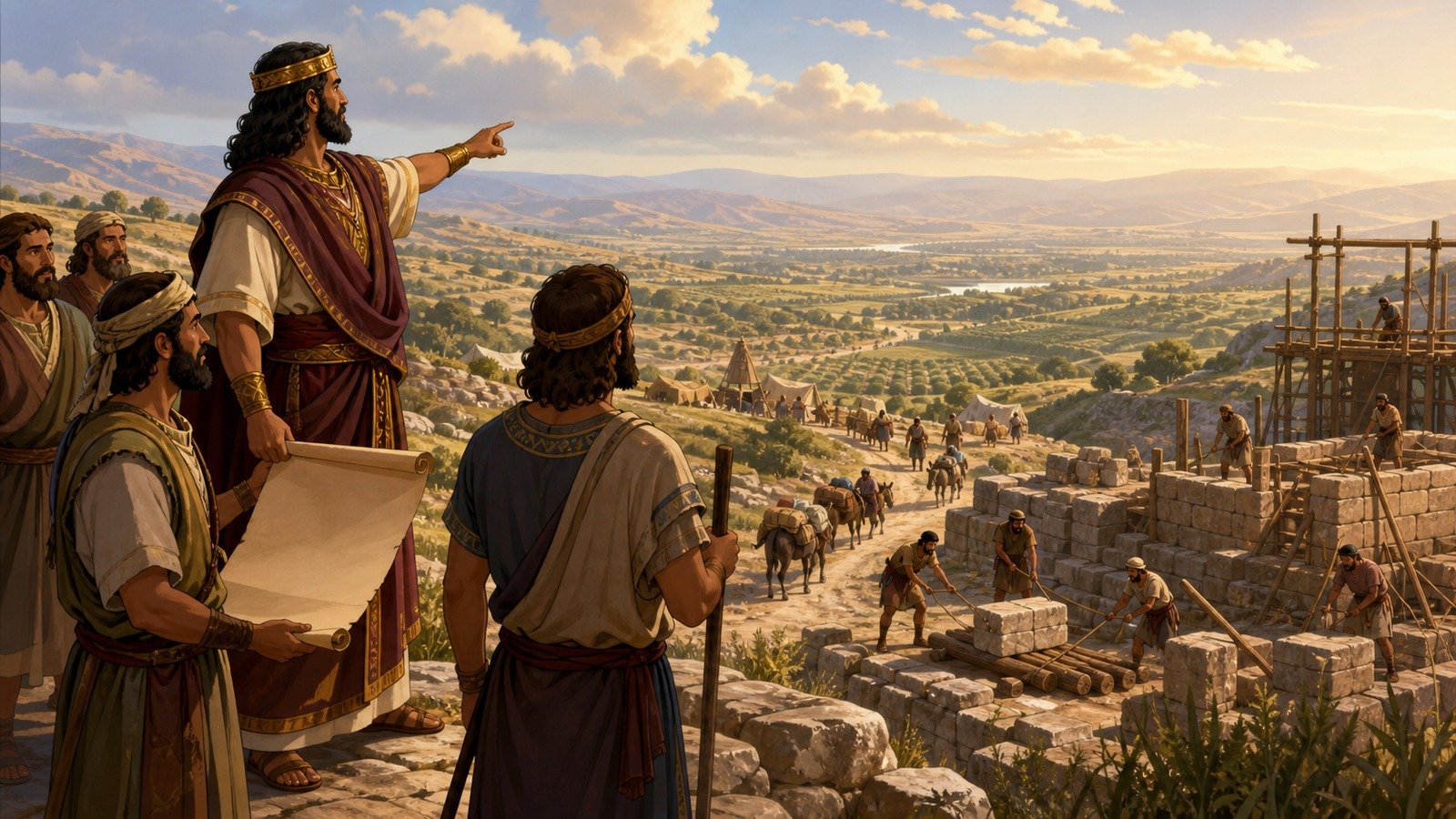
Omri outlasts a rival claimant, buys the hill of Samaria and builds it as his new capital, founding a dynasty significant enough that Assyrian records continued calling Israel "the House of Omri" long after his line ended.
Further context
3 min readTwelve years, six of them in Tirzah, and then he buys a hill and builds a city on it. He pays two talents of silver to a man named Shemer, and names the place after him.
Buying the site outright is the same manoeuvre David used with Jerusalem, and for the same reason. A capital purchased with the king's own money belongs to the crown rather than to a tribe, and nobody in the north can claim a prior interest in it. The hill is also well chosen: it stands isolated with steep sides, commands the main road through the central highlands and looks west towards the coastal plain and the Mediterranean, which matters for a kingdom whose wealth came from trade with Phoenicia.
Excavation on the site has found a royal quarter with masonry of a quality unmatched anywhere else in Iron Age Israel, along with a large collection of carved ivory fragments from furniture inlays, which is what lies behind a later prophet's attack on those who lie on beds inlaid with ivory. Sixty-three inscribed potsherds recording deliveries of oil and wine to the palace were also found, giving the names of officials and districts.
What Omri gets in the Bible is eight verses and a bad verdict: he did evil in the eyes of the LORD and sinned more than all those before him. What he gets outside it is more attention than any other king of Israel.
The Mesha Stele, a Moabite victory inscription of the ninth century BC discovered in 1868, names him directly: Omri king of Israel humbled Moab many years, and describes his son continuing the occupation. That is an enemy's account of an Israelite king, written within a generation, confirming a period of Israelite control over Moab that the biblical narrative mentions only in passing.
More striking still, Assyrian records refer to the northern kingdom as the house of Omri for the next century and a half, long after his dynasty had been destroyed. Jehu, who wiped out Omri's line, is called son of Omri in an Assyrian inscription, which is a scribe using a dynastic name for a territory in the way European chanceries used the name of a ruling house.
The gap between the biblical eight verses and the archaeological prominence is instructive rather than embarrassing. These histories are not written to record political achievement. They are assessing kings by one criterion, and by that criterion the founder of a dynasty, a capital and an international reputation gets less space than a prophet feeding ravens by a stream.
His son marries a Phoenician princess, which is the alliance that produces everything in the next generation.
Buying the hill of Samaria for two talents of silver from a man named Shemer, and naming the city after him, is the only recorded purchase of a capital site since David took Jerusalem, and it gave Omri a city that belonged to the crown rather than to any tribe.
The site is a steep isolated hill with good visibility and no natural water supply, chosen for defence. Excavations have uncovered a royal quarter with casemate walls and masonry of unusually high quality, and a collection of carved ivory fragments that fits the reference elsewhere to a house of ivory.
Omri is dismissed in eight verses and he was the most consequential northern king by a distance. Assyrian records refer to Israel as the house of Omri for a century and a half after his death, including in documents written when his dynasty had been extinct for generations.