

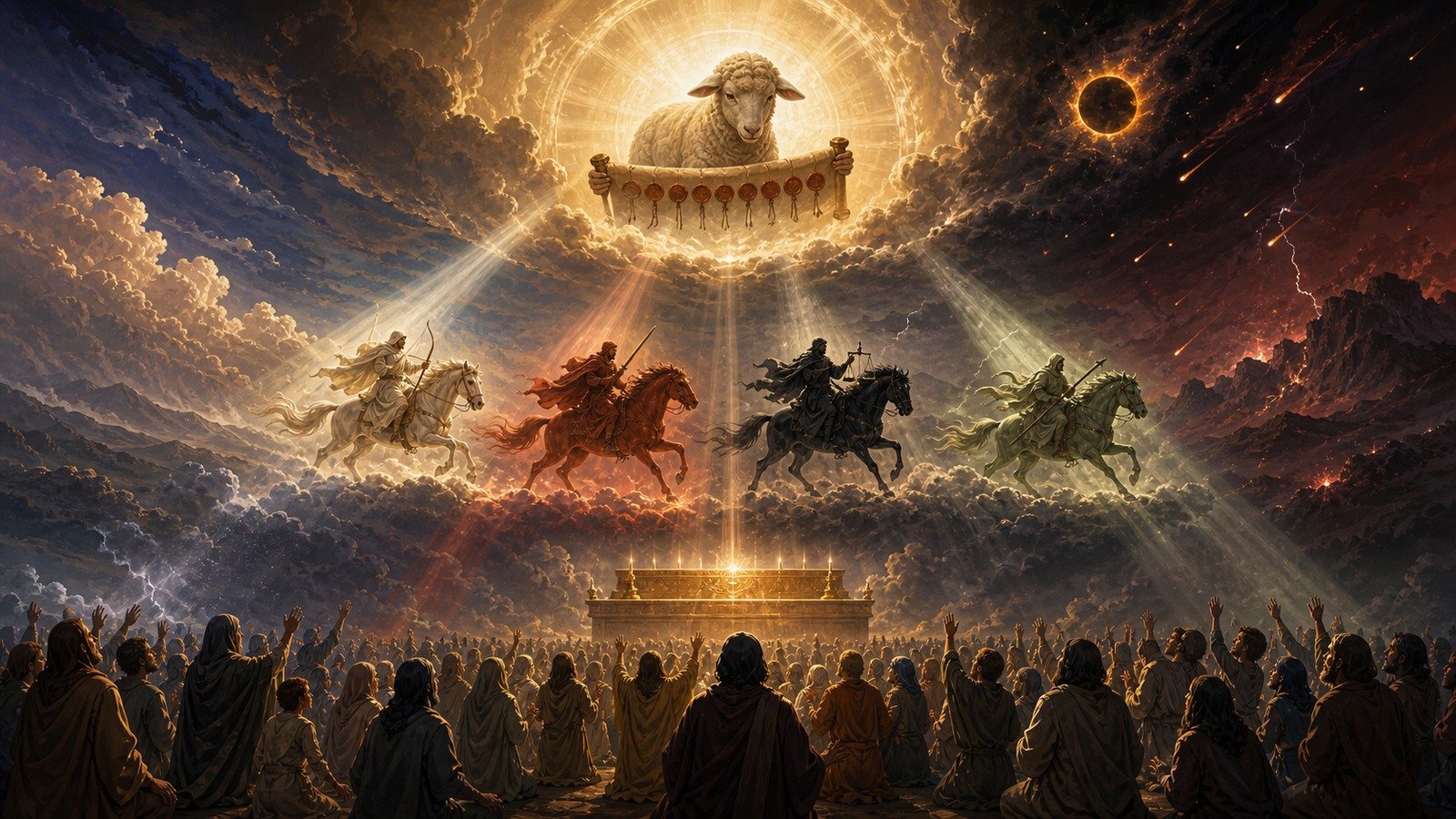
As the Lamb opens each seal, four riders on differently coloured horses appear, traditionally associated with conquest, war, famine and death, followed by the cry of martyrs under the altar and a great cosmic upheaval at the sixth seal.
Further context
2 min readAs the Lamb opens each of the first four seals, one of the living creatures says come, and a horse and rider appear.
The first is white, with a rider holding a bow and given a crown, riding out as a conqueror bent on conquest. Who he represents is the most argued point in the sequence. Some take him as Christ, because of a later rider on a white horse who is clearly Christ; others as conquest generally, or as false messianic claims, since the other three riders are all disasters. The bow is a detail with a possible edge: mounted archers were the distinctive weapon of the Parthians, Rome's undefeated eastern enemy, and a Parthian invasion was the standing nightmare of the province of Asia.
The second is fiery red, and its rider is given power to take peace from the earth and make people kill each other, and a large sword.
The third is black, and its rider holds a pair of scales, with a voice announcing prices: a quart of wheat for a day's wages, and three quarts of barley for a day's wages, and do not damage the oil and the wine. Those figures describe famine pricing precisely. A labourer's daily wage buying enough grain for one man, with nothing left for a family, is roughly eight times the normal price.
The fourth is pale, and its rider is named Death, with Hades following close behind, given power over a quarter of the earth to kill by sword, famine, plague and wild beasts.
The four together are conquest, war, famine and death, and they follow each other in the order those things actually arrive.
The fifth seal is different. Under the altar are the souls of those who had been slain because of the word of God and the testimony they had maintained, and they call out: how long, Sovereign Lord, holy and true, until you judge the inhabitants of the earth and avenge our blood? Each is given a white robe and told to wait a little longer.
That question, how long, is the oldest one in the Bible and the psalms are full of it. The answer given is not an explanation.
The sixth seal brings a great earthquake, the sun turning black like sackcloth, the moon like blood, stars falling, the sky receding like a scroll, and everyone from kings to slaves hiding in caves.
The four riders have been depicted in art more than any other part of the book, most famously by Dürer in a woodcut of 1498, which fixed the image of four horses charging abreast.
The instruction not to damage the oil and the wine under the third seal has been read as a limit on the famine and as a description of a real shortage, since grain fails before olives and vines, whose roots go deeper.
The riders are released rather than sent, and each is given power or authority by someone else, which is the grammar the whole book uses about evil: it operates on licence and within limits.