

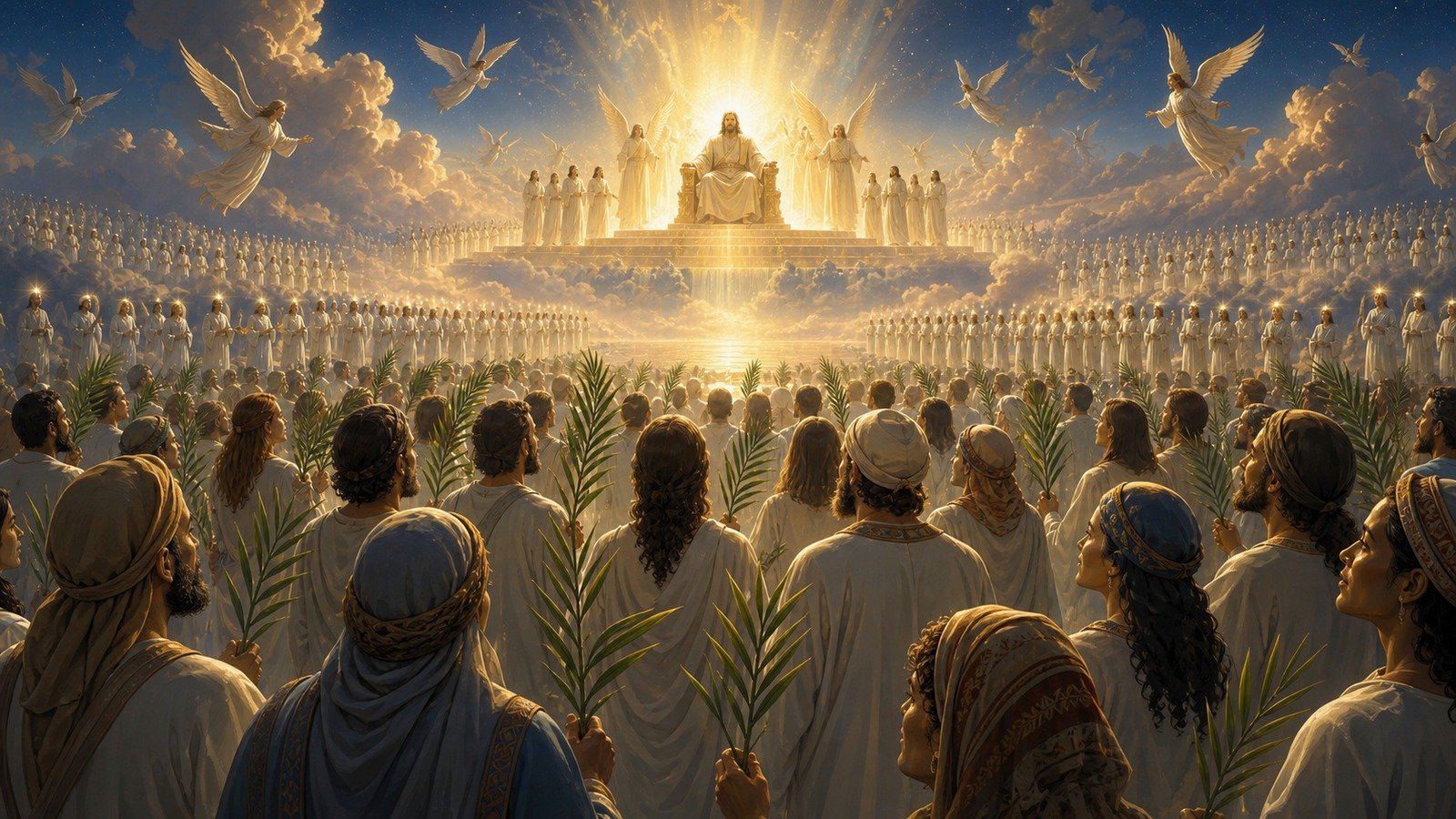
Before further judgement falls, 144,000 are sealed from the twelve tribes of Israel, followed by a vision of "a great multitude that no one could count," from every nation, standing before the throne in white robes.
Further context
2 min readBetween the sixth seal and the seventh the sequence pauses, and two crowds are described.
Four angels are holding back the four winds of the earth so that no wind can blow, and another angel comes with the seal of the living God, calling out to them not to harm the land or the sea or the trees until the servants of God have been sealed on their foreheads.
Sealing marks ownership and protection, and the image comes from Ezekiel, where a man with a writing kit goes through Jerusalem putting a mark on the foreheads of those who grieve over what is being done in the city.
The number sealed is a hundred and forty-four thousand, from all the tribes of Israel, and the tribes are then listed with twelve thousand from each.
The list is odd in ways worth noticing. Judah comes first rather than Reuben, which is a royal rather than a birth order. Dan is missing altogether, and Manasseh is included alongside Joseph to keep the count at twelve. Why Dan is omitted has been asked since the second century, and the answers offered, mostly involving the tribe's association with idolatry, are guesses.
The number itself is twelve squared multiplied by a thousand, and in a book where numbers work symbolically almost everywhere it is generally read as completeness rather than as a headcount. Groups that read it as a literal limit have existed, and one of them, the Jehovah's Witnesses, built a substantial doctrine on it.
Then John looks again and sees something he cannot count: a great multitude that no one could count, from every nation, tribe, people and language, standing before the throne and before the Lamb, wearing white robes and holding palm branches.
The two crowds are placed side by side deliberately. One is numbered, ordered by tribe, and Jewish. The other is uncountable and drawn from everywhere. Whether they are two groups or the same group seen twice is one of the standing questions about the book.
One of the elders asks who they are, and answers his own question: these are they who have come out of the great tribulation; they have washed their robes and made them white in the blood of the Lamb.
Never again will they hunger; never again will they thirst. And God will wipe away every tear from their eyes.
The palm branches held by the multitude are the branches of the Feast of Tabernacles and of the crowd on the road into Jerusalem, and the promise that God will shelter them uses the verb from which the word tabernacle comes.
The two crowds are also described in two different ways: the sealed are heard about, and the multitude is seen. The same technique is used with the Lion and the Lamb.
The great multitude serves God day and night in his temple, and later in the book the new city has no temple in it at all, which is one of several places where the imagery corrects itself as it goes.