

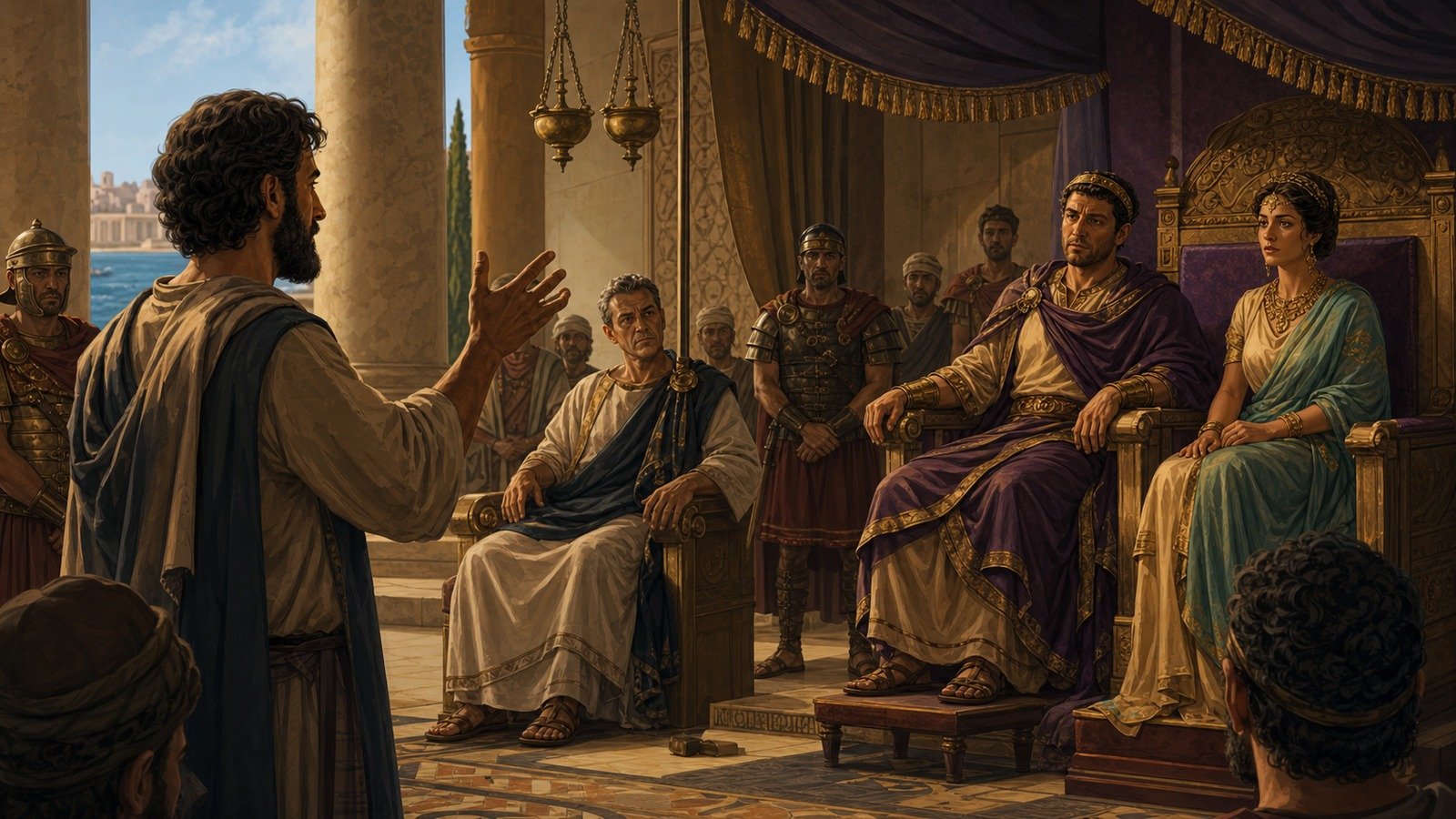
Festus invites the Jewish client king Agrippa II to hear Paul's case before sending him to Rome; Paul recounts his conversion and mission once more, and Agrippa remarks that Paul has almost persuaded him to become a Christian, while both agree Paul could have been freed had he not appealed to Caesar.
Further context
2 min readA few days later King Agrippa and Bernice arrive at Caesarea to pay their respects to Festus, and the new governor puts Paul's case to the king because he has a practical problem: he must send the prisoner to Rome and has nothing to write in the report.
Agrippa II was the last of the Herods, great-grandson of Herod the Great, and he had been given authority over the temple, including the right to appoint the high priest. That made him the closest thing available to an expert on Jewish religious questions who was also a Roman client.
Bernice was his sister. She had been married twice and lived with her brother, and Roman writers repeated the obvious rumour about them. She later became the mistress of Titus, the general who destroyed Jerusalem and afterwards became emperor, and their relationship was unpopular enough in Rome that he sent her away.
Festus explains his difficulty candidly and it is one of the more revealing statements by a Roman official anywhere. They did not charge him with any of the crimes I had expected. Instead, they had some points of dispute with him about their own religion and about a dead man named Jesus who Paul claimed was alive.
The next day Agrippa and Bernice come with great pomp and enter the audience room with the high-ranking military officers and the leading men of the city.
Paul's speech to them is the third and fullest telling of his own story, and it is pitched at a listener who knows the material. He begins with his upbringing as a Pharisee, moves to the hope of the promise God made to the ancestors, and asks: why should any of you consider it incredible that God raises the dead?
Then the Damascus road again, with one addition not in the earlier versions: the voice said, it is hard for you to kick against the goads, a proverb about an ox fighting the driver's stick that appears in Greek literature.
Festus interrupts, shouting: you are out of your mind, Paul! Your great learning is driving you insane.
I am not insane, most excellent Festus. What I am saying is true and reasonable. The king is familiar with these things. None of this has escaped his notice, because it was not done in a corner.
Then, to Agrippa: do you believe the prophets? I know you do.
Do you think that in such a short time you can persuade me to be a Christian?
Afterwards they agree among themselves: this man could have been set free if he had not appealed to Caesar.
The Herod family occupies a peculiar place in the New Testament. Herod the Great is on the throne at the birth; Antipas executes John the Baptist and mocks Jesus; Agrippa I kills James and imprisons Peter; and Agrippa II hears Paul. Four generations, and each appears at a decisive moment.
With Agrippa II the line ends. He supported Rome during the revolt, retired to Rome afterwards, and died around the turn of the century without an heir.