

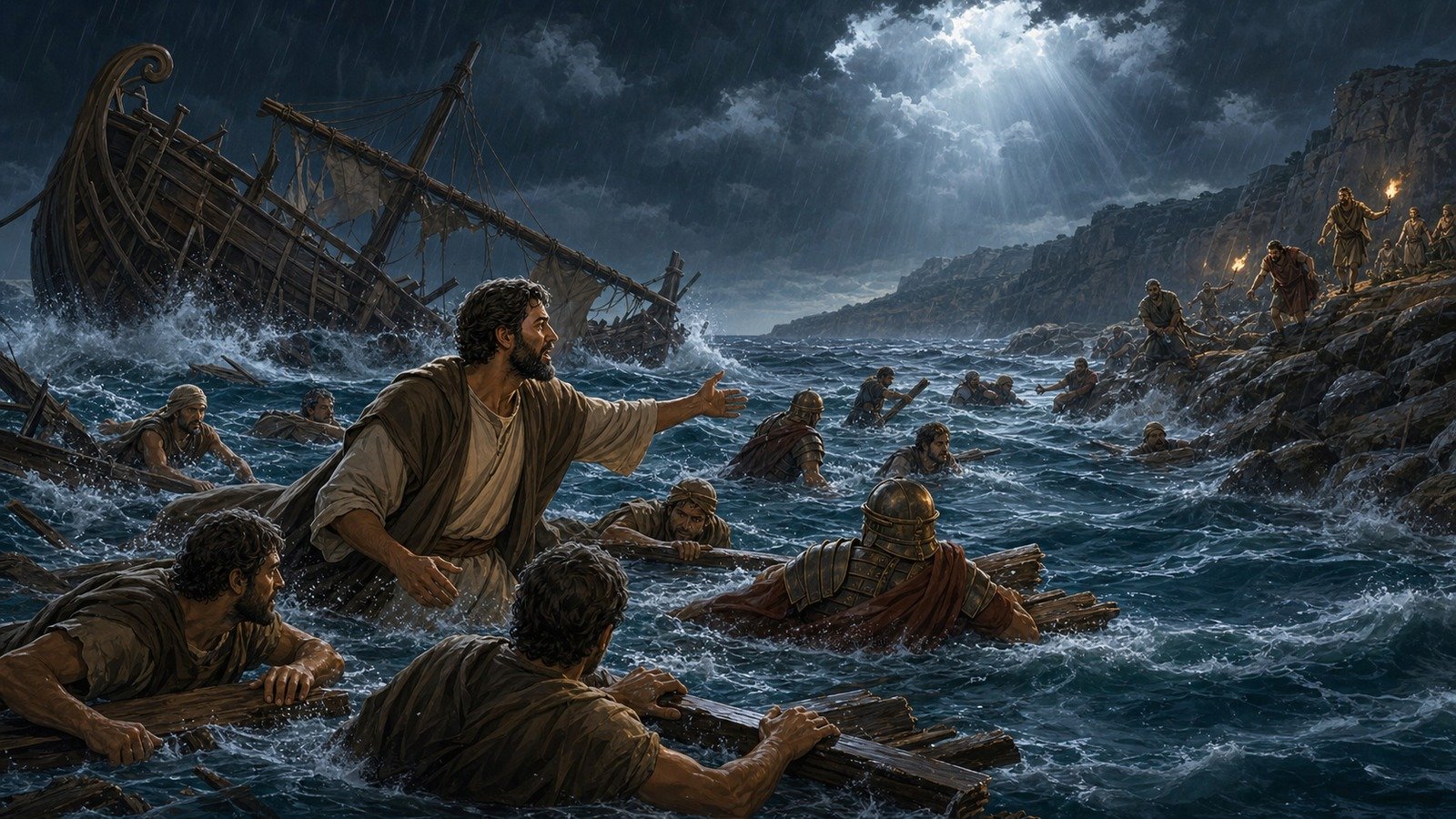
Sailing for Rome as a prisoner under guard, Paul's ship is caught in a violent storm and eventually wrecked off the island of Malta; Luke, an eyewitness for this section, records that all 276 people aboard reach land safely, as Paul had predicted.
Further context
3 min readThe voyage to Rome occupies one of the longest continuous stretches of first-person narrative in the New Testament, and it is regarded by classical scholars as one of the best surviving descriptions of seafaring in antiquity.
Paul is handed to a centurion named Julius of the Imperial Regiment, along with other prisoners. They sail up the coast, transfer at Myra to an Alexandrian grain ship bound for Italy, and make slow progress against the wind.
Grain ships were the largest vessels in the Mediterranean, carrying wheat from Egypt to feed Rome, and this one had two hundred and seventy-six people aboard.
At Fair Havens on Crete, with the sailing season closing, Paul warns them: I can see that our voyage is going to be disastrous. The centurion follows the advice of the pilot and the owner instead, and the majority decide to try for Phoenix, a better harbour for wintering.
A gentle south wind persuades them, and then a wind of hurricane force sweeps down from the island. The name given for it is the Euraquilo, a north-easter, and the ship is driven for fourteen days.
The seamanship is described in technical detail: they pass the lee of a small island, hoist the lifeboat aboard, pass ropes under the ship to hold it together, lower the sea anchor, throw the cargo overboard, and then the ship's tackle. Every one of those measures is what a first-century crew would have done in that order.
When neither sun nor stars appear for many days, they give up hope.
Paul tells them an angel has stood by him and that no one will be lost, though the ship will run aground on some island. On the fourteenth night the sailors sense land, take soundings that go from forty metres to thirty, and drop four anchors from the stern, praying for daylight.
The sailors try to escape in the lifeboat under pretence of laying anchors, and Paul tells the centurion that unless they stay aboard nobody will survive; the soldiers cut the ropes and let it fall.
At dawn they run the ship aground, the bow sticks fast and the stern breaks up, and every one of the two hundred and seventy-six reaches shore, some swimming and some on planks.
The technical vocabulary of the voyage was examined in detail in the nineteenth century by James Smith, a Scottish yachtsman who sailed the route himself, and his conclusion, that the writer was a passenger with no seafaring expertise recording accurately what he saw, is still the standard assessment.
The drift of a ship under bare poles from Crete in a north-easterly gale is calculable, and it arrives at Malta in about fourteen days.
The ship's company is given as two hundred and seventy-six, and some manuscripts read about seventy-six, which is the sort of variant that arises when numbers are written as letters.
Grain ships of the period could carry a thousand tonnes and several hundred passengers, and one described by a second-century writer was about fifty-five metres long. They sailed the Egypt to Rome route because Rome could not feed itself without it.
Julius the centurion treats Paul with consistent courtesy throughout, allowing him to visit friends at Sidon and later preventing the soldiers from killing the prisoners to stop them escaping, which was standard practice and would have killed Paul with the rest.