

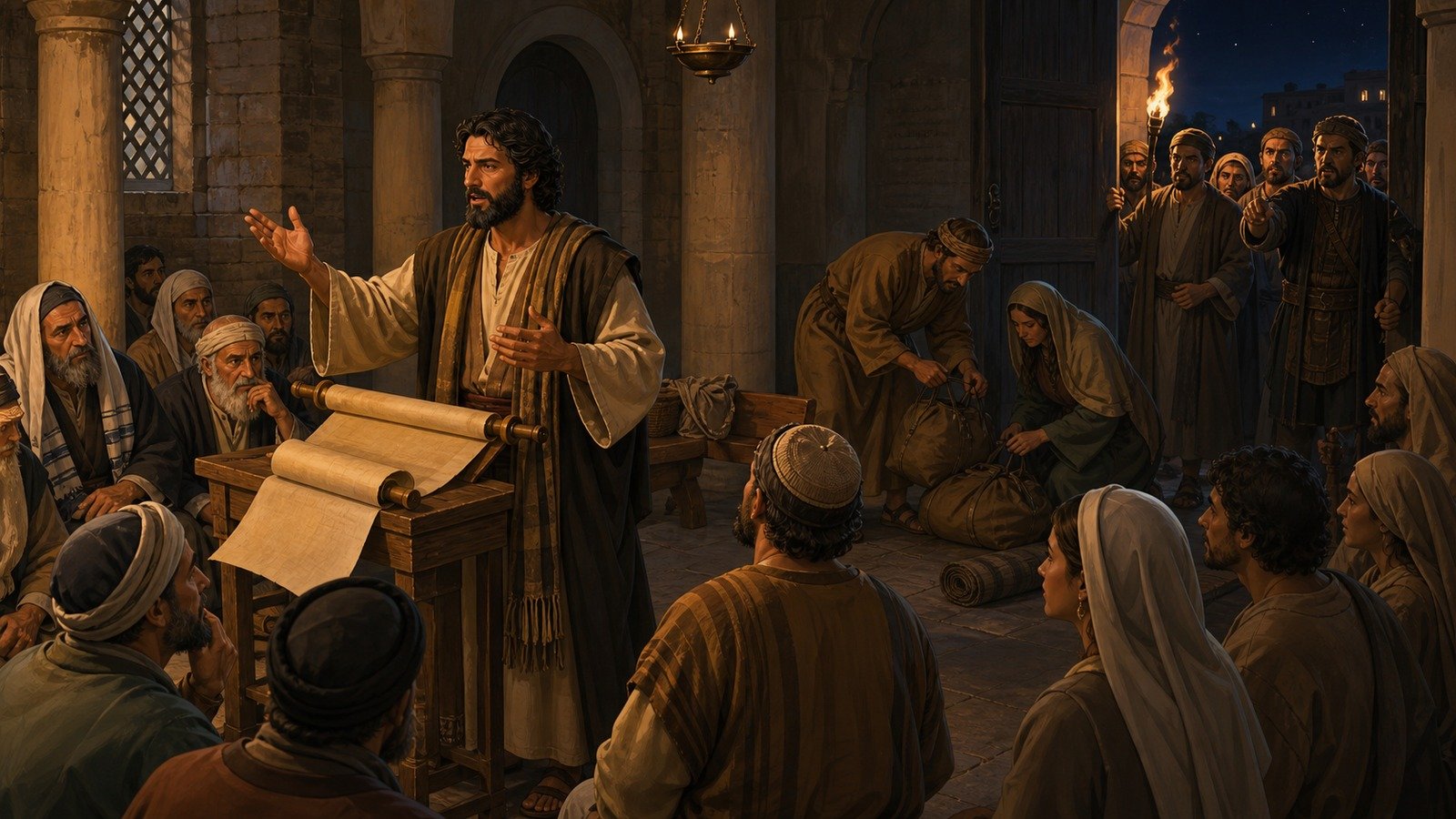
Paul reasons from the Scriptures in the Thessalonian synagogue for three Sabbaths, winning converts but also provoking a hostile crowd that drags a local believer before the city officials, forcing Paul and Silas to leave by night.
Further context
2 min readPaul and Silas travel through Amphipolis and Apollonia along the Via Egnatia, the Roman road running from the Adriatic to Byzantium, and come to Thessalonica, where there was a Jewish synagogue.
Thessalonica was the capital of the province of Macedonia and a free city, which meant it governed itself under its own magistrates. It had a good harbour, sat on the main road, and was substantially larger than Philippi. It survives as Thessaloniki.
As his custom was, Paul went into the synagogue, and on three Sabbath days he reasoned with them from the Scriptures, explaining and proving that the Messiah had to suffer and rise from the dead.
Two things are contained in that. The method is argument from texts they already accepted, and the difficulty being addressed is not whether Jesus rose but whether the Messiah was ever supposed to suffer at all, which was the sticking point for every Jewish audience.
Some of the Jews were persuaded, as were a large number of God-fearing Greeks and quite a few prominent women.
Then the opposition organises itself, and the description is unflattering: they rounded up some bad characters from the marketplace, formed a mob and started a riot. They rush to the house of a man named Jason, looking for Paul and Silas in order to bring them out to the crowd. Not finding them, they drag Jason and some other believers before the city officials.
The charge is the most politically dangerous one made anywhere on these journeys. These men who have caused trouble all over the world have now come here, and Jason has welcomed them into his house. They are all defying Caesar's decrees, saying that there is another king, one called Jesus.
Claiming another king was treason, and the officials are called politarchs, a title once thought to be a mistake until inscriptions from Thessalonica confirmed it.
The officials make Jason and the others post bond and let them go, which is a legal arrangement making Jason financially liable for keeping the peace, and probably explains why Paul says twice in a letter to this church that he wanted to come back and was prevented.
That night the believers send Paul and Silas away to Berea.
The two letters to this church are generally dated within a few months of the visit, which makes them very probably the earliest Christian documents in existence, written about twenty years after the crucifixion.
Their contents fit a congregation founded in three weeks and left in a hurry: Paul defends his conduct while he was there, worries about how they are holding up, and answers a question about believers who had died before the Lord's return, which suggests they had expected it sooner.
Politarch appears in more than thirty inscriptions from Macedonia, several of them from Thessalonica itself, and one of the stones was built into a city gate that survived into the nineteenth century. Before those were catalogued, the word was cited as evidence that the writer had invented his officials.