

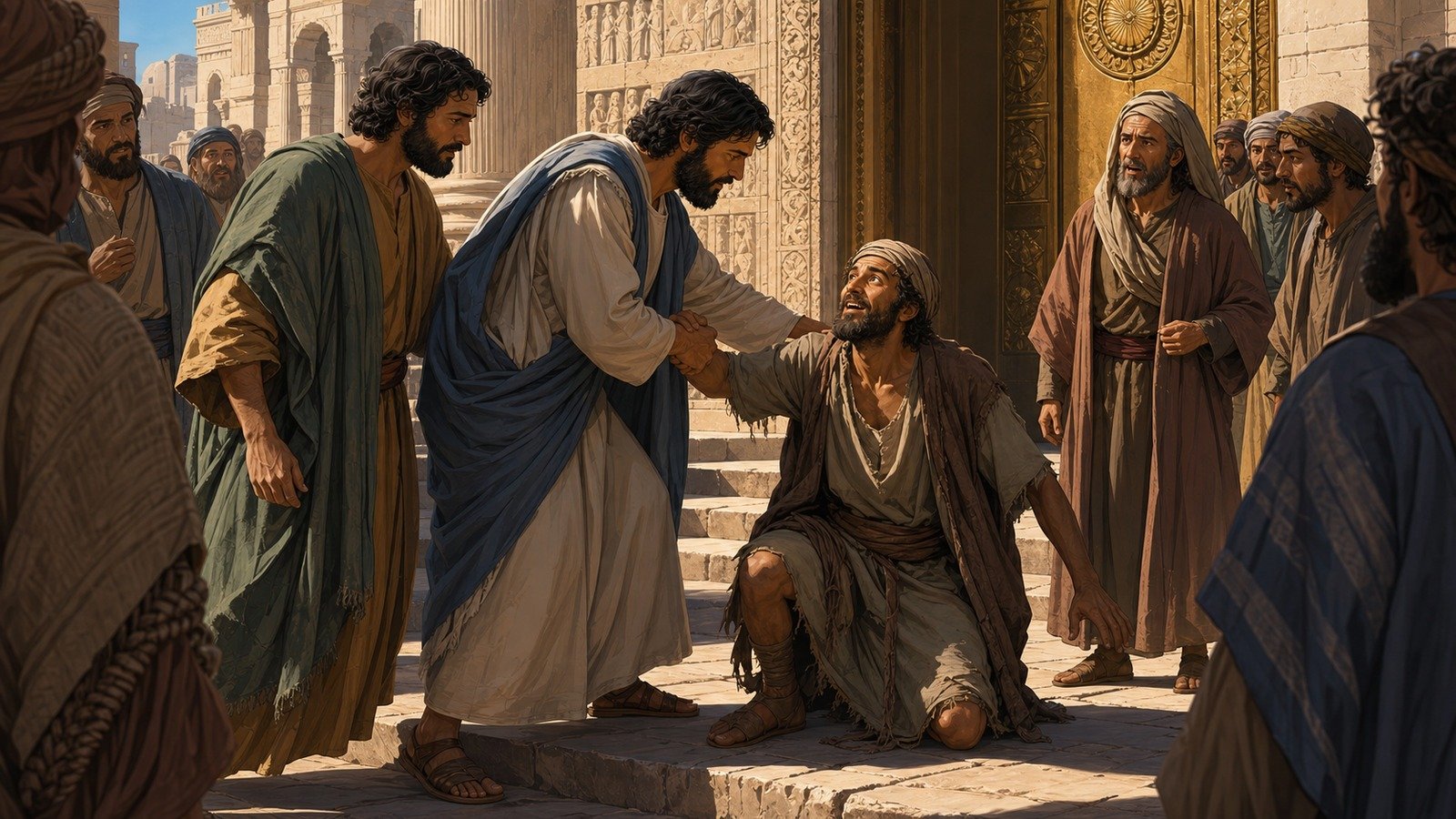
At the Temple's Beautiful Gate, Peter tells a man lame from birth, "silver or gold I do not have, but what I do have I give you," and heals him in Jesus' name; the man's leaping and praising draws an astonished crowd.
Further context
2 min readPeter and John are going up to the temple at three in the afternoon, the hour of prayer, and a man lame from birth is being carried to the gate called Beautiful, where he is put every day to beg from those going in.
The hour is the time of the afternoon sacrifice, when the courts were at their busiest, which is why a beggar was placed there then.
Which gate is meant is not certain. The most likely candidate is the Nicanor Gate, made of Corinthian bronze, which Josephus describes as far exceeding the others in value, and which stood between the court of the women and the inner court.
His position is also a legal one. A man with a disability of that kind was barred from the priesthood under the law, and later Jewish material shows debate about how far the disabled could participate in worship. He is at the gate, and he has never been through it.
He asks the two of them for money. Peter looks straight at him and says, look at us, and the man gives them his attention, expecting to get something.
Then the line everyone remembers: silver or gold I do not have, but what I do have I give you. In the name of Jesus Christ of Nazareth, walk.
Peter takes him by the right hand and helps him up, and the description of what follows is unusually physical: instantly the man's feet and ankles became strong. He jumped to his feet and began to walk. Then he goes with them into the temple courts, walking and jumping and praising God, which are the actions of someone who has never had to learn how much noise is appropriate indoors.
Luke, whose vocabulary elsewhere suggests some medical training, uses the anatomical terms for feet and ankles here.
The crowd recognises him. All the people saw him walking and praising God, and when they realised he was the same man who used to sit begging at the temple gate called Beautiful, they were filled with wonder and amazement.
That recognition is what makes the healing impossible to argue about afterwards, and it is exactly what the council discovers when it tries.
The man himself holds on to Peter and John, and the whole crowd comes running to them in the place called Solomon's Colonnade, which gives Peter his second audience.
Peter's words have become one of the most quoted sentences in the New Testament, and they are usually cited in the wrong register, as though they were about generosity. What they actually say is that the two men had no money at all, which was literally true of a group living out of a common purse in a city where they had no trade.
The healing is also the first recorded miracle performed by anyone other than Jesus, and the formula used, in the name of Jesus Christ of Nazareth, is the one that recurs through the rest of the record.
Lame from birth is stated twice, and the man's age is given later as over forty, which together close off the possibility of a temporary condition that had passed.