

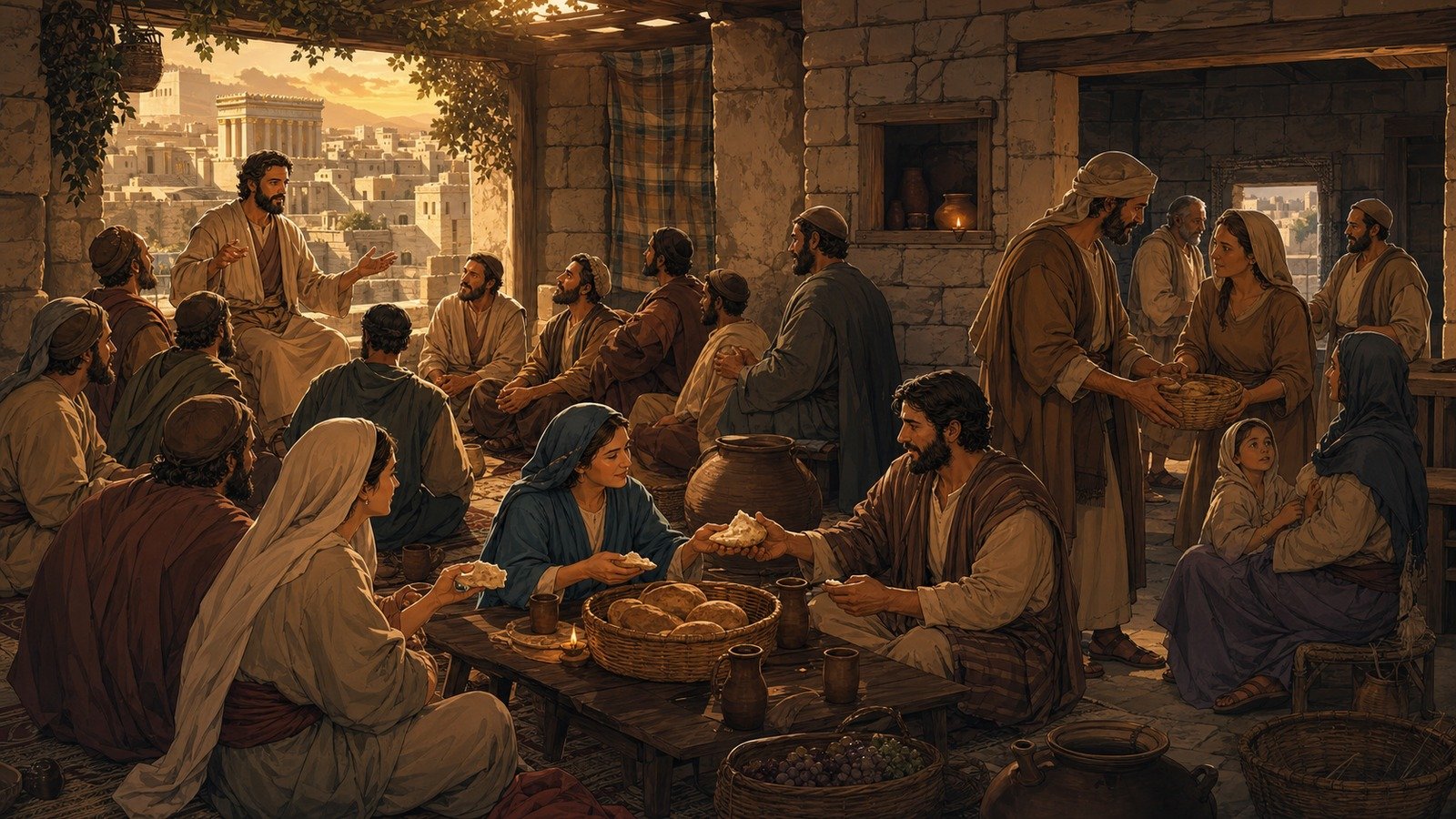
Luke summarises the young Jerusalem church's pattern of life: devotion to the apostles' teaching, communal meals, shared property to meet one another's needs, and daily meeting both at the Temple and in homes, with numbers growing steadily.
Further context
2 min readFour practices are listed as what the new community devoted itself to, and the list is short enough to memorise: the apostles' teaching, the fellowship, the breaking of bread, and prayer.
Each of them means something concrete.
The apostles' teaching was instruction from men who had been there, at a point when nothing had been written down. The fellowship translates koinonia, a word meaning partnership or having something in common, used in ordinary Greek of business partners sharing a venture. The breaking of bread covers shared meals, with the supper Jesus had instituted somewhere inside them. Prayer, in a group of Jews, meant continuing to keep the hours of prayer at the temple, which is exactly what they are described as doing.
Then the part that has caused the most argument in the two thousand years since. All the believers were together and had everything in common. They sold property and possessions to give to anyone who had need.
What that arrangement actually was matters, because it has been claimed as a precedent for a good deal. It was voluntary, as Peter says explicitly to Ananias a chapter later: the property was yours before you sold it, and the money was at your disposal. It was local, confined to Jerusalem, and no other congregation in the letters is described doing it. And it appears to have been driven by immediate need, since a large number of pilgrims had stayed on in a city where they had no work and no household.
It also did not last. Within about fifteen years the Jerusalem church was poor enough that Paul was organising collections for it from congregations in Greece and Asia Minor.
The daily pattern described is worth noticing for what it combines. Every day they continued to meet together in the temple courts. They broke bread in their homes and ate together with glad and sincere hearts.
Nobody has left the synagogue or the temple. This is a movement inside Judaism, keeping its festivals and its hours of prayer, whose members happen to believe the Messiah has come.
And the Lord added to their number daily those who were being saved.
The number involved is worth keeping in view. Three thousand at Pentecost, then five thousand men mentioned a little later, in a city whose ordinary population was perhaps forty thousand. Even allowing for the usual caution about ancient figures, a movement of that size meeting daily in the temple courts was not a private matter, which is why the authorities move as quickly as they do.
Whether the shared possessions were a mistake has been debated since the Reformation, usually by people with a position on property to defend.
None of this happens in a church building. There were none for another two centuries, and the two locations named are the temple courts and private houses.
The four practices listed have been used as a template by more or less every renewal movement in Christian history, which says more about the appetite for a simple pattern than about the paragraph itself. What it describes is a community improvising, in a hurry, under conditions none of them had planned for, and it lasted a few years in one city.