
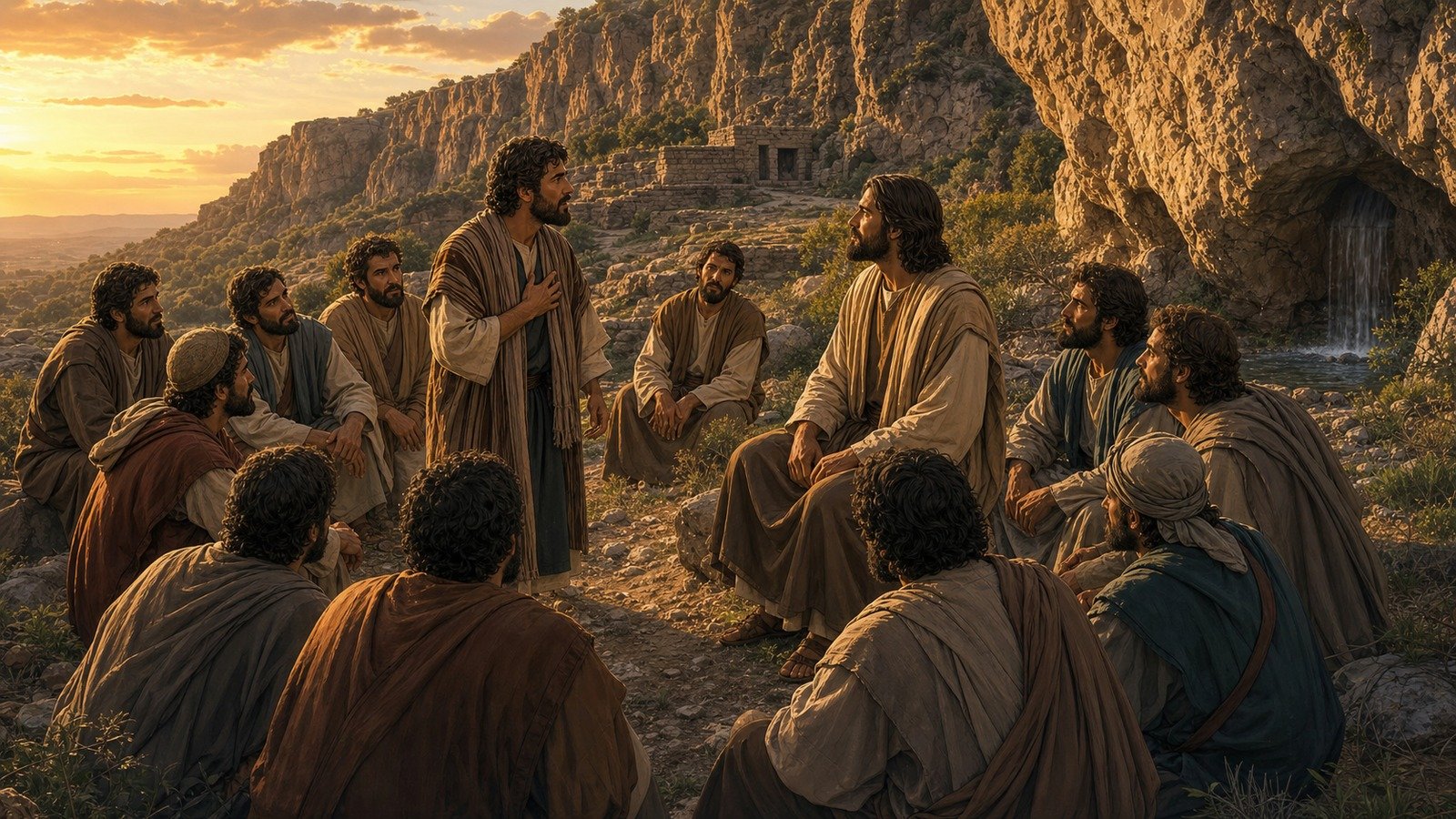
Asked who people say he is, and then who the disciples themselves say he is, Peter answers, "You are the Messiah, the Son of the living God." Jesus affirms this and states he will build his church on this confession, while instructing the disciples not yet to publicise it.
Further context
2 min readThe location matters more here than almost anywhere else.
Caesarea Philippi sat at the foot of Mount Hermon, about forty kilometres north of the lake, at one of the sources of the Jordan where a spring emerged from a cave in a cliff face. The place had been a shrine to the Greek god Pan for centuries and was known as Paneas, and the niches cut into the rock for statues are still visible. Philip the tetrarch rebuilt it and named it after the emperor, adding his own name to distinguish it from the coastal Caesarea. Herod the Great had built a temple to Augustus there, dedicated to a man worshipped as a god.
Standing in front of that cliff, he asks who people say the Son of Man is.
The answers reported are all respectful and all wrong: John the Baptist, Elijah, Jeremiah, one of the prophets. Every one of them puts him in the category of a forerunner.
Then the second question, and the pronoun is emphatic in Greek: but you, who do you say I am?
Peter answers for the group. You are the Messiah, the Son of the living God.
Messiah translates a Hebrew word meaning anointed one (mashiach), the Greek equivalent being Christ. Kings and priests were anointed with oil when they took office, and the term had come to mean the coming deliverer from David's line who would restore Israel. The living God, said in front of a cliff full of dead gods, has a certain force to it.
The response is a blessing, and it says the recognition did not originate with him. Blessed are you, Simon son of Jonah, for this was not revealed to you by flesh and blood, but by my Father in heaven.
Then the wordplay. You are Peter (Petros), and on this rock (petra) I will build my church, and the gates of Hades will not overcome it. The two Greek words differ only by gender, and in Aramaic, which is what was actually spoken, the same word kepha would have served for both, which is why Paul later calls him Cephas.
What the rock is has divided Christians more than almost any other sentence in the Bible. Peter himself, his confession, or the truth he stated: each reading has been held by serious people for a very long time, and the Reformation ran partly along this fault line.
He is given the keys of the kingdom of heaven, and the authority to bind and loose, which was rabbinic terminology for declaring things permitted or forbidden.
Then an order to tell no one that he was the Messiah.
The order to say nothing about it is the same instruction given after almost every recognition, and by this point it has a clear rationale. The title carried freight he did not intend: an anointed king meant, to most people who used the word, a military deliverer who would remove the Romans. Peter demonstrates within a few sentences that even the men closest to him were carrying that expectation, and a crowd carrying it would have produced exactly the rising the council later feared.
Twenty kilometres of walking separate this conversation from the lake, and everything after it moves south.