

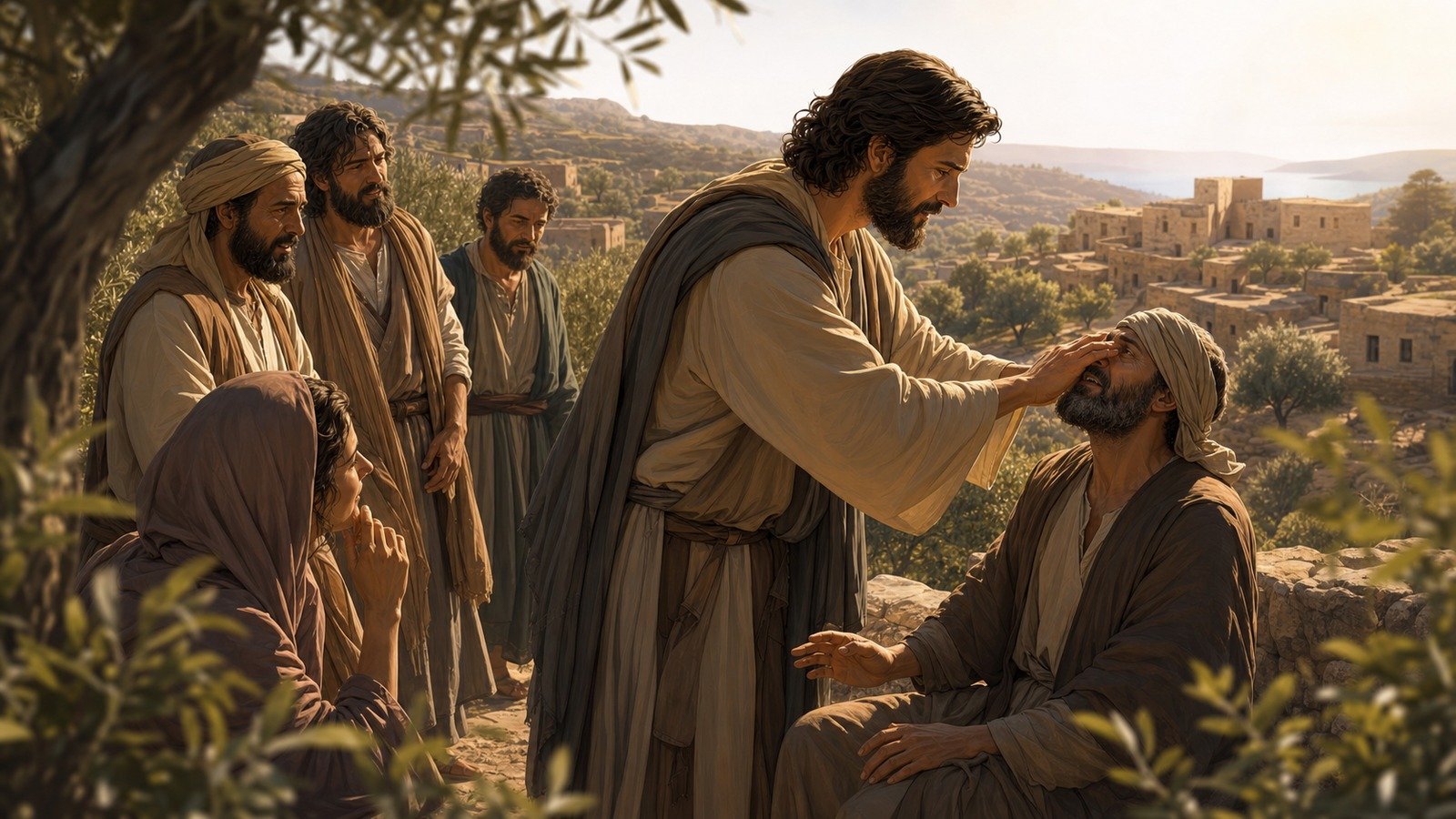
Jesus heals a blind man in two stages, an unusual, gradual healing that first restores partial, blurred sight before a second touch brings full clarity, recorded only in Mark.
Further context
2 min readJesus and his disciples come to Bethsaida, a fishing settlement at the north-east corner of the lake near where the Jordan enters it. Philip the tetrarch had rebuilt it as a city and renamed it Julias after a member of the imperial family, and it appears elsewhere among the towns denounced for having seen so much and changed so little.
Some people bring a blind man and beg him to touch him.
The healing that follows happens in two stages, and it is the only one anywhere in the Gospels that does.
First he takes the blind man by the hand and leads him outside the village, which repeats the pattern used with the deaf man in the Decapolis and has the same effect: no crowd, no spectators, a private encounter with a man who cannot see the people around him.
Then he spits on the man's eyes and puts his hands on him, and asks a question he asks nowhere else: do you see anything?
The answer is one of the most vivid sentences in the Gospels. I see people; they look like trees walking around.
That reply carries an implication often missed. A man describing shapes as trees has seen trees, so he has not been blind from birth; he has lost sight he once had, and retains the vocabulary to describe what he is now half-seeing.
Then a second touch on the eyes, and his eyes were opened, his sight was restored, and he saw everything clearly. The Greek uses three verbs in sequence, and the last of them describes seeing at a distance.
He is sent home with an instruction not to go into the village.
Why this one required two attempts has bothered readers for a long time, and the honest answer is that nobody knows. What can be observed is where the episode sits. Immediately before it, the disciples are asked whether they have eyes but fail to see. Immediately after it, Peter identifies him correctly as the Messiah and then, within a few sentences, gets the meaning of it so badly wrong that he is rebuked in the harshest terms used to anyone in the Gospels.
A man who sees, but not yet clearly, and then sees fully, is placed exactly between those two scenes. Whether the arrangement is deliberate cannot be proved, but the placement is hard to miss.
Bethsaida has itself been argued over. Two candidate sites sit near the north-eastern corner of the lake: et-Tell, a mound about two kilometres inland where a substantial Iron Age gate and Roman-period buildings have been excavated, and el-Araj, closer to the present shoreline, where a first-century settlement and later a Byzantine church have been uncovered. The shoreline has shifted considerably through silting, which is why a fishing town can now be found some distance from water.
Whichever is right, the town's fate is not in doubt. It had a population in the first century and none by the fourth, and the denunciation recorded of it stands with those of Chorazin and Capernaum, all three within a short walk of each other.