

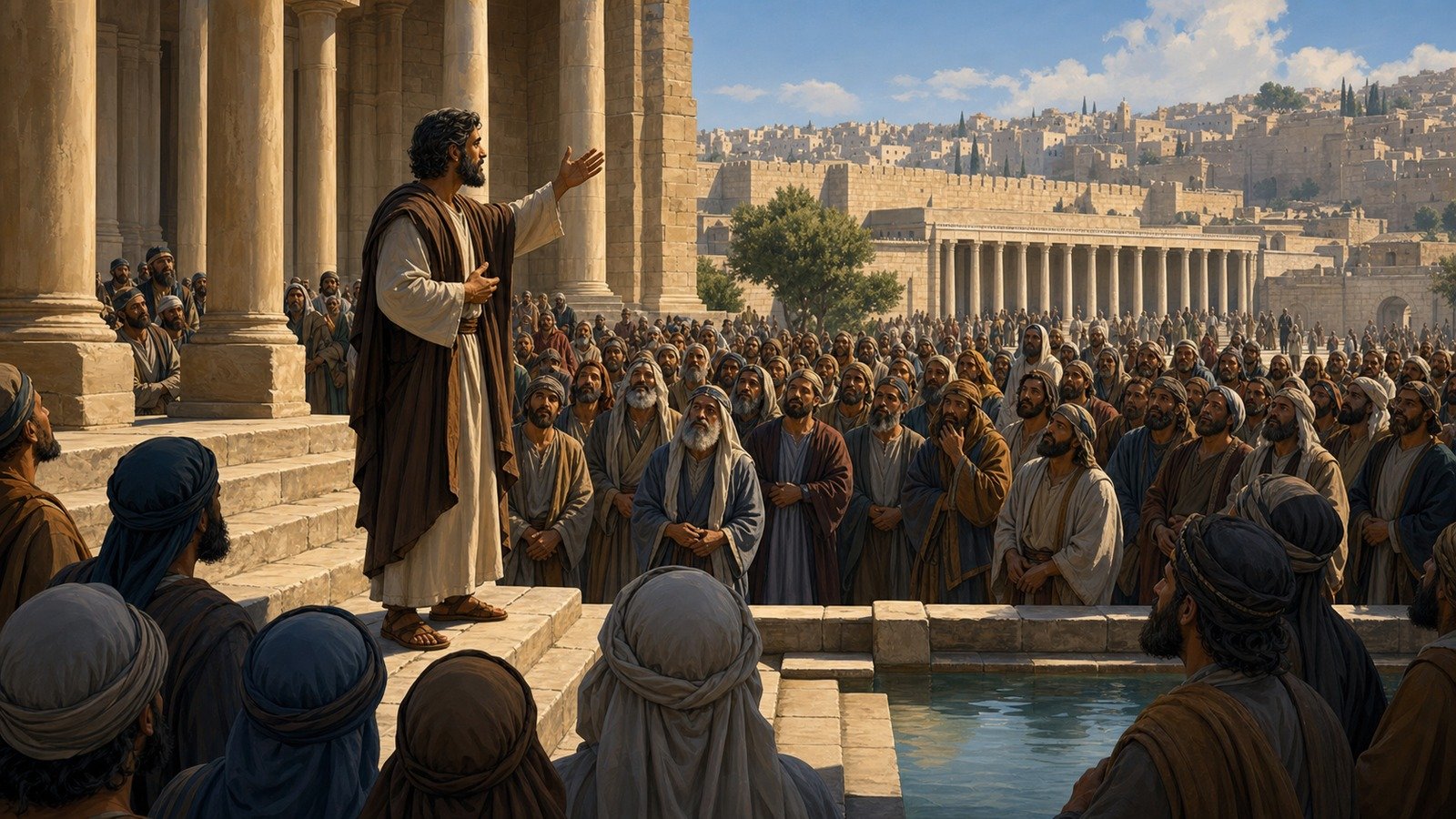
Peter addresses the Pentecost crowd, arguing from the prophet Joel and from the Psalms that Jesus is both Lord and Messiah; his hearers are "cut to the heart," and about three thousand are baptised that day, usually reckoned the church's founding moment.
Further context
2 min readPeter stands up in front of a festival crowd and gives the first Christian sermon on record, and the man doing it had denied knowing Jesus to a servant girl seven weeks earlier.
He begins by dealing with the accusation of drunkenness, and then quotes the prophet Joel: in the last days, God says, I will pour out my Spirit on all people. Your sons and daughters will prophesy, your young men will see visions, your old men will dream dreams. Even on my servants, both men and women, I will pour out my Spirit in those days.
The word all is carrying the argument. Prophecy in Israel's history had come to particular people at particular times; what is being claimed is a general distribution across sex, age and social rank.
Then the substance, and it is put in terms his audience could check. Jesus of Nazareth was a man accredited by God to you by miracles, wonders and signs, which God did among you through him, as you yourselves know. The last clause assumes the crowd's own knowledge of recent events in their own city.
This man was handed over to you by God's deliberate plan and foreknowledge, and you, with the help of wicked men, put him to death by nailing him to the cross. But God raised him from the dead, freeing him from the agony of death, because it was impossible for death to keep its hold on him.
Then two arguments from the Psalms. The first is a psalm of David in which the speaker says God will not let his holy one see decay, and the argument is that David plainly did see decay, since his tomb was in Jerusalem and everyone knew where it was. The second is the line about the Lord saying to David's lord, sit at my right hand.
Therefore let all Israel be assured of this: God has made this Jesus, whom you crucified, both Lord and Messiah.
The response is described physically: when the people heard this, they were cut to the heart, and said to Peter and the other apostles, brothers, what shall we do?
Repent and be baptised, every one of you, in the name of Jesus Christ for the forgiveness of your sins.
About three thousand were added to their number that day.
Where three thousand people were baptised in a city with limited water has a plausible answer in the archaeology: dozens of ritual immersion pools, used by pilgrims for purification before entering the temple, have been excavated along the southern approach to the temple mount.
David's tomb is invoked as a piece of common knowledge, and it was: Josephus records that it was opened and robbed twice, once by a Hasmonean ruler and once by Herod, which means its location was well known in the first century.
The sermon also sets the pattern for the ones that follow. Each of them establishes what the audience already knows, quotes Scripture they accept, states plainly what was done to Jesus, asserts the resurrection with witnesses named, and ends with a call to repent. The structure barely varies.