

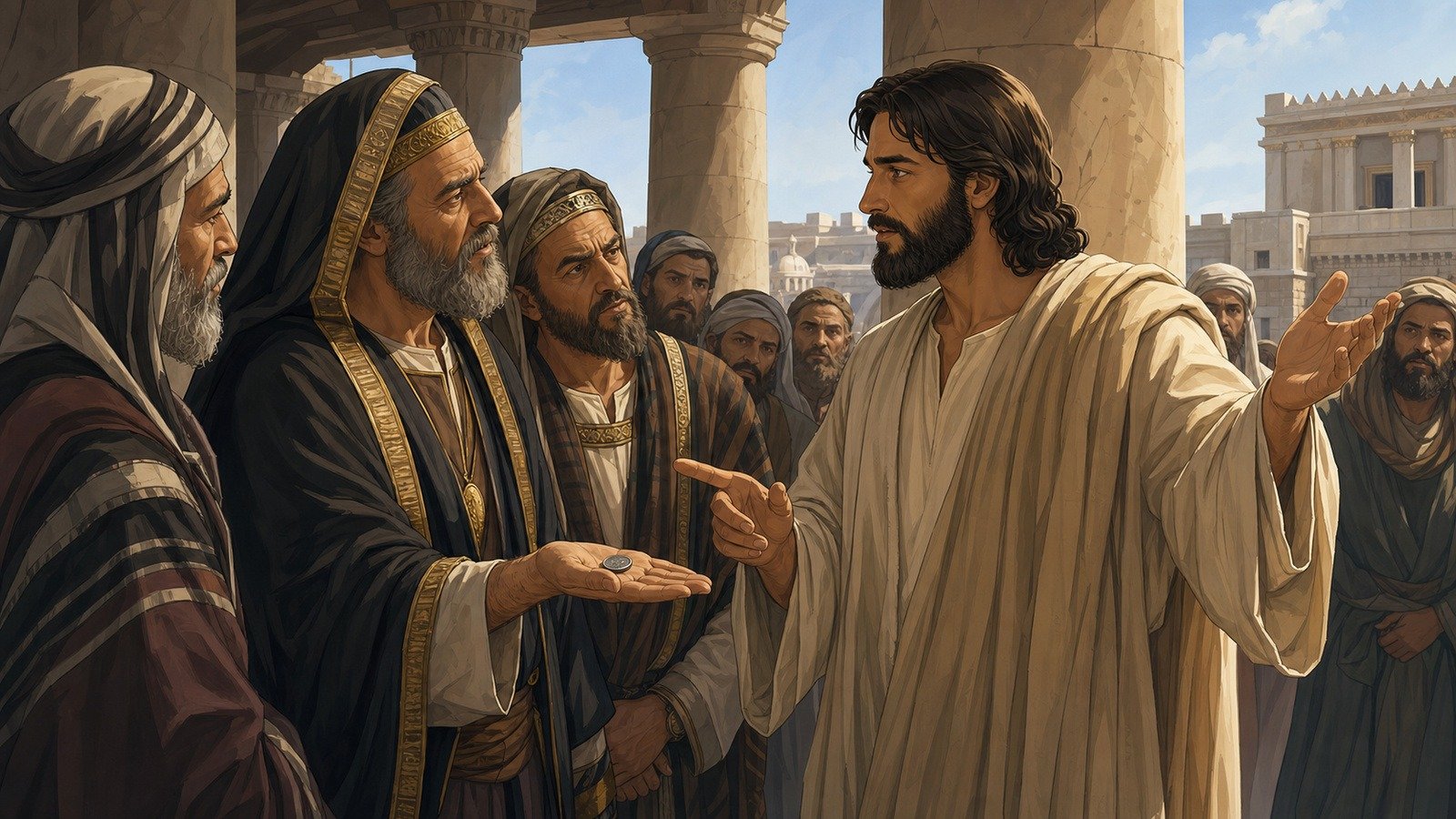
Opponents try to trap Jesus into either endorsing or rejecting Roman taxation; his answer, "give back to Caesar what is Caesar's, and to God what is God's," avoids the trap while raising a deeper question about ultimate loyalty.
Further context
2 min readThe Pharisees send their disciples along with the Herodians, and that pairing is the first thing worth noticing. The Pharisees resented Roman rule; the Herodians were the party of the client dynasty that governed under Roman licence. They agreed on very little, and here they arrive together.
The approach is flattery laid on with a trowel: teacher, we know that you are a man of integrity and that you teach the way of God in accordance with the truth. You are not swayed by others, because you pay no attention to who they are.
Then the question. Is it right to pay the imperial tax to Caesar or not?
The tax in view is the poll tax, a fixed head tax on every adult in the province, payable in Roman coin. It had been imposed when Judea came under direct administration in AD 6, and the census that introduced it had provoked a revolt led by Judas the Galilean, whose followers held that paying it was an admission that Rome, and not God, owned the land. That movement was still alive. Men had died over this question within living memory.
The trap is symmetrical and well built. Say the tax is lawful, and he loses the crowd. Say it is not, and the Herodians have a treasonable statement to carry to the prefect, who was in the city for the festival.
Show me the coin used for paying the tax, he says, and they bring him a denarius.
The coin itself is part of the answer. A denarius of Tiberius carried the emperor's head in profile with an inscription reading, in abbreviation, Tiberius Caesar, son of the divine Augustus, and on the reverse a seated female figure with the title Pontifex Maximus, high priest. Carrying it into the temple courts was carrying a graven image and a claim to divinity through the gates, and the men producing one from a purse at his request had it on them.
Whose image is this? And whose inscription?
Caesar's, they answer.
Then give back to Caesar what is Caesar's, and to God what is God's.
The verb translated give back means to return something to its owner, and it is not the ordinary word for paying. Whatever carries the emperor's stamp may be handed back to him. What carries God's is a different question, and everyone in that courtyard had been taught from childhood that humanity is made in God's image.
They were amazed, and they left him and went away.
The answer has been used to support almost every position on church and state that has ever been held, from complete submission to civil authority through to a doctrine of two separate spheres, and its brevity is what makes that possible. It settles a trap and does not settle a political theory.
What it plainly does not do is what both sides wanted. The Pharisees got no denunciation of Rome and the Herodians got nothing to report, and the coin they had produced was handed back.