

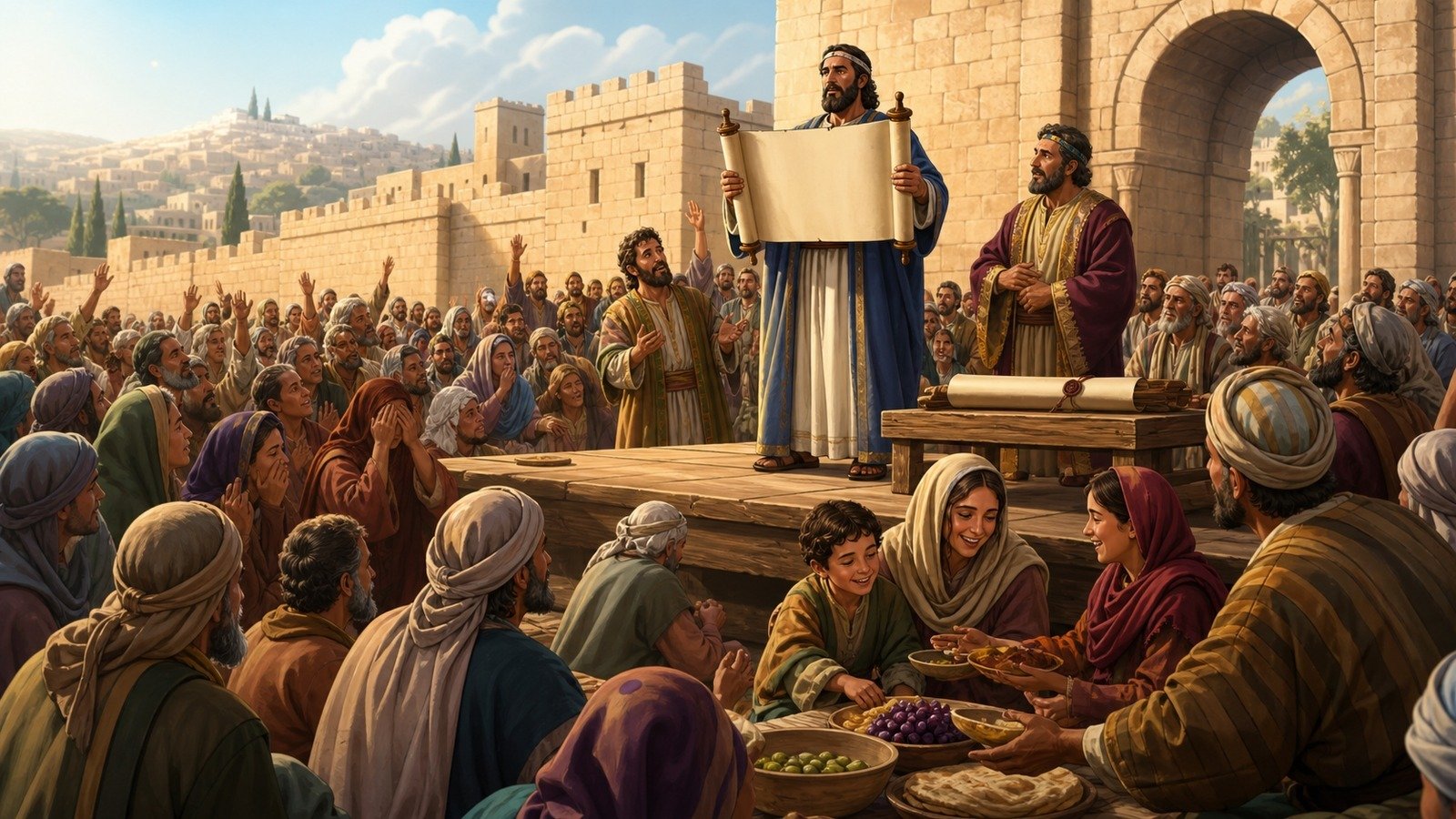
With the walls complete, Ezra publicly reads the Law to the assembled community, who weep and then celebrate; the people confess their history of failure and formally recommit themselves in a written covenant to obey God's law.
Further context
3 min readThe wall is up, and what happens next is a public reading that lasts most of a week.
All the people assemble as one in the square before the Water Gate and ask Ezra to bring out the Book of the Law of Moses. He reads it aloud from daybreak till noon, in the presence of men, women and others who could understand, and all the people listen attentively.
Two details of the arrangement are worth having. He stands on a high wooden platform built for the occasion, with thirteen named men beside him, and when he opens the book all the people stand up. And Levites are stationed among the crowd instructing them, making it clear and giving the meaning so that the people understand what is being read. The community had spent generations in Babylonia and Aramaic had become the everyday language, so a Hebrew scroll needed explaining as it went. That practice of reading and then interpreting is the origin of the synagogue sermon and, further on, of the Aramaic paraphrases used in worship for centuries.
The response is weeping, and it is stopped. Nehemiah, Ezra and the Levites tell them the day is sacred and they must not mourn or weep, and the instruction is one of the more unexpected things in these books: go and enjoy choice food and sweet drinks, and send some to those who have nothing prepared. Do not grieve, for the joy of the LORD is your strength.
The next day the family heads come back to study further, and they find in it the requirement to live in shelters during the festival of the seventh month. They go out and bring branches of olive, wild olive, myrtle, palm and shade trees and build booths on their roofs, in their courtyards, in the temple courts and in the squares, and the note attached is that the Israelites had not celebrated it like that since the days of Joshua.
A day of fasting and confession follows, and the prayer offered is a compressed retelling of the whole national story from creation through Abraham, Egypt, Sinai, the wilderness, the land, the judges, the kings and the exile, admitting failure at every stage and repeating that God was patient at every stage. Its central sentence is the summary of the whole arrangement: you are a forgiving God, gracious and compassionate, slow to anger and abounding in love.
The instruction to send portions to those who have nothing prepared is repeated at the festival a few days later and again when the agreement is signed, and it turns up in the Purim regulations as well. A community that has just rebuilt a wall and read a law scroll for a week keeps being told, in the middle of the celebrations, to check who has nothing to eat.
Then a binding agreement is put in writing and sealed by the leaders, Levites and priests, committing them to the law, to intermarriage restrictions, to the Sabbath, to the temple tax and to the tithes.
The reading takes place in the square before the Water Gate, from daybreak until noon, in front of men, women and all who could understand.
Two details in the description are worth having. When Ezra opened the book, all the people stood up, and they stayed standing for the whole reading. And the Levites are described instructing the people while they stood there, reading from the Book of the Law of God, making it clear and giving the meaning so that the people understood what was being read.
That last phrase is generally taken to mean translation. The population had come back speaking Aramaic, and the law was in Hebrew, which is the beginning of the practice of reading with an interpreter that later produced the Aramaic paraphrases.
The reaction is weeping, and the leaders stop it: this day is holy. Do not grieve, for the joy of the LORD is your strength. Then they are told to go and eat, drink, and send portions to those who have nothing.