

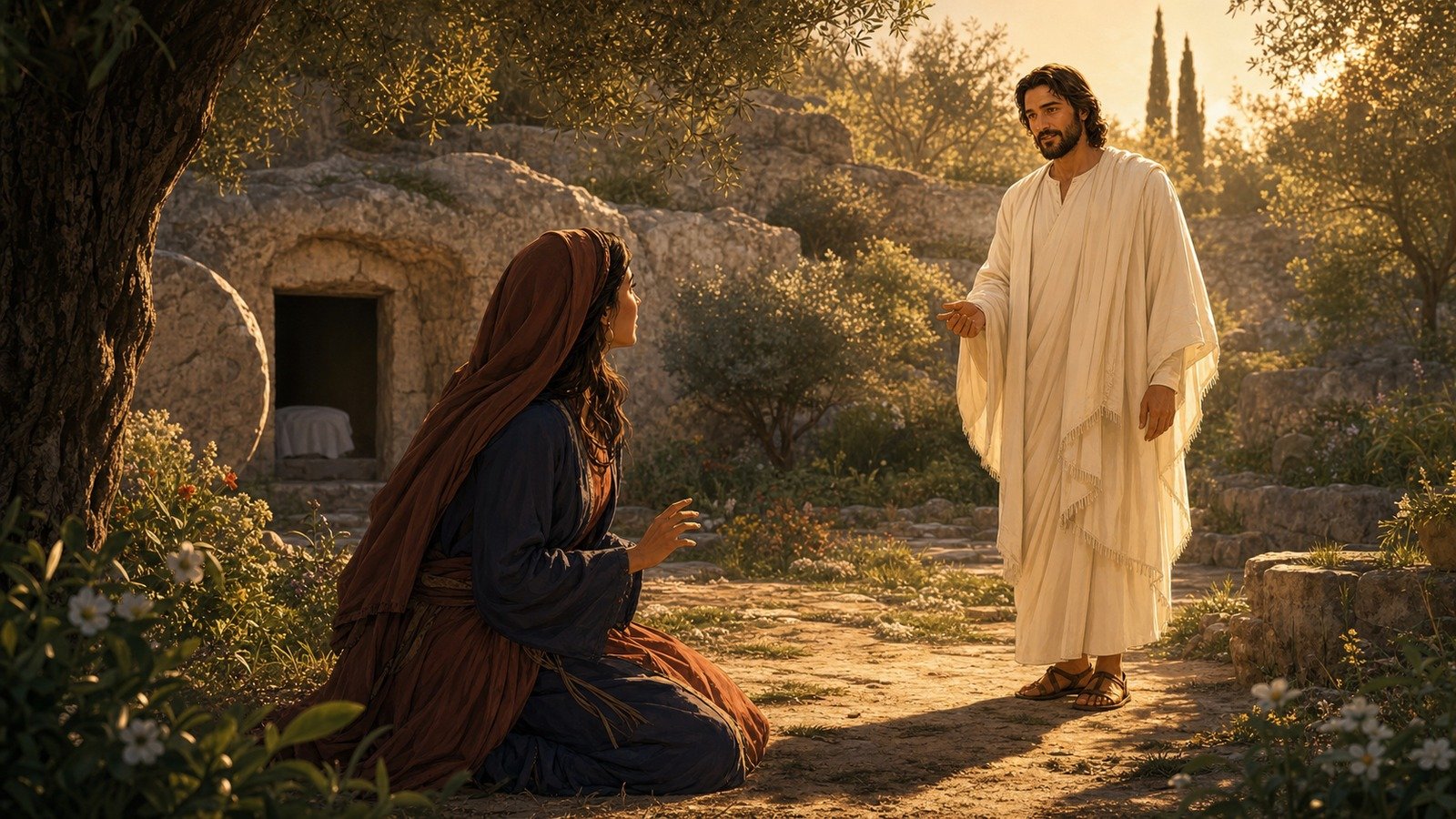
The risen Jesus appears first to Mary Magdalene at the tomb, who initially mistakes him for a gardener, then recognises him when he speaks her name, and becomes the first witness to carry news of the resurrection to the other disciples.
Further context
2 min readMary Magdalene stands outside the tomb crying after the others have gone.
She is introduced elsewhere as a woman out of whom seven demons had been driven, and as one of several who travelled with the group and supported them out of their own means. Magdala was a fishing town on the western shore of the lake with a substantial industry salting fish for export. The medieval identification of her with the sinful woman who anointed his feet has no basis in anything written about her, and it has been abandoned even by the church that popularised it.
She bends over to look into the tomb and sees two angels in white, seated where the body had been, one at the head and one at the foot. They ask why she is crying, and her answer is entirely practical: they have taken my Lord away, and I do not know where they have put him.
Then she turns round and sees a man standing there and does not know it is Jesus.
Supposing him to be the gardener, which in a tomb set in a garden at dawn is a reasonable inference, she says: sir, if you have carried him away, tell me where you have put him, and I will get him.
That is the offer of a woman who has thought no further than her own strength and intends to carry a corpse herself.
He says one word: Mary.
She turns and says Rabboni, which is Aramaic and means my teacher, an intensified and more personal form than the ordinary rabbi.
Then a sentence translated variously and awkwardly: do not hold on to me, for I have not yet ascended to the Father. The verb suggests clinging to something already grasped rather than a refusal of contact, and within a week Thomas is invited to touch him.
Go instead to my brothers and tell them, I am ascending to my Father and your Father, to my God and your God.
She goes to the disciples with the news: I have seen the Lord!
The first person to see him alive, and the first sent to announce it, was a woman with a history the movement had no reason to advertise. Later writers called her apostle to the apostles, and the phrase is at least accurate about what she was asked to do.
Magdala has been excavated since 2009, and the remains include a first-century synagogue, one of very few known from the period, along with a harbour and installations for processing fish. Whatever she had been, she came from a working town of some substance.
Her name appears in every list of the women at the crucifixion and at the tomb, and always first, which in ancient lists usually indicates prominence rather than alphabetical accident.
The garden setting has been read since the early centuries against the first chapters of Genesis: a garden, a man mistaken for the gardener, and a woman told to go and tell.
Her report is also the first thing any human being said about the resurrection, and it is four words long: I have seen the Lord. Everything the movement went on to say rests on statements of that form, made by people who claimed to have been there.