

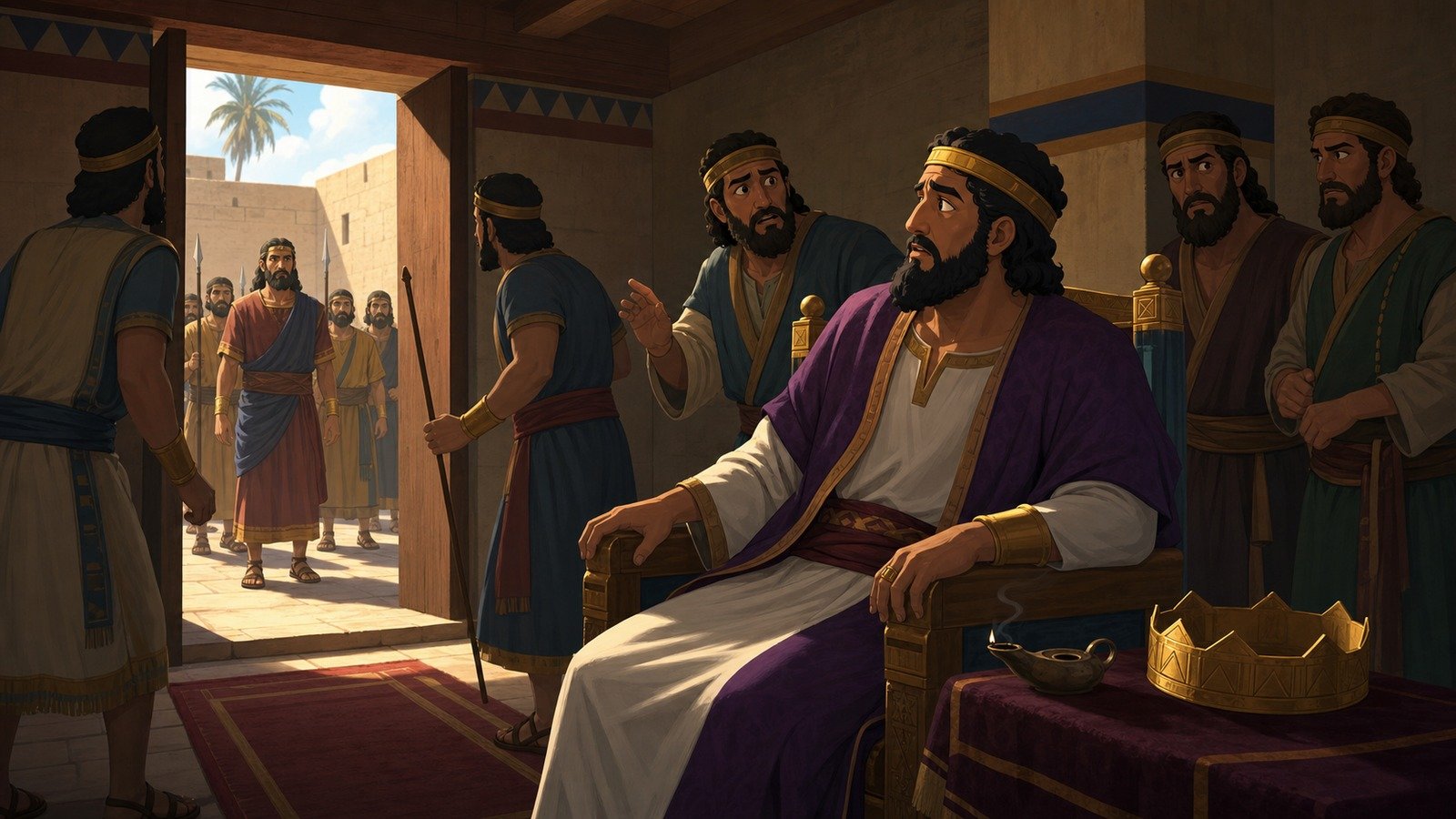
Shallum holds the throne for only a month before Menahem kills him and seizes power in turn, part of a rapid sequence of assassinations marking the northern kingdom's final, unstable decades.
Further context
3 min readOne month in Samaria, and then Menahem son of Gadi comes up from Tirzah, attacks him, assassinates him and takes the throne.
That is the whole of what is known about him. He is the man who ended the dynasty of Jehu after a hundred years, and he held what he had taken for four weeks.
Tirzah, where his killer comes from, had been the northern capital before Omri bought the hill at Samaria, and a challenger emerging from the old capital to take the new one suggests a regional split behind the coups rather than pure opportunism. Something similar happened when Omri himself faced a rival claimant and fought a civil war for several years before winning.
What follows Menahem's accession is a piece of brutality reported in one sentence and easy to skim: he attacked Tiphsah and everyone in the city and its vicinity, because they refused to open their gates. He sacked Tiphsah and ripped open all the pregnant women. Which town that was is unclear; the name usually refers to a place on the Euphrates, which is far outside Israelite territory, and some ancient witnesses read a different name closer to Tirzah. What is not unclear is the method, and it is the same atrocity that prophets of this period condemn foreign kings for committing against Israel.
The pattern across these two decades is worth setting out because it is the clearest picture anywhere of a state failing. Jeroboam II reigns forty-one years and leaves a large and prosperous kingdom. His son is murdered after six months. That killer is murdered after one month. The next man holds power for ten years by paying an empire to protect him. His son is murdered by a chariot officer after two years. That officer is removed by Assyria after twenty. The last king is imprisoned by an Assyrian emperor and the country ceases to exist.
Six kings, four assassinations, and two hundred and nine years of independence ending in a deportation.
One thing about him is worth stating precisely because it is so rarely noticed. He killed the last king of the only northern dynasty that had lasted a century, in public, and nobody appears to have opposed him for a month. The house of Jehu had held the throne through four generations, survived Aramean occupation and Assyrian tribute, and it ended without a single recorded defender.
Whether the pattern of these months was purely opportunistic is worth questioning. The killers come from different places, one from Tirzah, one from Gilead, and the direction of the coups suggests regional factions rather than individual ambition. A kingdom that had lost its eastern territory to Aram and was about to lose its northern territory to Assyria was being fought over by whoever still had troops in a district.
The verdict formula is not even applied to Shallum. He is given three sentences: his name, the length of his reign, his death, and a cross-reference to a book of annals that has not survived.
One month is the second shortest reign in the Bible after Zimri's week.
He is killed by Menahem son of Gadi, who comes up from Tirzah, the old northern capital, which suggests a rival power base rather than an opportunist in the palace.
What is recorded of Menahem's accession is a single atrocity carried out at a town that refused to open its gates to him: he sacked Tiphsah and ripped open all the pregnant women. That sentence appears in the middle of an accession notice and is not commented on.
The pace of the collapse is the point of these compressed entries. Three kings in the space of about seven months, two of them murdered, in a kingdom that had been at its territorial peak within living memory.