

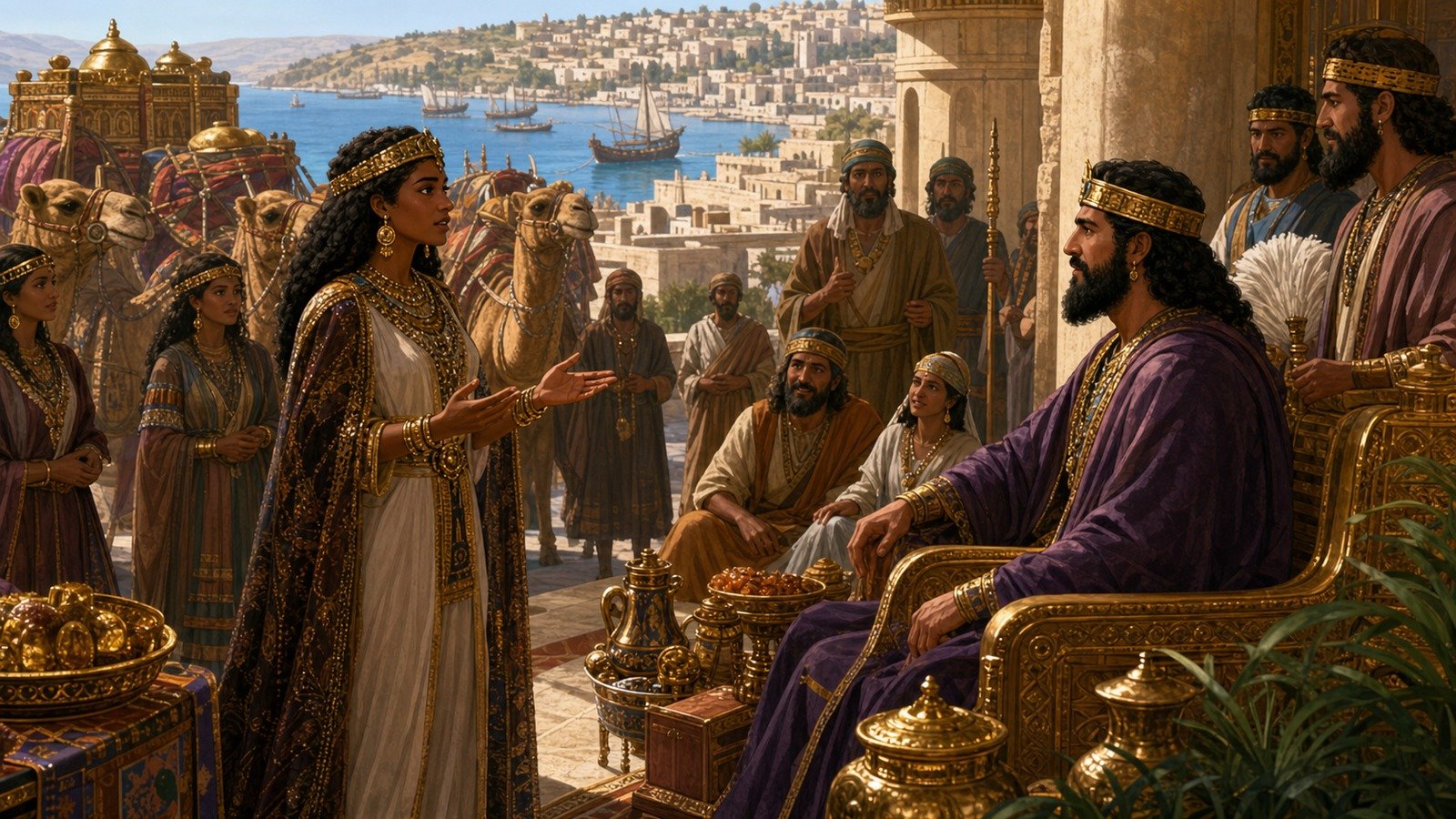
Solomon's fame draws the Queen of Sheba to test him with hard questions; she leaves impressed by his wisdom and wealth, which the chapter goes on to describe in detail, including a fleet trading in gold, and a throne without equal in any kingdom.
Further context
2 min readSheba is generally located in south-western Arabia, in what is now Yemen, and it was the centre of the incense trade. Frankincense and myrrh came from there and from the Horn of Africa, and the caravan route ran two thousand kilometres north through the Arabian desert to the Mediterranean markets, passing through territory Solomon controlled. A ruler of Sheba arriving in Jerusalem is a trading partner examining a man who has just placed himself across her supply line.
She comes to test him with hard questions, and the phrase covers riddles and difficult cases, which was a recognised diplomatic sport between courts. She arrives with a very great caravan, camels carrying spices, large quantities of gold and precious stones.
He answers all of it, and then she is shown the establishment: the food on his table, the seating of his officials, the attending servants in their robes, the cupbearers, and the burnt offerings he made at the temple. She is overwhelmed, and the phrase used is that there was no more breath in her.
Her speech afterwards has two halves and both are quotable. The report I heard in my own country about your achievements and your wisdom is true. But I did not believe these things until I came and saw with my own eyes. Indeed, not even half was told me; in wisdom and wealth you have far exceeded the report I heard. Then the second half, which is why the visit is recorded at all: praise be to the LORD your God, who has delighted in you and placed you on the throne of Israel. Because of the LORD's eternal love for Israel, he has made you king to maintain justice and righteousness.
She gives a hundred and twenty talents of gold, large quantities of spices and precious stones, and never again were so many spices brought in as those she gave. He gives her everything she asks for, and she goes home.
The figures that follow are the ones that make people uneasy, and the tension in them is deliberate even if the writers did not intend it. Six hundred and sixty-six talents of gold a year in revenue. Two hundred large shields and three hundred small ones of hammered gold. A great throne of ivory overlaid with fine gold, with six steps and twelve lions. All the goblets in the palace of gold, because silver was considered of little value in his day. Horses imported from Egypt and Kue.
Set that against the instructions given centuries earlier for any future king of Israel, which forbade exactly three things: acquiring great numbers of horses, especially from Egypt; taking many wives, who would turn his heart away; and accumulating large amounts of silver and gold.
He does all three, and Jesus later mentions him in passing while pointing at a wildflower and saying that Solomon in all his splendour was not dressed like one of these.