

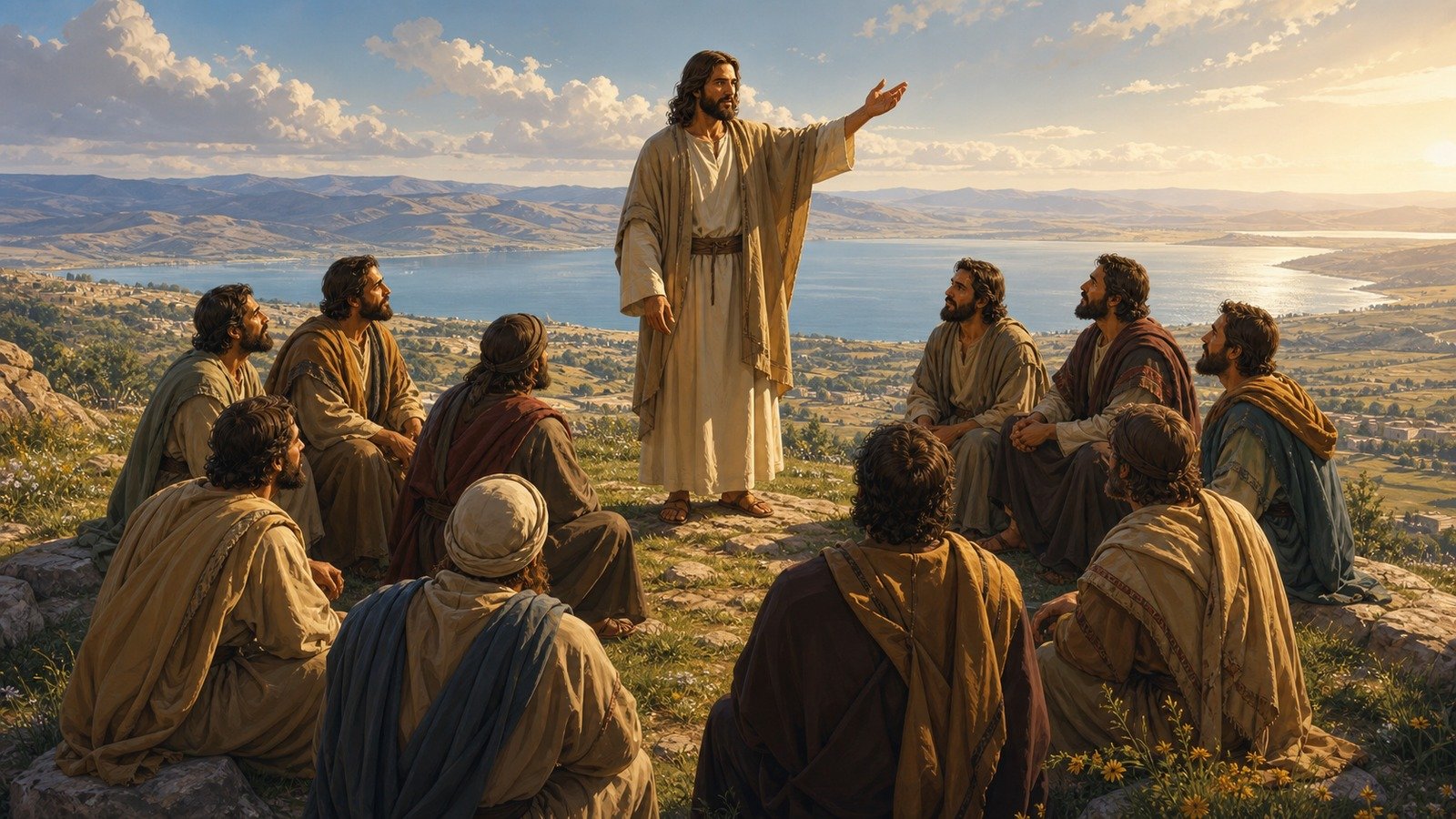
On a mountain in Galilee, Jesus commissions the eleven remaining disciples to make disciples of all nations, baptising and teaching them, with the promise, "I am with you always, to the very end of the age," the founding mandate for the Church's later mission.
Further context
2 min readThe eleven go to Galilee, to the mountain where Jesus had told them to go, and what is recorded when they see him is not straightforward triumph: when they saw him, they worshipped him; but some doubted.
That clause has bothered copyists and translators for a long time, and it is in the earliest manuscripts. The Greek word covers hesitation and wavering rather than flat disbelief, and its presence at the climax of the book is difficult to explain except as something that actually happened.
All authority in heaven and on earth has been given to me.
The claim comes before the instruction, and the instruction depends on it. What follows is a single command in Greek, make disciples, supported by three participles describing how: going, baptising and teaching.
Therefore go and make disciples of all nations, baptising them in the name of the Father and of the Son and of the Holy Spirit, and teaching them to obey everything I have commanded you.
Two things in that sentence changed the shape of what came next.
All nations is the first. The mission until this point had been almost entirely to Jews, and he had said so himself when a Phoenician woman asked for help. The book that opens with a genealogy tracing him through Abraham and David closes by sending men to everybody, and the church spent the next thirty years arguing about the practical consequences, as the letters and the record of the early years both show.
The baptismal formula is the second. Baptism in the earliest church is elsewhere described as being in the name of Jesus, and the threefold form here is the one that entered general use. A manual of church practice from around the end of the first century already prescribes it, with instructions about running water and cold water, which shows how quickly it became standard. It is also the seed from which the doctrine of the Trinity grew: three named together, as one name, without explanation.
And surely I am with you always, to the very end of the age.
The book began with a child called Immanuel, which means God with us, and it ends with the same statement made directly by the person concerned. Whether the arrangement is deliberate is hard to doubt.
No response from the eleven is recorded. The book simply stops.
Galilee as the setting is worth pausing on. The commission to go to all nations is given in the northern province the Jerusalem establishment looked down on, in a district with mixed populations and Greek cities on its borders, rather than in the temple courts.
The other accounts place the final instructions near Jerusalem. Whether there were two mountains or the traditions preserve different occasions is not resolvable, and the appearances are described as running over forty days, with plenty of room for both.
Making disciples is a verb built on the noun for a learner, and it means something more particular than gaining converts: attaching people to a teacher for the purpose of being changed by him.