

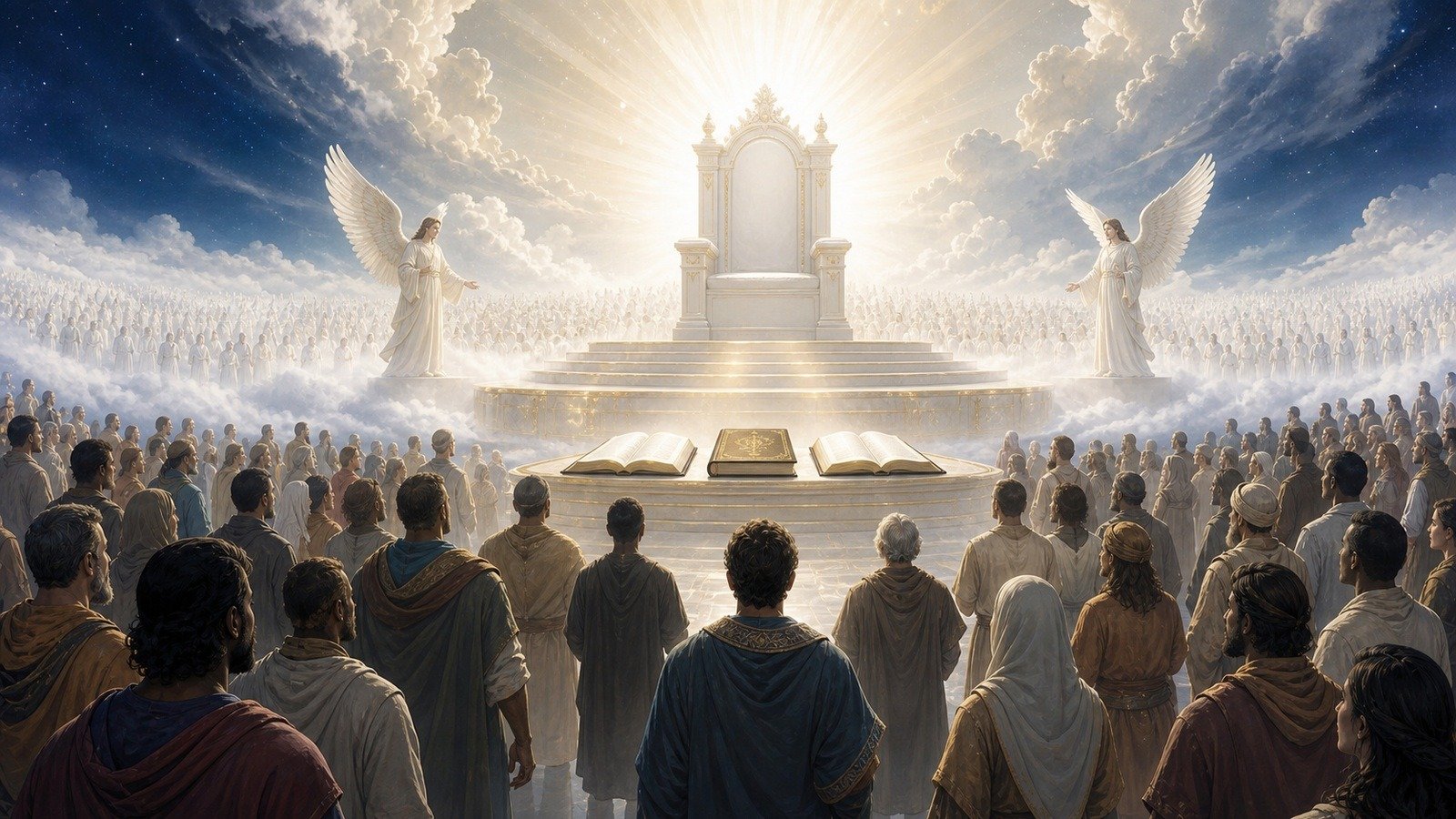
The dead, great and small, stand before a great white throne to be judged according to what they have done, recorded in books, while anyone whose name is not found written in the book of life is thrown into the lake of fire.
Further context
2 min readJohn sees a great white throne and the one seated on it, and the description of what happens next begins with a detail that is easy to read past: the earth and the heavens fled from his presence, and there was no place for them.
Whatever the scene is, it is not taking place anywhere. The setting has gone.
And I saw the dead, great and small, standing before the throne, and books were opened. Another book was opened, which is the book of life. The dead were judged according to what they had done as recorded in the books.
The plural and the singular are doing different work. The books record what people did; the book of life records who they are. Both are ancient images. Kings kept records of loyal service, which is how Mordecai's case is reopened in the book of Esther, and cities kept registers of citizens, which is where the book of life comes from.
The sea gave up the dead that were in it, and death and Hades gave up the dead that were in them, and each person was judged according to what they had done.
Naming the sea separately mattered to an ancient audience in a way it does not now. Anyone drowned and unburied was thought by many to be beyond proper rest, and sailors and fishermen made up a large part of the population of the coastal cities these congregations lived in.
Then death and Hades themselves are thrown into the lake of fire. The two things that had held the dead are disposed of, and the sentence attached explains what the lake is: the lake of fire is the second death.
That is the only definition offered anywhere.
Anyone whose name was not found written in the book of life was thrown into the lake of fire.
Judgement according to works, in a book written by a movement that taught justification by faith, has occupied Christian writers for two thousand years. The commonest resolution is that the books record the evidence and the book of life records the verdict, and that what a person did is treated as showing what a person was, which is the same argument James makes about faith without works.
Nothing is said here about degrees, and nothing is said about mercy. What is described is a court with complete records and no absentees.
White is the colour used throughout the book for what is true rather than for what is pure: white robes, a white horse, a white stone. A great white throne is a court whose verdicts are not in doubt.
Nothing is said about a defence, an advocate or a plea. What is described is records being read, and the only thing that changes the outcome is whether a name is in the register.
That the sea gives up its dead alongside death and Hades has been read as a deliberate reassurance to congregations in port cities who had lost people at sea, and the next chapter says there will no longer be any sea.