
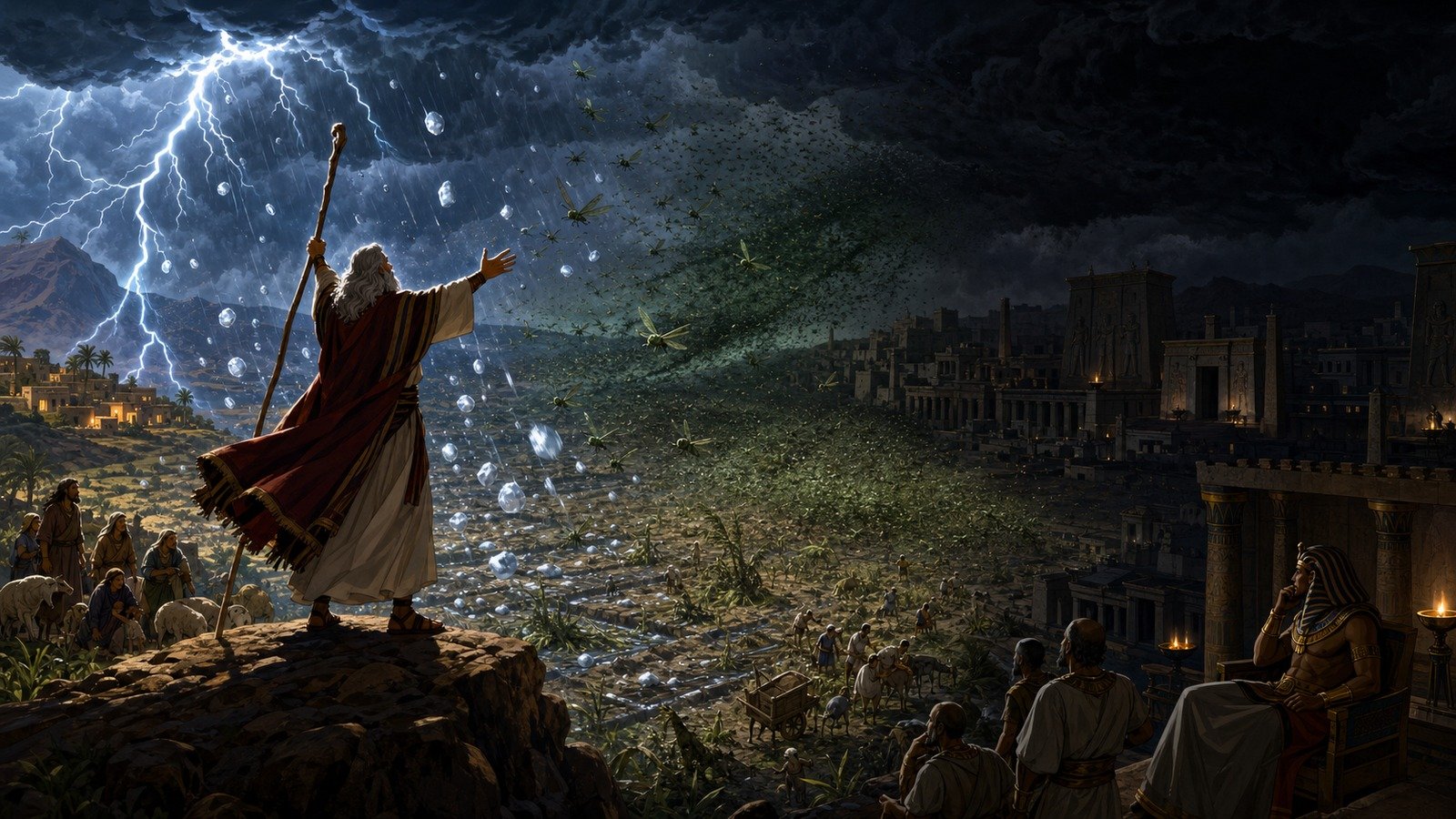
Devastating hail, a locust swarm that strips the land bare, and three days of total darkness bring Egypt to its knees; Pharaoh repeatedly offers partial concessions and withdraws them once each plague lifts.
Further context
3 min readThe hail comes with the longest warning of the series and an unusual instruction: bring your livestock and everything you have in the field into shelter, because the hail will fall on every person and animal left outside. What follows is a report on individual Egyptians. Those officials of Pharaoh who feared the word of the LORD hurried to bring their slaves and livestock inside, and those who ignored it left theirs in the field. The court is no longer united, and some Egyptians are now acting on what Moses says.
The hail destroys everything in the open, and one detail is agriculturally precise: the flax and barley were destroyed, since the barley had headed and the flax was in bloom, but the wheat and spelt were not, because they ripen later. That is accurate for the Nile valley, where flax and barley ripen around January and February and wheat and spelt several weeks afterwards. It also fixes the point in the farming year and leaves a standing crop for the locusts to take.
Pharaoh's admission here is the fullest he makes: this time I have sinned. The LORD is in the right, and I and my people are in the wrong. When the hail stops, he changes his mind again.
His own officials confront him before the locusts arrive. How long will this man be a snare to us? Let the people go. Do you not yet realise that Egypt is ruined? He recalls Moses and offers terms, then withdraws them when he learns that the women and children are to go too. An east wind brings the locusts, which cover the ground until it is black and eat everything the hail left, and a west wind carries them into the Red Sea.
Then three days of darkness over Egypt, described as darkness that can be felt, in which nobody could see anyone else or move about, while the Israelites had light where they lived. The khamsin, a spring sandstorm that can blot out the sun for days, is often proposed as the mechanism, and the same objection applies as everywhere else: what is being reported is the timing, the duration and the exemption rather than the meteorology. In a country whose principal deity was the sun, three days of darkness is also a statement.
The pattern of the negotiations across all nine is a steady retreat that never quite becomes surrender. Pharaoh first offers worship inside Egypt, then a journey but not far, then the men only, then everyone but not the livestock. Each concession is larger than the last and each is withdrawn once the pressure lifts. The one thing he will not do at any stage is release the labour force permanently, which is what has been asked from the first sentence.
The final negotiation collapses over property. He will let the people go but the flocks and herds must stay. Moses refuses on the ground that they will not know what to sacrifice until they arrive, and not a hoof is to be left behind. Pharaoh's last words to him are a threat: get out of my sight, and make sure you do not appear before me again, for the day you see my face you will die. Moses agrees, and the agreement turns out to be accurate.