

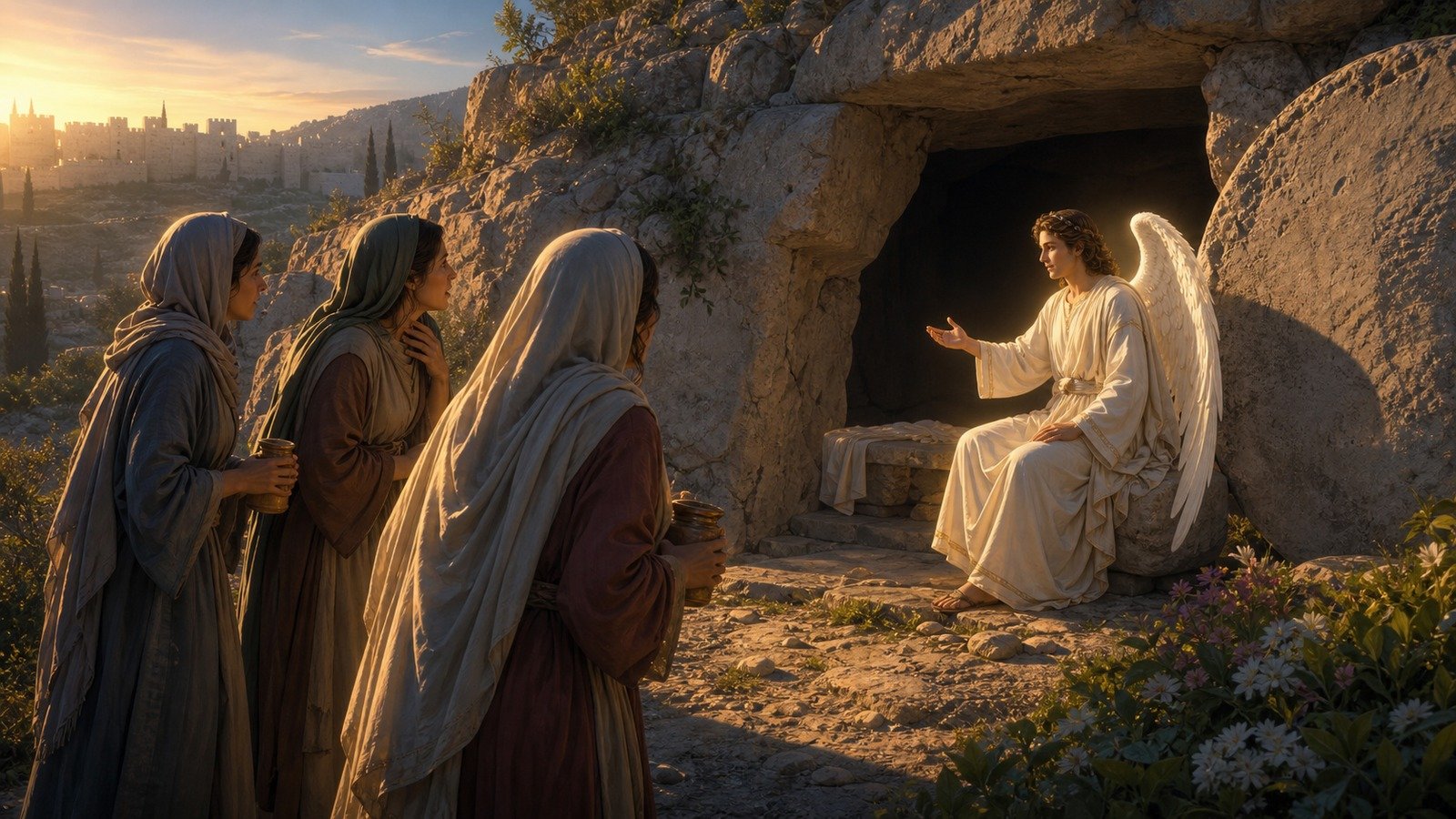
Women arriving to anoint Jesus' body find the tomb's stone already rolled away and the tomb empty; an angel, or angels, announce that Jesus has risen, and the women run to tell the disciples, who initially dismiss the report as "nonsense."
Further context
2 min readVery early on the first day of the week, while it is still dark, the women go to the tomb of Jesus with the spices they had prepared.
Their purpose is worth stating because it settles what they expected. They are going to finish a burial. Nobody carrying perfumed oils to a grave at dawn is expecting anything except a body, and the practical problem they discuss on the way is who will roll the stone away, since it was very large.
They find it already rolled back and the tomb empty.
What happens next differs in detail between the four accounts, and the differences are worth being honest about rather than smoothing over. The number of women varies. One angel is described, or two. Some have them at the tomb, some sitting inside. Whether Mary Magdalene ran before or after seeing the messengers is not consistent.
Historians who work on eyewitness testimony generally treat that pattern as characteristic of independent reports of a confused event rather than as evidence of fabrication, since invented accounts tend to agree too well. What all four agree on is the day, the empty tomb, and that women found it.
That last point carries more weight than it looks. Women's testimony was not accepted in Jewish courts on most matters, and Josephus states the disqualification explicitly. A movement inventing a story to persuade a first-century audience would not have chosen women as its only witnesses to the central claim, and the earliest written summary of the resurrection, in a letter of Paul's, lists the appearances without mentioning them.
The message given is: do not be afraid. You are looking for Jesus the Nazarene, who was crucified. He has risen! He is not here. See the place where they laid him. Then an instruction to go and tell his disciples and Peter, and the naming of the man who had denied him three days earlier is not accidental.
Peter and another disciple run to the tomb and go in. What they find is described precisely: the strips of linen lying there, and the cloth that had been wrapped round the head folded up by itself, separate from the linen.
Grave robbers do not fold the linen.
They still did not understand from Scripture that he had to rise from the dead, and they went back to where they were staying.
Where the tomb was is contested between two sites. The Church of the Holy Sepulchre stands over ground that was outside the city wall in AD 33 and contains rock-cut tombs of the right period, and the identification goes back to the fourth century when a temple built by Hadrian was demolished to reach it. The Garden Tomb, north of the Damascus Gate, was proposed in the nineteenth century and its burial chamber appears to be several centuries too old.
The archaeology favours the first, and neither can be proved.
The stone is described as very large, and blocking stones recovered from first-century tombs around Jerusalem weigh several hundred kilograms, which is why the women's question about who would move it was the practical problem of the morning.