

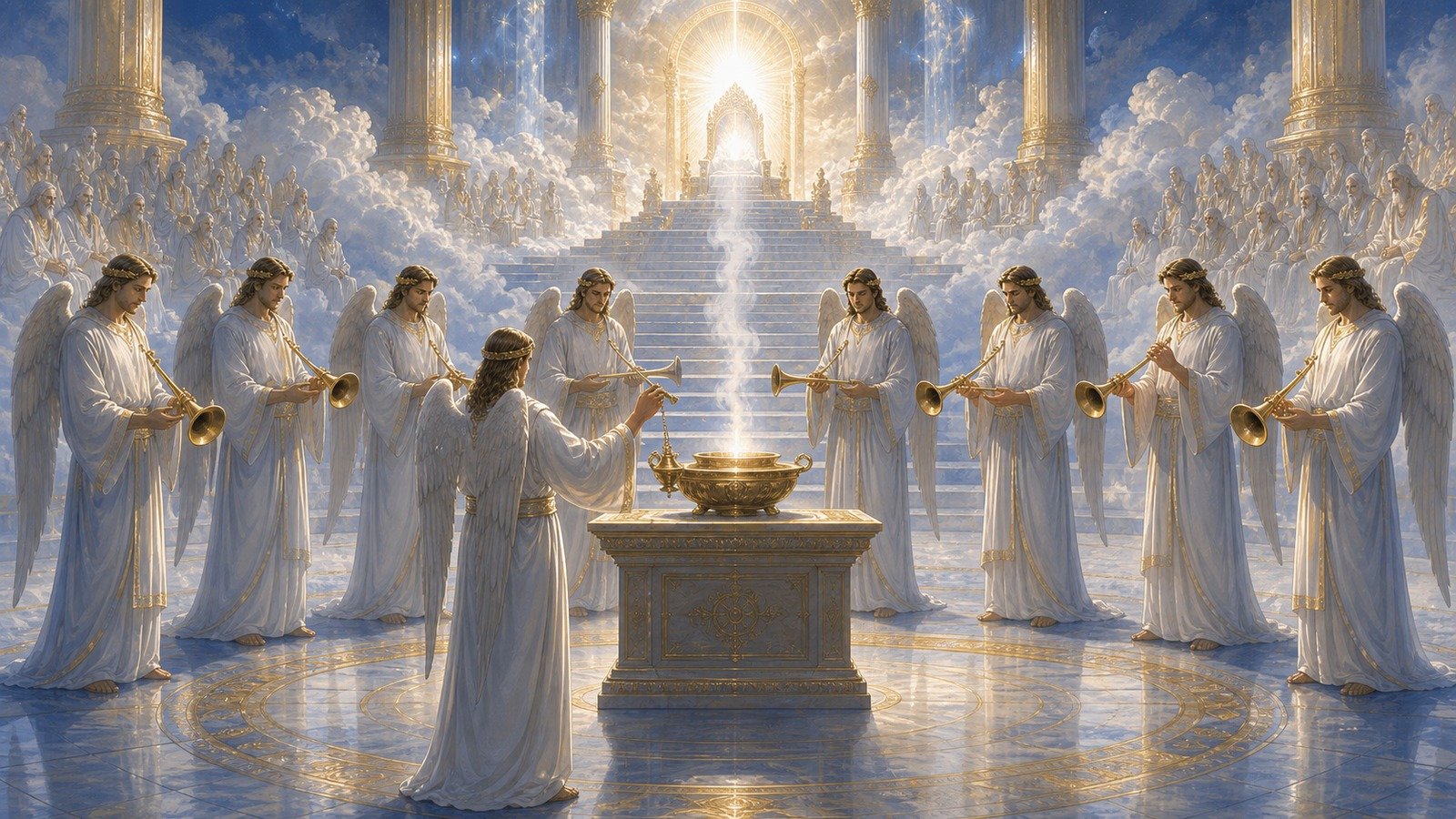
The seventh seal opens to "silence in heaven for about half an hour," followed by the prayers of God's people rising like incense and seven angels being given trumpets to sound in turn.
Further context
2 min readWhen the Lamb opened the seventh seal, there was silence in heaven for about half an hour.
After six seals of conquest, war, famine, death, martyrdom and cosmic collapse, and after two chapters of continuous singing by an uncountable crowd, everything stops.
That silence has been read in several ways: as the hush before a verdict, as the pause in temple ritual while incense was offered, and as a deliberate refusal to describe what the seventh seal contains. The half hour is the only measured interval in the book, and it is precise enough to be strange.
Then seven angels who stand before God are given seven trumpets.
Before any of them sound, another angel comes and stands at the altar with a golden censer. He is given much incense to offer, with the prayers of all God's people, on the golden altar in front of the throne, and the smoke of the incense, together with the prayers, goes up before God from the angel's hand.
That image is doing something specific. Under the fifth seal the martyrs had asked how long, and had been told to wait. The prayers are still there, and they are being handled with the care given to a temple offering.
Then the angel takes the censer, fills it with fire from the altar, and hurls it on the earth, and there come peals of thunder, rumblings, flashes of lightning and an earthquake.
The same fire that carried the prayers upward is thrown down, and what follows is the trumpets.
Trumpets in Israel's practice announced the new moon and the festivals, summoned the assembly and sounded the alarm for war. Seven of them had been carried round Jericho for seven days.
The structure of the book turns on numbered sevens: seven messages to churches, seven seals, seven trumpets and seven bowls, with interludes between the sixth and seventh of each. Whether the three sequences describe consecutive events or the same events from three angles is one of the fundamental interpretative decisions, and it divides the major schools of reading.
Those schools are worth naming, because the same text yields very different books depending on which is chosen: that it describes the first century, that it describes the whole span of church history, that it describes the end, or that it presents recurring patterns without a timetable.
Then the first angel sounded his trumpet.
The half hour of silence is the only place in the book where nothing at all happens, and it comes immediately after the loudest scene in it.
The four schools of interpretation each produce a coherent reading and none of them can be established from the wording alone, which is why the book has generated more commentary per page than anything else in the Bible and more disagreement than all of it.
Half an hour is short enough to be almost nothing and long enough to be unbearable if the room is full of people waiting, which is presumably the effect intended.