

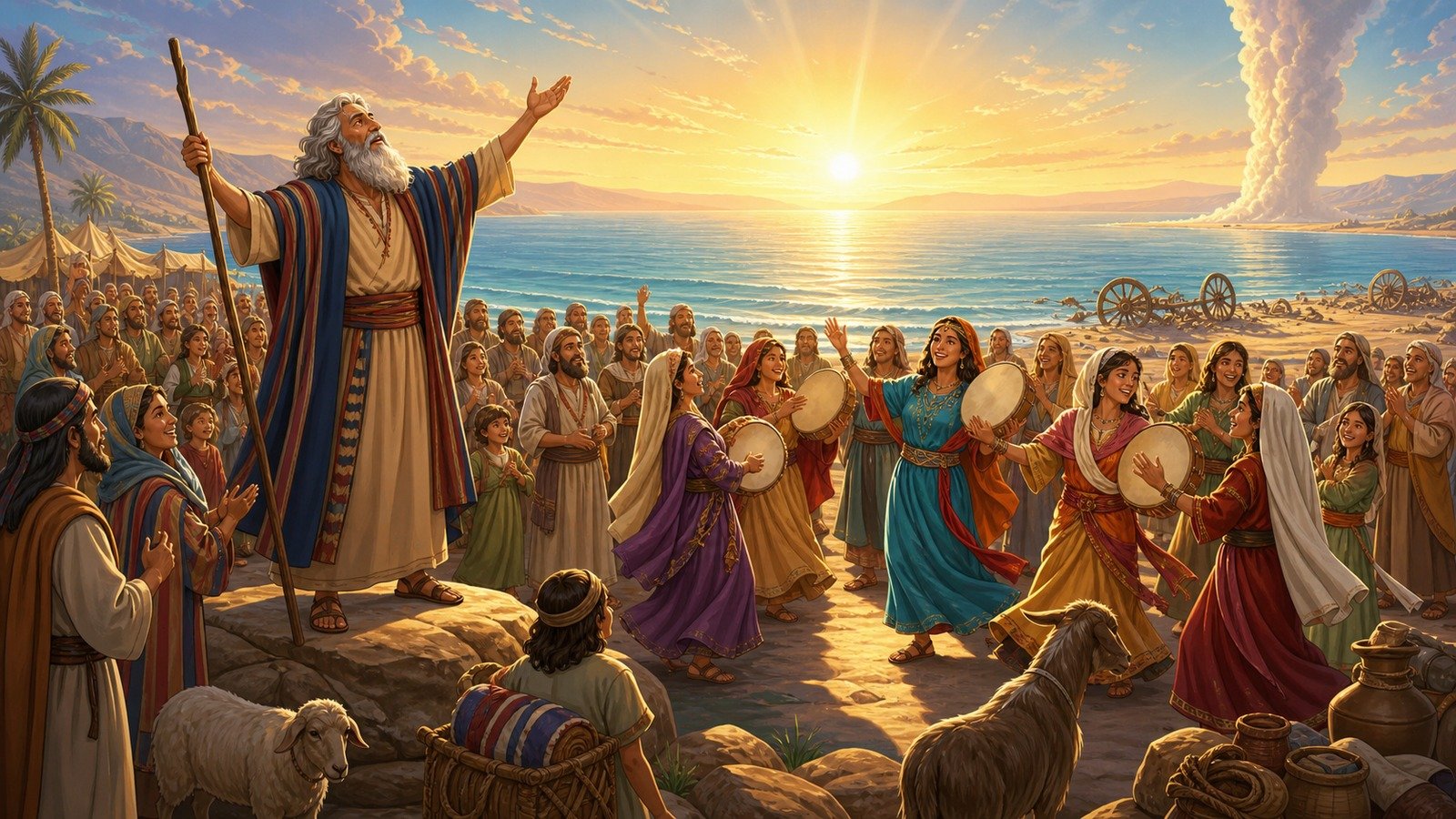
Moses and Miriam lead the people in songs celebrating the sea's crossing and God's power over Pharaoh's army, among the oldest poetry preserved in the Bible.
Further context
3 min readWhat the people produce on the far shore is poetry, and it is very old poetry. Its grammar contains forms that had dropped out of use in later Hebrew, its vocabulary includes words that occur nowhere else, and its structure uses a repeating parallel style found in Ugaritic verse from the second millennium BC. On those grounds many scholars who date the surrounding prose late still treat this as among the oldest continuous material in the Hebrew scriptures.
It opens with a declaration rather than a description: I will sing to the LORD, for he is highly exalted; both horse and driver he has hurled into the sea. The line that follows, the LORD is my strength and my defence, he has become my salvation, is quoted twice more elsewhere in the Hebrew scriptures, which shows how widely it was known.
The middle retells the crossing in images rather than sequence. The waters pile up, the deeps congeal in the heart of the sea, the enemy boasts that he will pursue and overtake and divide the spoil, and then a single breath sinks him like lead in the mighty waters. The enemy's speech runs to six short clauses and is answered in one.
A question sits at the centre: who among the gods is like you, LORD? Who is like you, majestic in holiness, awesome in glory, working wonders? The claim is comparative, and it is addressed to a world in which every nation had gods and Egypt had a great many.
The second half looks forward rather than back and names peoples the Israelites have not yet met: the chiefs of Edom, the leaders of Moab, the people of Canaan and the inhabitants of Philistia. It closes with a mountain that will be God's inheritance, a sanctuary established by his hands, and the last line, the LORD reigns for ever and ever. An escape from a labour camp is being set inside a much longer arc.
Then a short piece of prose introduces the other singer. Miriam the prophet, Aaron's sister, takes a tambourine in her hand, and all the women follow her with tambourines and dancing, and she sings the opening couplet back to them. She is the first woman anywhere given the title prophet. Some scholars argue that her two lines are the original core of the whole piece, with the longer version developed out of them, on the grounds that short refrains of that kind are the oldest layer of oral poetry.
The song marks a change in what is happening. Everything up to now has been reported: what Pharaoh said, what Moses did, what happened at the water. This is the first time the people speak for themselves at length, and what they produce is not a report but a claim about who God is, addressed to him rather than about him.
One line in it has puzzled readers for centuries: the LORD is a warrior. Applied to a God who has just refused to let his people fight, and who won an engagement in which not one Israelite lifted a weapon, the title is being used against expectation. Nobody on that shore drew a sword. What the song celebrates is a victory its singers had no part in, which is the same claim the prose has been making in a flatter register since the first plague.
The wilderness that follows is full of their speech again, and almost all of it is complaint. The distance between this song and the first grumbling is three days.