

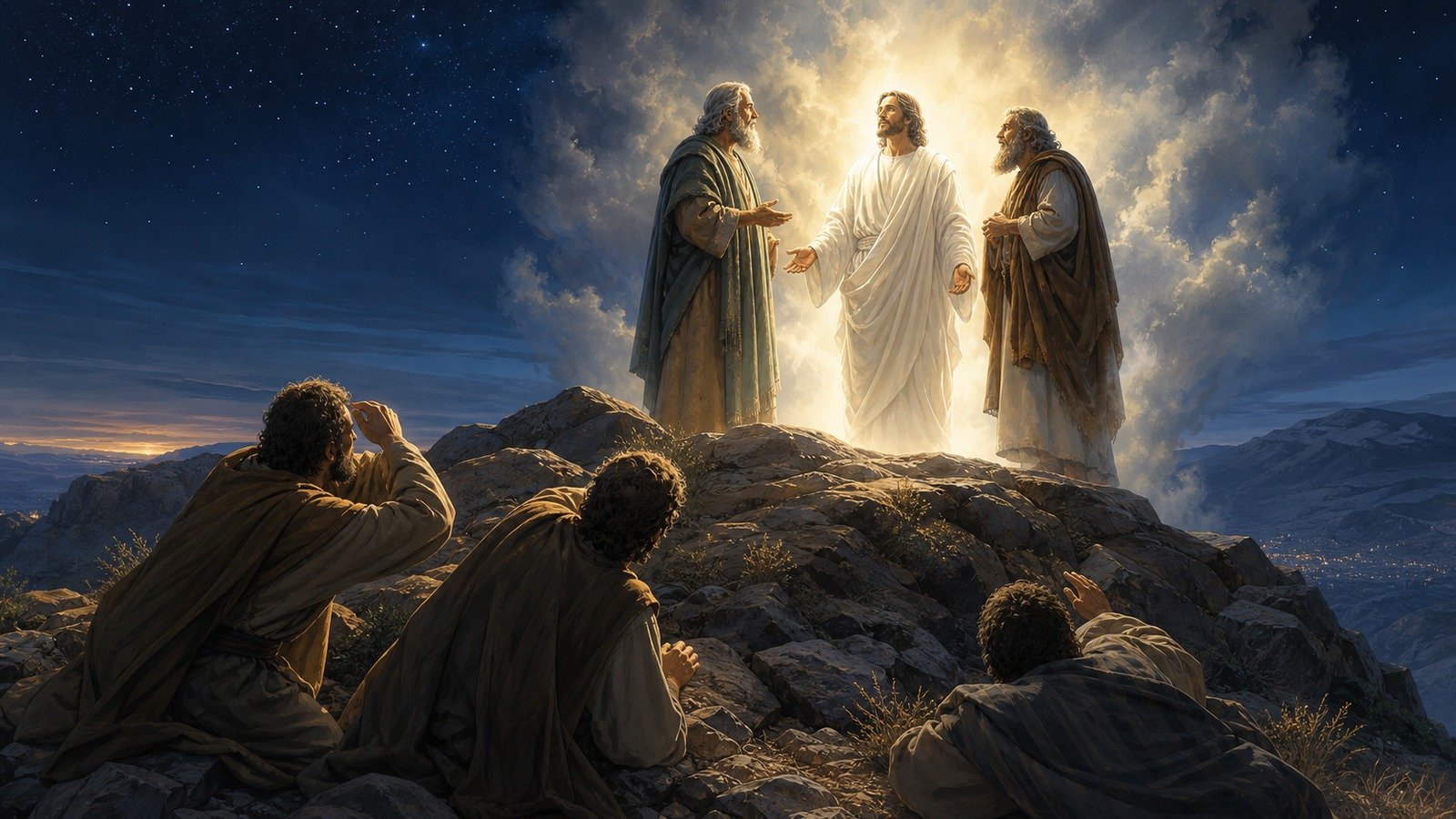
On a mountain, Jesus is transfigured before Peter, James and John, his face and clothes becoming dazzlingly bright, and appears conversing with Moses and Elijah; a voice from a cloud again identifies him as God's beloved Son, echoing the baptism.
Further context
3 min readSix days later, and the interval is specified in an unusually exact way, Jesus takes Peter, James and John up a high mountain by themselves.
Which mountain is disputed. Christian tradition since the fourth century has settled on Tabor, a rounded hill rising abruptly from the Jezreel valley, and a church stands on the summit. The difficulty is that Tabor had a fortified settlement on top in the first century and is not especially high. Hermon, near where the previous conversation happened, rises to over two thousand seven hundred metres and is snow-covered for much of the year, and fits high mountain better while being a long climb.
There he was transfigured before them. The Greek verb is the one behind the English metamorphosis. His clothes became dazzling white, whiter than anyone in the world could bleach them, and his face shone like the sun.
The comparison to a launderer is a strange, homely detail, and it comes from a man reaching for something to compare it to and finding nothing adequate.
Moses and Elijah appear and talk with him. The pairing is not random. Moses received the law at Sinai and Elijah met God at the same mountain centuries later, and both had unusual departures: Moses buried by God in a place nobody found, Elijah taken up in a whirlwind. What they discussed is recorded only in one account, and the word used is his departure (exodos), which he was about to bring to fulfilment at Jerusalem.
Peter speaks, and the reason given for what he says is that he did not know what to say and they were terrified. His suggestion is to put up three shelters, one for each of them. The word means the temporary booths of branches that Jews built and lived in during the autumn Feast of Tabernacles, remembering the wilderness years. It is not a foolish instinct; it is an attempt to prolong something and to house it.
While he is still speaking, a bright cloud covers them. Cloud in this tradition is where God is present and hidden at the same time, filling the tabernacle and the temple so that priests could not stand to minister.
A voice from the cloud says: this is my Son, whom I love. Listen to him.
The same words were spoken at the Jordan. The addition here is the command, and it follows six days after the disciples heard something they did not want to hear.
They fall face down, terrified. He comes and touches them and says, get up, do not be afraid. When they look up, they see no one except Jesus.
Coming down, they are told not to tell anyone until the Son of Man has risen from the dead. They keep the matter to themselves, discussing what rising from the dead meant.
Peter refers to this episode in a letter written decades later, saying that they did not follow cleverly devised stories but were eyewitnesses of his majesty, and that they themselves heard the voice from heaven when they were with him on the sacred mountain. It is a rare instance of one of the three describing something he had been present at.
Whichever mountain it was, the three men taken up are the same three taken into the room where a dead girl was raised and, later, further into the olive grove than the rest. What they saw here they were told to keep to themselves, and the reason given is a date rather than a policy: until the Son of Man has risen from the dead.