

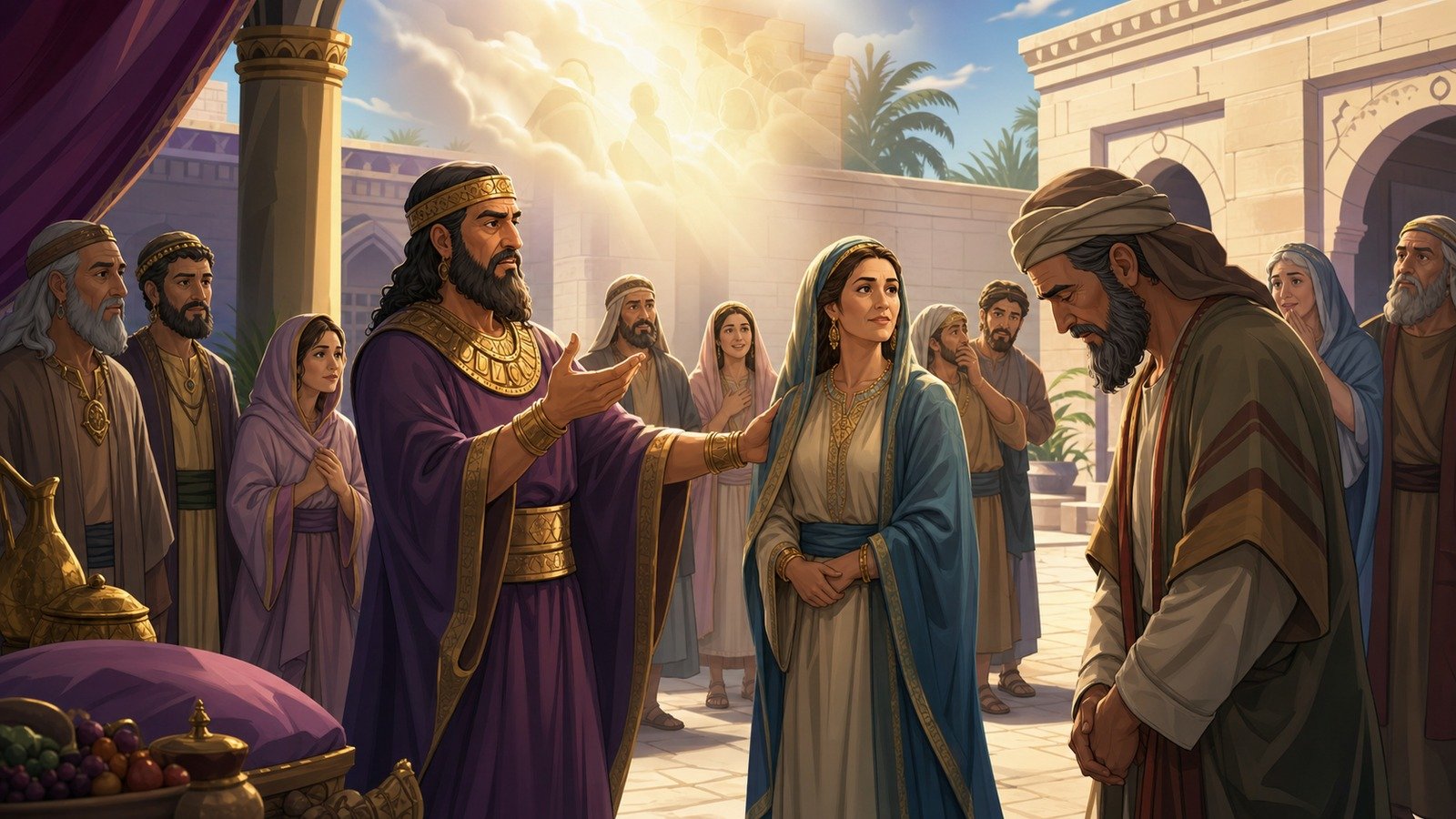
Abraham again presents Sarah as his sister, this time to Abimelech of Gerar, who takes her in good faith and is warned off by God in a dream before any wrong is done. Abimelech restores Sarah and rebukes Abraham, who intercedes to heal Abimelech's household.
Further context
3 min readAbraham moves south into the Negev, settles for a time in Gerar, and says of his wife Sarah: she is my sister. Abimelech, the local king, sends for her and takes her into his household. It is the same situation as in Egypt some twenty-five years earlier, and no attempt is made to present it as a new idea.
What differs is the treatment of the king. God comes to Abimelech in a dream and tells him he is as good as dead, because the woman he has taken is married. His reply is a legal defence: will you destroy an innocent nation? He was told she was the man's sister, and she said the same, and he acted with a clear conscience and clean hands. The answer he receives concedes the point, saying that God knew he had done this with a clear conscience and had kept him from touching her. He is then told to return her, and that Abraham is a prophet who will pray for him. That is the first use of the word prophet anywhere, and it is applied to a man who has just lied to protect himself.
Abimelech confronts Abraham the next morning in front of his officials, who are described as very much afraid. The questions are direct: what have you done to us, what did I do to you that you brought such great guilt on me and my kingdom, and what was your reason?
Abraham's answer has two parts. He assumed there was no fear of God in the place and that he would be killed on account of his wife. And she really is his sister, the daughter of his father though not of his mother, an arrangement he had asked her to keep wherever they went.
The first half of that answer is refuted by everything that has just happened. Fear of God is exactly what the king and his court have displayed, and the man carrying the promise is the one who lied.
Abimelech gives sheep, cattle and slaves, returns Sarah, and offers Abraham the run of his land. He also gives a thousand shekels of silver, described as covering the offence against her before everyone, so that she is publicly vindicated. Abraham prays, and God heals the king, his wife and his slave girls, who had all been prevented from having children.
One difficulty here is chronological and is better stated than glossed over. Sarah is about ninety at this point and has been described as past childbearing, and Isaac is born very shortly afterwards. Readers have proposed that the events are not in strict sequence, that the descriptions of her age emphasise the improbability of the birth rather than her appearance, or that a king's interest in her was political, since alliance by marriage was routine and she belonged to a wealthy incoming household. The question is not addressed anywhere.
The timing carries a further weight that is easy to miss. The son promised to Sarah specifically, through whom the covenant was to run, is conceived within months of his mother spending a period in another man's household. Making the point that God kept the king from touching her, twice over and in the king's own words as well, is not incidental. It settles in advance a question about the child's parentage that anyone hearing the story in that world would have thought of immediately.