

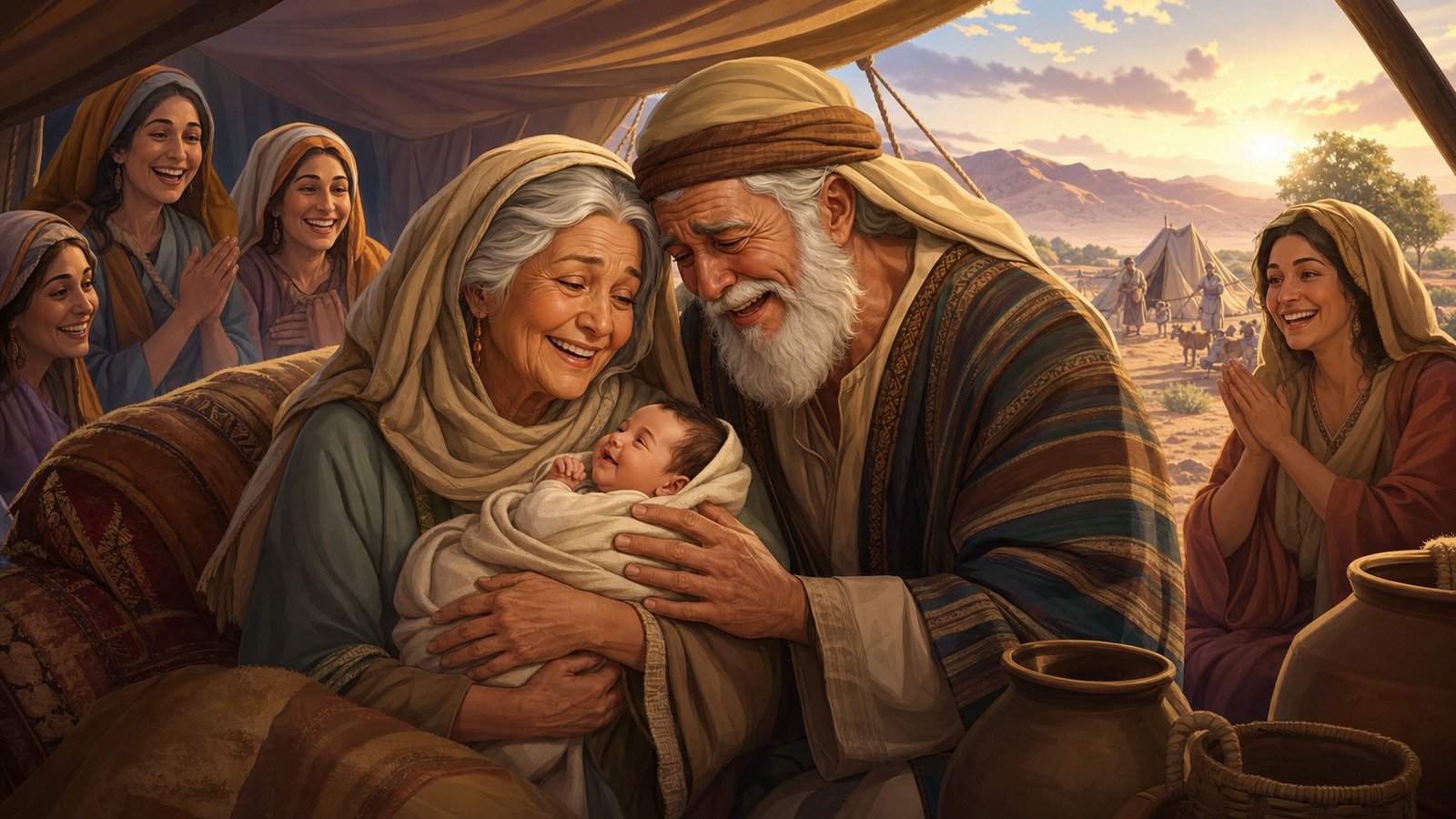
Sarah bears Isaac when Abraham is 100 years old, exactly as God had promised, fulfilling the covenant promise of a son through whom the line of blessing will continue.
Further context
2 min readTwenty-five years after the first promise, a hundred-year-old man and a ninety-year-old woman have a son. The wording insists on the connection three times in two sentences: the LORD was gracious to Sarah as he had said, and did for Sarah what he had promised, and she bore a son at the very time God had promised.
In those twenty-five years the couple had left Harran, crossed into Canaan, gone down to Egypt and come back, separated from Lot, tried an arrangement of their own that produced Ishmael, laughed at the announcement in turn, changed their names and moved through three territories. The waiting takes up nine chapters and the fulfilment takes seven verses. The imbalance is deliberate.
The child is named Isaac, and he is circumcised on the eighth day. This is the first time anyone is circumcised at the age the covenant specified, so the sign given to a ninety-nine-year-old is applied to the son that sign was pointing towards.
Sarah's response is a short piece of poetry that completes the pun the story has been building. God has brought me laughter, she says, and everyone who hears about this will laugh with me. The word is the same one behind the boy's name. Both parents laughed in disbelief when the birth was announced, and the child carries that laughter as a name for the rest of his life, with its meaning turned inside out. She then asks who would ever have said to Abraham that Sarah would nurse children, since she has borne him a son in his old age, and the question expects no answer.
Later writers make particular use of the physical facts. One describes descendants as numerous as the stars coming from a man as good as dead; another says Abraham faced the fact of his own body and of Sarah's without weakening. The argument being made in both places depends on the couple's age being a genuine obstacle rather than a literary flourish.
For the timeline this is the point where the promise of a nation stops being a statement about the future and becomes a household with two sons: one born by ordinary means to a slave, one born against every expectation to a wife of ninety. The tension between them occupies the next episode and shapes the rest of the family's history, and it is the reason a birth notice of seven verses carries as much weight as it does.
Rachel, Hannah, the mother of Samson and Elizabeth will all be described in similar terms in the centuries that follow: a woman unable to conceive, a long wait, and a son who matters. The pattern starts here, and it is used to make the same claim every time. The nation exists because it was given, not because it was produced.
One detail of the naming is worth holding on to. Isaac is the only one of the three patriarchs whose name was chosen before he was conceived, announced by God rather than by a parent, and given a meaning in advance. Abram and Jacob were both renamed later in life after something had happened to them. This child is named for something that happened before he existed, and what it commemorates is his parents refusing to believe the announcement.