

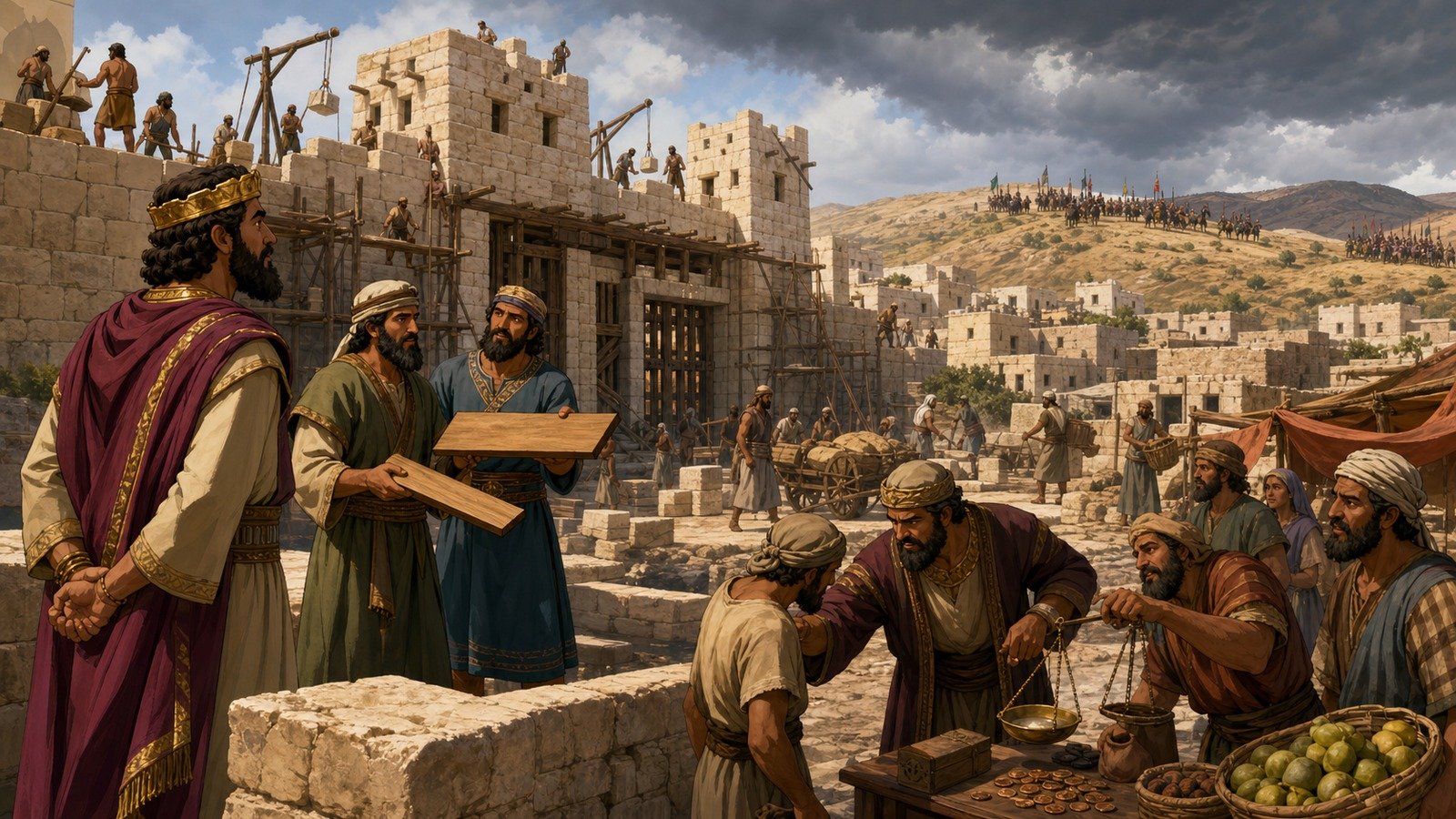
Jotham continues his father Uzziah's building projects and remains personally faithful, but the text notes the people themselves remain corrupt, and Aram and Israel begin pressuring Judah's borders during his reign.
Further context
3 min readSixteen years, and a good verdict with the standard qualification: he did what was right in the eyes of the LORD, just as his father Uzziah had done, but the high places were not removed and the people continued to offer sacrifices and burn incense there.
He governs for years before he formally reigns. His father, excluded from the temple by the skin disease that struck him at the altar, lives in a separate house while his son has charge of the palace and governs the people of the land, which makes this one of the clearest co-regencies in the period and part of the reason the regnal figures in these decades overlap in ways that are hard to reconcile.
He rebuilds the Upper Gate of the temple and does extensive work on the wall at the hill of Ophel, and builds towns in the hill country of Judah and forts and towers in the wooded areas. He defeats the Ammonites and takes a heavy tribute from them for three years: a hundred talents of silver, ten thousand cors of wheat and ten thousand of barley.
One sentence assesses him and it is the most economical summary of a good reign anywhere: Jotham grew powerful because he walked steadfastly before the LORD his God.
There is also a clause that qualifies all of it, and it is aimed at the country rather than the king: the people, however, continued their corrupt practices.
He is the last southern king before the crisis. In his reign the pressure begins, with Aram and Israel starting to move against Judah, and the full weight of it lands on his son, who reverses everything.
Two prophets are working in Judah at this point and are dated to his reign among others. Isaiah is at the Jerusalem court, and Micah is in the Judean lowlands, and the two are contemporaries who overlap in language: one of the most famous passages in the Hebrew scriptures, about beating swords into ploughshares and spears into pruning hooks and nations not learning war any more, appears in both books in almost identical wording, and which of them has it first is unknown.
Ophel, where he does the wall work, is the ridge between the old City of David and the temple platform, and it is one of the most intensively excavated areas in Jerusalem. Substantial eighth-century fortification remains have been found there, along with a monumental gate complex, and dating them to particular kings is contested in the way most Jerusalem archaeology is.
Micah's own summary of what is required has become the standard one-sentence statement of the prophetic position: he has shown you, mortal, what is good, and what does the LORD require of you? To act justly, to love mercy and to walk humbly with your God.
Sixteen years, and a good verdict with one qualification that recurs through every reign in Judah: the high places were not removed, and the people continued their corrupt practices.
The high places were local hilltop sanctuaries, some of them older than Israel's presence in the land, where sacrifice was offered without any of the controls the temple imposed. Every reforming king is measured against them and only two of them, Hezekiah and Josiah, are recorded actually clearing them.
He rebuilt the Upper Gate of the temple, did extensive work on the wall at Ophel and built towns in the Judean hills and forts and towers in the wooded areas, which is the profile of a king expecting a war.
He also defeated the Ammonites and took tribute in silver, wheat and barley for three years.