

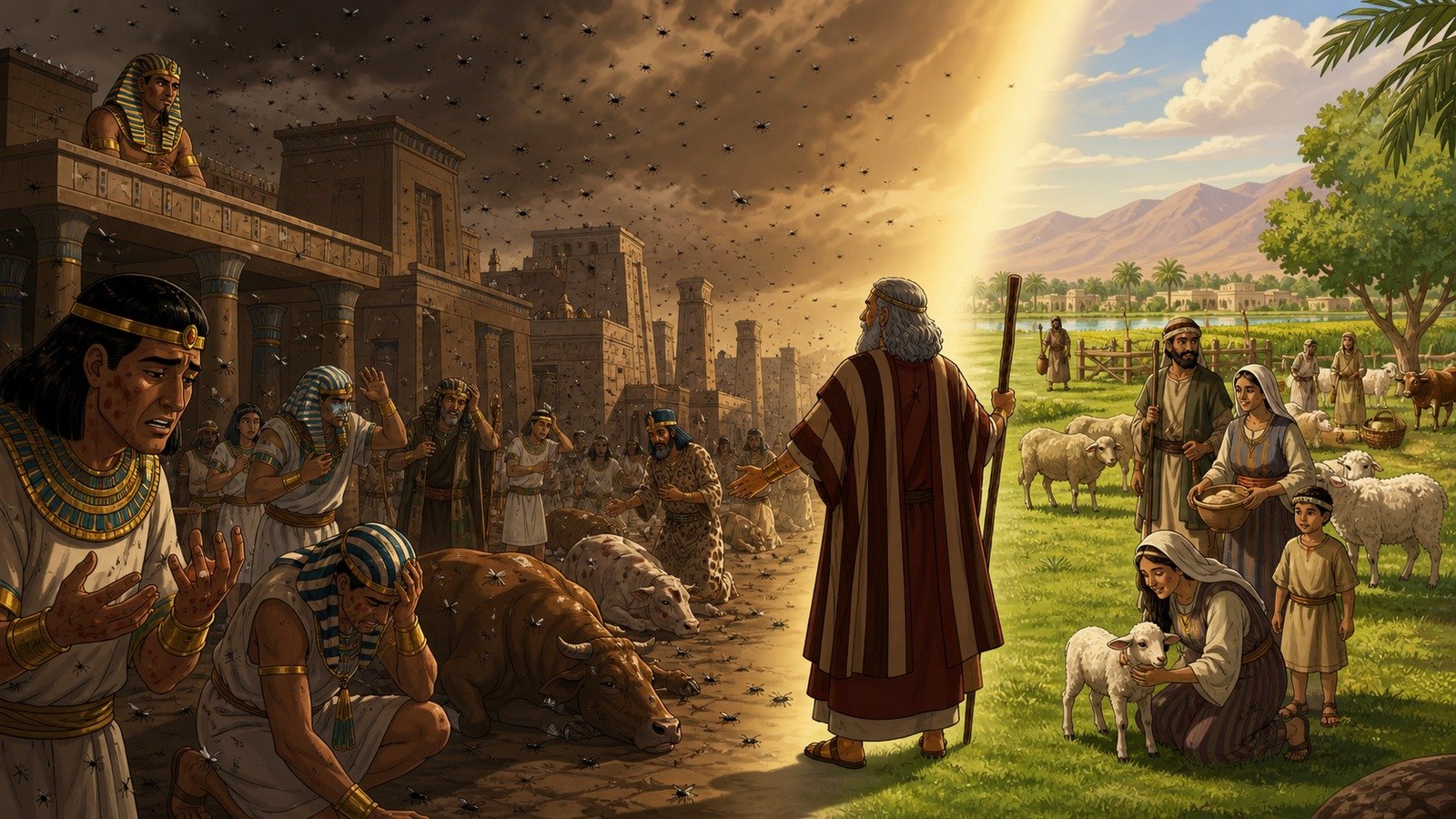
Swarms of flies, a plague on Egyptian livestock, and painful boils on people and animals follow; from this point Exodus notes God begins distinguishing Goshen, where the Israelites live, from the rest of Egypt.
Further context
3 min readWith the swarms of flies a distinction appears that runs through everything afterwards. God says he will deal differently with the land of Goshen, where his people live, so that no swarms will be there. Until now everything has fallen on the whole country. From here Israel is exempted, and the stated reason is so that Pharaoh will know that the LORD is in this land.
Pharaoh's first real concession comes here, and it is a negotiation rather than a surrender. Go, sacrifice to your God here in the land. Moses refuses, and his reason is an observation about Egyptian religion. The sacrifices we offer are detestable to the Egyptians, and if we offer them before their eyes, will they not stone us? Israelite worship involved slaughtering animals that Egyptians treated as sacred, and the objection is practical. Pharaoh then permits a journey, adding that they must not go very far, and asks Moses to pray for him. When the flies are removed he hardens his heart again.
The livestock plague is specific in its wording: on horses, donkeys, camels, cattle, sheep and goats that are in the field. All the livestock of the Egyptians died and not one animal belonging to the Israelites died, and Pharaoh sends men to check, which is the first time he investigates rather than reacts.
That qualification about animals in the field matters, because livestock appear again in the hail and in the death of the firstborn, and readers have long noticed the difficulty. Limiting it to animals left outside accounts for the survivors, and the hail episode explicitly involves bringing animals under shelter.
The boils are produced when Moses tosses soot from a furnace into the air in front of Pharaoh, and festering sores break out on people and animals throughout Egypt. The magicians appear one last time and not as competitors: they could not stand before Moses because of the boils that were on them and on all the Egyptians. The professional class that opened the contest by duplicating the first two signs is now among the casualties.
Something else changes at exactly this point, and it is the most argued-over feature of the whole series. Through the first five disasters Pharaoh hardens his own heart, or his heart becomes hard. From the sixth onwards the LORD hardens Pharaoh's heart. The shift is consistent and is unlikely to be accidental, and it raises the question of responsibility directly.
One further detail of the middle three is worth noticing. The exemption of Goshen is announced in advance and then verified: Pharaoh sends investigators to check whether Israelite livestock really did survive, and they report back that not one animal had died. He is not being asked to take anything on trust. He commissions an inquiry, receives an accurate answer, and hardens his heart anyway, which is the pattern the rest of the confrontation follows.
Paul takes the matter up and quotes a line about Pharaoh being raised up for this very purpose, concluding that God has mercy on whom he wants to have mercy and hardens whom he wants to harden. Christian interpreters have divided for centuries over whether the hardening confirms a disposition Pharaoh had already chosen five times over, or whether it precedes his choosing, and the argument turns on how much weight the order of the two formulas carries.